
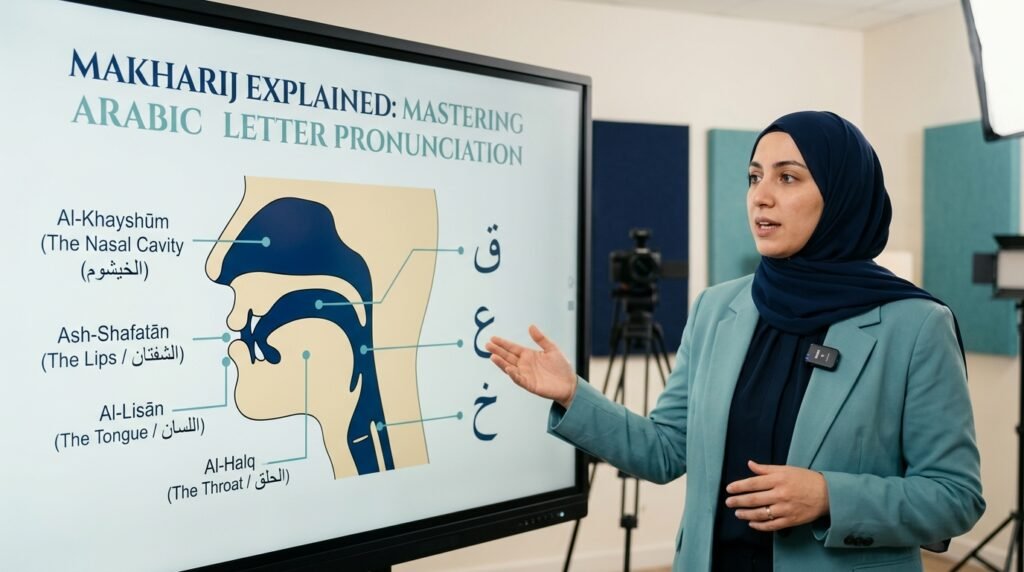
Mastering the pronunciation of Arabic letters is both a linguistic milestone and a foundational requirement for reciting the Quran with Tajweed. The Arabic language relies on precise anatomical mechanics: slight shifts in tongue placement, vocal cord tension, or airflow create entirely distinct phonemes that carry completely different meanings.
In Arabic linguistics and Tajweed, the science of letter positioning is called Makhārij al-Hurūf (مَخَارِجُ الحُرُوف), meaning “the points of exit for letters.” Without anchoring each letter to its true anatomical origin, non-native speakers routinely conflate acoustically adjacent letters—such as confusing ح with ه, س with ص, or ت with ط.
This comprehensive guide details the anatomy of Arabic phonetics, the classification system codified by classical scholars, and practical mechanics to master every letter.
What Does “Makhraj” Mean?
The word Makhraj (مَخْرَج) literally translates to an exit, outlet, or point of departure. Its plural form is Makhārij (مَخَارِج).
In phonetics, a makhraj refers to the exact location within the vocal tract where the breath stream or sound is stopped, constricted, or shaped to produce a distinct phoneme.
The Diagnostic Technique for Finding Any Makhraj
Classical scholars developed a simple diagnostic method to locate any letter’s articulation point:
- Place a hamzah with a vowel (typically a Fatḥah or Kasrah) before the letter: أَ or إِ.
- Give the target letter a Sukūn (vowelless state) or a Shaddah (gemination/doubling).
- Pronounce the combined sound and hold it (e.g., to find Mīm, pronounce أَمْ (am); to find Qāf, pronounce أَقْ (aq)).
- The physical spot where the sound or airflow halts is the precise makhraj of that letter.
The Classification of Makharij
While historical phoneticists debated minor categorizations (such as Sibawayh counting 16 points and Al-Farahidi counting 17), the majority consensus followed by Imam Ibn al-Jazari establishes:
- 5 General Areas (Al-Makhārij al-‘Āmmah): The broad anatomical regions of the human vocal apparatus.
- 17 Specific Exit Points (Al-Makhārij al-Khāṣṣah): The exact anatomical contact zones distributed across those five main areas.
| General Area (Arabic) | General Area (English) | Specific Points | Letters Produced |
| Al-Jawf (الجَوْف) | The Oral & Throat Cavity | 1 | 3 Madd (elongation) letters |
| Al-Ḥalq (الحَلْق) | The Throat / Pharynx | 3 | 6 letters |
| Al-Lisān (اللِّسَان) | The Tongue | 10 | 18 letters |
| Ash-Shafatān (الشَّفَتَان) | The Two Lips | 2 | 4 letters |
| Al-Khayshūm (الخَيْشُوم) | The Nasal Cavity | 1 | Ghunnah (nasal resonance) |
1. Al-Jawf (The Empty Space / Interior Cavity)
Al-Jawf refers to the open, resonant space comprising the pharynx and the oral cavity. Unlike consonants, these sounds do not contact two articulatory surfaces; they are sustained by unrestricted acoustic flow.
- Specific Exit Points: 1
- Letters Produced (3): The letters of Madd (prolongation).
- Alif Maddiyyah (ا): Preceded by a Fatḥah (e.g., قَالَ – Qāla).
- Wāw Maddiyyah (و): Preceded by a Ḍammah (e.g., يَقُولُ – Yaqūlu).
- Yā’ Maddiyyah (ي): Preceded by a Kasrah (e.g., قِيلَ – Qīla).
How to produce them: Ensure the jaw drops naturally for Alif, the lips round cleanly without tension for Wāw, and the middle tongue lowers slightly while the sound resonates outward for Yā’. Because their sound ends only with the cessation of breath, they are classified as non-fixed, estimated points (Makhraj Taqdiri).
2. Al-Ḥalq (The Throat)
The throat contains three distinct levels, progressing from the deepest point near the chest up to the junction where the pharynx meets the mouth.
- Specific Exit Points: 3
- Letters Produced (6): Known collectively as Al-Ḥurūf al-Ḥalqiyyah (Throat Letters).
A. Deepest Throat (Aqṣal-Ḥalq – أَقْصَى الحَلْق)
- Location: The region of the vocal cords and the base of the larynx.
- Letters:
- Hamzah (ء): A crisp glottal stop produced by the complete closure followed by explosive release of the vocal folds.
- Hā’ (هـ): A soft, breathy glottal fricative produced with an open glottis, allowing relaxed airflow without chest tension.
B. Middle Throat (Wasaṭ al-Ḥalq – وَسَط الحَلْق)
- Location: The epiglottic region, specifically where the epiglottis draws back toward the posterior pharyngeal wall.
- Letters:
- ‘Ayn (ع): A voiced pharyngeal constriction. Many non-native speakers mistakenly push this sound from the chest; it is produced purely by tightening the middle pharynx and retracting the epiglottis.
- Ḥā’ (ح): A voiceless pharyngeal friction sound. It is a clean, sharp, raspy exhalation—similar to warming one’s cold hands with breath, but focused in the mid-throat.
C. Closest Throat (Adnal-Ḥalq – أَدْنَى الحَلْق)
- Location: The upper throat near the uvula and the base of the soft palate.
- Letters:
- Ghayn (غ): A voiced velar/uvular fricative, acoustically similar to the French “r” or the sound of gargling without water.
- Khā’ (خ): A voiceless velar/uvular fricative, characterized by a dry scraping sound produced when the back of the tongue approaches the soft palate/uvula.
3. Al-Lisān (The Tongue)
The tongue is the most versatile articulator in the human body, responsible for 18 letters across 10 specific points. Phoneticists divide the tongue into four functional segments: the Root/Deep Back (Aqṣā), the Middle (Wasaṭ), the Sides (Ḥāfah), and the Tip (Ṭaraf).
   [ Throat ] <--- Aqsa (Back) --- Wasat (Middle) --- Taraf (Tip) ---> [ Teeth ]
                         \                             /
                          \------- Hafah (Edges) -----/
A. Deep Back of the Tongue (Aqṣal-Lisān)
- Qāf (ق): The extreme back of the tongue raised firmly against the soft palate (the fleshy, flexible tissue behind the hard roof). It produces an elevated, emphatic, explosive sound.
- Kāf (ك): The back of the tongue contacting the junction between the soft and hard palates, slightly forward of the Qāf position. It is accompanied by a light puff of air (Hams).
B. Middle of the Tongue (Wasaṭ al-Lisān)
Contacting the opposite hard palate: 3. Jīm (ج): The middle of the tongue presses flat against the hard palate, closing off airflow completely before releasing cleanly without excessive hissing. 4. Shīn (ش): The middle of the tongue raises toward the hard palate without fully closing, allowing airflow to spread widely across the mouth (Tafashshī). 5. Non-Madd Yā’ (ي): Consonantal Yā’ (such as in Yawm), produced with the middle tongue elevated toward the palate with a narrow friction channel.
C. Sides/Edges of the Tongue (Ḥāfat al-Lisān)
- Ḍād (ض): One of the most phonetically distinct letters in Arabic. It is formed by resting one or both rear edges of the tongue against the upper molars. The sound is elongated (Istiṭālah) by pressure building behind the closure, while the tip of the tongue rests lightly without generating the acoustic stop.
- Lām (ل): Produced using the anterior edge of the tongue (from the side forward to the tip) contacting the gums of the upper front teeth.
D. Tip of the Tongue (Ṭaraf al-Lisān)
The tip of the tongue accounts for the remaining 5 specific points and 11 letters:
- Nūn (ن): The tip of the tongue touches the upper gums (alveolar ridge), directly below the position of Lām, accompanied by intrinsic nasal resonance.
- Rā’ (ر): The tip of the tongue strikes the gums of the upper front teeth just behind the Nūn position, permitting a slight, controlled vibration of the tongue tip without excessive trilling.
- The Dental Plosives — Ṭā’ (ط), Dāl (د), Tā’ (ت): The top surface of the tongue tip contacts the base of the two upper front incisors.
- Ṭā’ (ط) is elevated and velarized.
- Dāl (د) is soft and voiced.
- Tā’ (ت) is voiceless and accompanied by a brief release of air (Hams).
- The Whistle Letters (Ṣafīr) — Ṣād (ص), Zayn (ز), Sīn (س): The tongue tip positions just above the inner edges of the lower front incisors, allowing air to funnel sharply between the front teeth.
- Ṣād (ص) is heavy and backed.
- Sīn (س) and Zayn (ز) are sharp and forward.
- The Interdental Letters — Ẓā’ (ظ), Dhāl (ذ), Thā’ (ث): The upper surface of the tongue tip extends slightly between the edges of the top and bottom front incisors.
- Ẓā’ (ظ) is heavy and elevated.
- Dhāl (ذ) and Thā’ (ث) are light and un-elevated.
4. Ash-Shafatān (The Lips)
The lips produce four distinct consonants across two exit points:
- Specific Exit Points: 2
- Letters Produced (4):
- Fā’ (ف): The wet inner margin of the lower lip contacts the edges of the upper two front incisors, expelling breath through a narrow constriction.
- The Bilabial Group — Bā’ (ب), Mīm (م), Non-Madd Wāw (و):
- Bā’ (ب): Formed by closing the wet inner sections of both lips firmly, blocking airflow completely before release.
- Mīm (م): Formed by closing the dry outer surfaces of both lips comfortably while sound passes through the nasal cavity.
- Non-Madd Wāw (و): Formed by rounding both lips into a small circle without complete closure, allowing sound to project through the center.
5. Al-Khayshūm (The Nasal Cavity)
Al-Khayshūm is the inner nasal passage connecting the back of the pharynx to the nostrils.
- Specific Exit Points: 1
- Product: Al-Ghunnah (الغُنَّة) — a resonant, hum-like nasal tone.
The nasal passage is not the exclusive origin of an independent letter, but rather the mandatory secondary sound chamber for Nūn (ن) and Mīm (م). When pronouncing a prolonged Ghunnah (such as on a Nūn Mushaddadah نّ or during Ikhfā’), if you pinch your nostrils shut, the sound stops immediately.
Common Pronunciation Traps for Learners
    Common Confusions:
    [ ح ] (Mid-throat rasp)      vs.   [ هـ ] (Chest/deep-throat whisper)
    [ ق ] (Deep soft-palate pop) vs.   [ ك ] (Hard-palate "K")
    [ ذ ] (Interdental buzz)     vs.   [ ز ] (Dental alveolar buzz)
    [ ت ] (Light dental stop)    vs.   [ ط ] (Heavy, elevated stop)
- Confusing Ḥā’ (ح) and Hā’ (هـ): Substituting the soft, relaxed هـ for the tight, breathy ح transforms the meaning of words completely. For example, Raḥīm (Merciful) vs. Rahīm (devoid of meaning/distorted).
- Collapsing Qāf (ق) into Kāf (ك): Beginners often pull Qāf too far forward into the mouth. Qāf must strike the soft, fleshy uvular tissue, not the hard roof.
- Flapping the Rā’ (ر): Non-native speakers frequently slip into a Spanish multi-trill or an American liquid “R”. The Arabic Rā’ requires a single, controlled closure of the tongue tip with the alveolar ridge, maintaining open lateral margins.
- Biting the Tongue on Thā’ (ث), Dhāl (ذ), and Ẓā’ (ظ): Only the very edge of the tongue tip needs to touch the top teeth. Protruding the tongue too far distorts the acoustic velocity.
Practical Drills to Build Muscle Memory
- Isolate with Sukūn: Read lists of letters with an initial Hamzah: Ab, At, Ath, Aj, Aḥ, Akh. Note the exact tactile feedback of your tongue and palate.
- Tactile Throat Check: Place your fingertips gently on your Adam’s apple. When making ‘Ayn (ع) and Ḥā’ (ح), you should feel the larynx rise slightly as the pharynx tightens.
- Mirror Work: Stand in front of a mirror to verify lip roundness on و, interdental tongue placement on ث/ذ/ظ, and to ensure your lower jaw does not jut out sideways when articulating Ḍād (ض).
- Continuous Audio Comparison: Record yourself reciting isolated pairs (e.g., Tā’/Ṭā’, Dāl/Ḍād, Sīn/Ṣād) and compare your waveforms or auditory timbre against a master reciter.
Mastery of the Makhārij turns Arabic from a collection of unfamiliar sounds into an intuitive phonetic system. By anchoring each letter to its true anatomical origin, proper pronunciation becomes consistent, natural, and precise.