
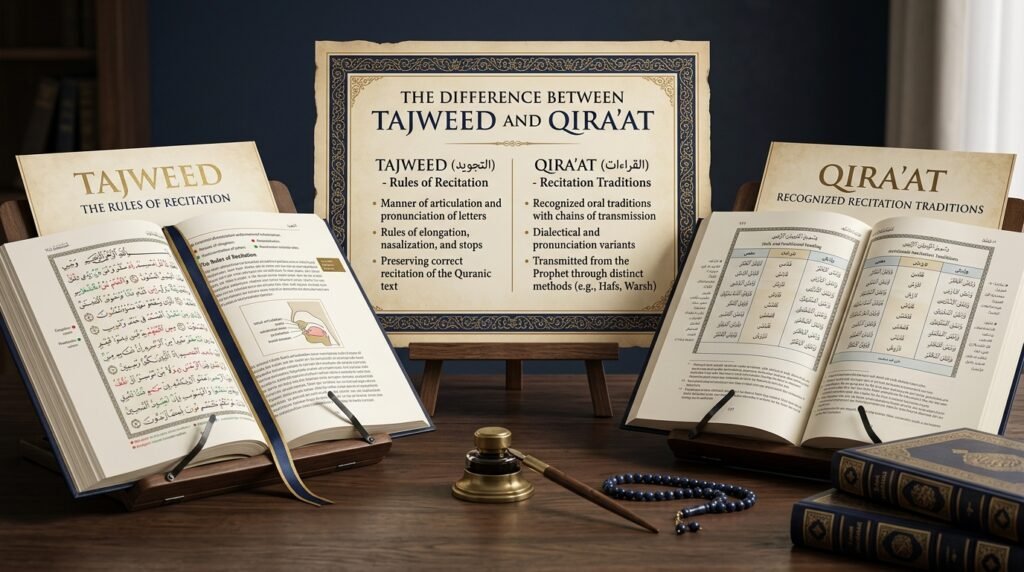
For centuries, the recitation of the Holy Quran has stood as both a sacred act of worship and a precise oral science. Muslims across the globe strive to recite the Quran with clarity, beauty, and strict adherence to divine revelation. However, learners and casual readers often encounter two foundational terms that are frequently conflated: Tajweed and Qira’at.
While both disciplines govern how the Quran is pronounced and transmitted, they address distinct dimensions of Quranic phonetics, grammar, and history. Understanding the difference between Tajweed and Qira’at is essential for anyone seeking deeper knowledge of Quranic sciences (‘Ulum al-Quran).
1. Defining the Terms
What Is Tajweed?
Linguistically, the Arabic root J-W-D (جود) translates to “improving,” “beautifying,” or “making something excellent.”
In Islamic terminology, Tajweed is the science of articulating every single Arabic letter of the Quran from its correct point of origin (Makhraj) while granting each letter its inherent and conditional characteristics (Sifat).
Tajweed is normative and universal across all valid modes of recitation. It defines the mechanics of the voice and articulatory organs:
- Where the tongue touches the palate.
- How long a vowel is prolonged (Madd).
- When nasalization (Ghunnah) is triggered.
- How sounds transition smoothly between consecutive words.
In essence, Tajweed is the phonetical blueprint that protects the reciter from mispronouncing Arabic sounds and altering word meanings.
What Is Qira’at?
Linguistically, Qira’at (قراءات) is the plural of Qira’ah, which derives from the root Q-R-’ (قرأ), meaning “reading” or “reciting.”
In Quranic scholarship, Qira’at refers to the authorized, mutawatir (mass-transmitted) variant methods of reciting the words of the Quran. These variations trace back directly to the Prophet Muhammad ﷺ through sound chains of transmission (Isnad).
Rather than changing fundamental meanings, these variants reflect dialectal variations, grammatical nuances (I’rab), and vocalization differences that existed among early Arab tribes. For example:
- Subtle shifts in voweling (Harakat).
- Variations in consonant dots or vocal forms that enrich textual meaning without contradiction.
- Stylistic phonetic tendencies (e.g., Imalah—vowel inclination, or Tashil—softening of the Hamzah).
In short, Qira’at represents the authorized textual and structural variations in the transmitted oral text of the Quran.
2. Core Differences at a Glance
| Feature | Tajweed | Qira’at |
| Linguistic Meaning | Beautification, proficiency, improvement. | Readings, recitations, variants. |
| Primary Scope | Articulation points, phonetic rules, letter qualities. | Dialectal differences, vocabulary vocalization, grammatical structures. |
| Universal Application | Applies universally across all Qira’at. | Represents distinct schools led by specific Master Reciters. |
| Rulings / Obligation | Obligatory (Fard ‘Ayn) at a foundational level for every reciter. | Communal obligation (Fard Kifayah) preserved by specialized scholars. |
| Origin in Revelation | Rooted in the natural classical pronunciation of the Prophet ﷺ. | Rooted in the revelation of the Quran upon “Seven Ahruf” (modes). |
| Subject Matter | Makharij, Sifat, Ikhfa, Idgham, Madd. | Differences in words (e.g., Maliki vs. Maaliki in Surah Al-Fatihah). |
3. The Origins: Ahruf, Uthmanic Codices, and the Ten Readers
To understand why Qira’at exist alongside Tajweed, one must examine the early history of Quranic transmission.
The Seven Ahruf (Modes)
During the lifetime of the Prophet Muhammad ﷺ, Islam spread rapidly among diverse Arab tribes (such as Quraysh, Hudhayl, Tamim, and Hawazin). While all spoke Arabic, they held distinct accents, vocal inclinations, and grammatical idioms.
To make recitation accessible to all tribes without hardship, Allah revealed the Quran in seven Ahruf (styles or modes). The Prophet ﷺ stated:
“Gabriel recited the Quran to me in one mode. Then I asked him to increase it, and I kept asking him to increase it until it reached seven modes.” (Sahih al-Bukhari)
The Uthmanic Mus-haf
During the Caliphate of Uthman ibn Affan (RA), the Islamic empire expanded across non-Arab lands, leading to disputes over tribal recitations. Uthman commissioned a unified written standard based on the primary Qurayshite dialect, omitting diacritical marks and vowel signs (Nuqat wa Harakat).
This script (Rasm al-Uthmani) was intentionally written to accommodate the authentic Ahruf that fit within its skeletal structure. Authentic Qira’at are those that fulfill three strict scholarly criteria:
- Complete conformity to the skeletal Uthmanic script.
- Compliance with classical Arabic grammar rules.
- An unbroken, mass-transmitted chain of narration (Tawatur) reaching the Prophet ﷺ.
The Canonical Readers (Al-Qurra’ al-Asharah)
In the 4th century AH, the scholar Ibn Mujahid formalized the most prominent chains into the famous Seven Readers, which scholars later expanded to the Ten Canonical Qira’at. Each master reciter (Imam) had two primary transmitters (Rawis):
- Nafi’ al-Madani (Transmitters: Qalun & Warsh)
- Ibn Kathir al-Makki (Transmitters: Al-Bazzi & Qunbul)
- Abu ‘Amr al-Basri (Transmitters: Al-Duri & Al-Susi)
- Ibn ‘Amir al-Shami (Transmitters: Hisham & Ibn Dhakwan)
- Asim al-Kufi (Transmitters: Shu’bah & Hafs) — Hafs ‘an ‘Asim is the most widely recited globally today.
- Hamzah al-Kufi (Transmitters: Khalaf & Khallad)
- Al-Kisa’i al-Kufi (Transmitters: Abu al-Harith & Al-Duri)
- Abu Ja’far al-Madani (Transmitters: Ibn Wardan & Ibn Jammaz)
- Ya’qub al-Hadrami (Transmitters: Ruways & Rawh)
- Khalaf al-Bazzar (Transmitters: Ishaq & Idris)
4. The Science of Tajweed in Detail
While Qira’at specifies which words and grammatical forms are recited, Tajweed teaches how the human vocal apparatus must deliver them.
Tajweed is divided into four major pillars:
1. Makharij al-Huruf (Points of Articulation)
There are 17 specific articulation points distributed across five main regions:
- Al-Jawf (The Empty Space): The throat and mouth cavity, responsible for elongated vowels (Alif, Waw, Ya).
- Al-Halq (The Throat): Deep, middle, and upper regions that produce letters like Hamzah (ء), Haa (هـ), ‘Ayn (ع), and Khaa (خ).
- Al-Lisan (The Tongue): The origin of 18 letters, utilizing the base, middle, edges, and tip.
- Al-Shafatan (The Lips): Producing Baa (ب), Meem (م), Waw (و), and Faa (ف).
- Al-Khayshum (The Nasal Cavity): The sole site of Ghunnah (nasal resonance).
2. Sifat al-Huruf (Characteristics of Letters)
Every letter carries intrinsic qualities that give it a distinctive sound even when originating from the same point of articulation:
- Hams vs. Jahr: Whispered breath versus trapped airflow.
- Shiddah, Rakhawah, and Tawassut: Strength/stoppage of sound versus continuum or moderation.
- Isti’la’ vs. Istifal: Elevation of the back of the tongue (causing heavy/emphatic sounds like Saad and Taa) versus lowering (light sounds).
- Qalqalah: The echoing bounce heard on unvoweled letters of Qaf, Taa, Baa, Jeem, and Daal (ق, ط, ب, ج, د).
3. Rules of Nun Sakinah, Tanween, and Meem Sakinah
Rules governing phonetic transitions between words:
- Izhar: Clear pronunciation without nasal delay.
- Idgham: Merging one letter into the following letter (with or without nasalization).
- Iqlab: Converting a Nun sound into a Meem before the letter Baa.
- Ikhfa: Concealing the sound between clear articulation and full merging, accompanied by Ghunnah.
4. Ahkam al-Madd (Prolongation Rules)
Controlling the precise counts (typically measured as 2, 4, 5, or 6 rhythmic units/Harakat) applied to long vowels depending on whether they precede a Hamzah or a Sukun.
5. Practical Examples: How Tajweed and Qira’at Interact
Tajweed and Qira’at do not operate in isolation; they are intertwined in practice. A reciter first chooses a specific Qira’ah (along with its specific transmitter, Riwayah), and then applies the Tajweed principles mandated by that specific transmission.
Example 1: Surah Al-Fatihah (1:4)
- In the recitation of Hafs ‘an ‘Asim (common in most of the Muslim world), the opening of verse 4 is read as:$$\text{مَالِكِ يَوْمِ الدِّينِ}$$(Mālik-i yawm-id-dīn) — meaning “Owner/Master of the Day of Judgment.”
- In the recitation of Warsh ‘an Nafi’ (common in North and West Africa), it is read as:$$\text{مَلِكِ يَوْمِ الدِّينِ}$$(Malik-i yawm-id-dīn) without the elongated Alif — meaning “King of the Day of Judgment.”
The Distinction:
- The variation in spelling and vowel length (Mālik vs. Malik) is a matter of Qira’at. Both meanings complement each other: Allah is both the absolute Owner and the Sovereign King of the Day of Judgment.
- How the reciter pronounces the letter Lam lightly, articulates the Kaf crisply from the back of the mouth, and prolongs the final Madd ‘Arid li-s-Sukun at the end of Ad-Deen is governed strictly by Tajweed.
Example 2: Imalah (Vowel Tilting)
In Surah Hud (11:41), the word referring to Noah’s Ark is written:
$$\text{مَجْرَاهَا}$$
- In Hafs ‘an ‘Asim, this single word is read with Imalah—tilting the “aa” sound toward an “ay” sound (Maj-ray-ha). Hafs applies this rule almost exclusively here.
- In the Qira’ah of Hamzah or Al-Duri, Imalah is not an isolated exception; it is a systematic, consistent phonological rule applied across hundreds of words ending in Alif Maqsurah (e.g., Ad-Duha becomes Ad-Duhay, Al-Huda becomes Al-Huday).
The Distinction:
- The structural presence of this systematic shift across the reading is a rule of Qira’at.
- The mechanical execution of the tilted vowel (maintaining exact mouth positioning so it does not degrade into a pure “E” or flat “A”) is governed by the science of Tajweed.
6. Scholarly Classification and Religious Obligation
Islamic jurisprudence (Fiqh) distinguishes clearly between the necessity of learning Tajweed versus mastering Qira’at.
The Ruling on Tajweed: Individual vs. Collective
- Fard ‘Ayn (Individual Obligation): Practicing basic Tajweed during personal recitation to avoid major, meaning-altering errors (Al-Lahn al-Jaliyy, such as changing a Taa to a Twa or shifting a Dammah to a Fathah) is obligatory for every Muslim. The Quran commands:$$\text{وَرَتِّلِ الْقُرْآنَ تَرْتِيلًا}$$“And recite the Quran with measured, distinct recitation.” (Surah Al-Muzzammil 73:4)
- Fard Kifayah (Collective Obligation): Memorizing the theoretical terminology, structural definitions, and complex nuances of Tajweed (Al-Lahn al-Khafiyy, such as slightly improper prolongation lengths or minor nasal timing) is a collective duty handled by scholars and teachers.
The Ruling on Qira’at: Preservation by Specialists
Studying and preserving the multiple Qira’at is strictly a Fard Kifayah. The vast majority of Muslims recite according to the single Riwayah prevalent in their geographic region (such as Hafs in Asia and the Middle East, Warsh or Qalun in North Africa, or Al-Duri in parts of Sudan and East Africa).
Only a qualified subset of scholars and memorizers (Huffaz) study the full scope of the Ten Qira’at to ensure the living oral transmission of the divine revelation remains unbroken.
Conclusion
Tajweed and Qira’at are two pillars supporting the same architectural wonder: the preserved preservation of the Quran.
- Tajweed provides the phonetic discipline, acoustic precision, and physical mechanics required to articulate words correctly. It prevents human corruption of sacred phonology.
- Qira’at preserves the multi-faceted oral traditions authorized by revelation, highlighting the linguistic depth and miraculous literary coherence of the text across varying dialects.
Together, they guarantee that the Quran recited today across prayer rugs, classrooms, and minarets remains identical in sound, spirit, and structure to the revelation heard more than fourteen centuries ago.