
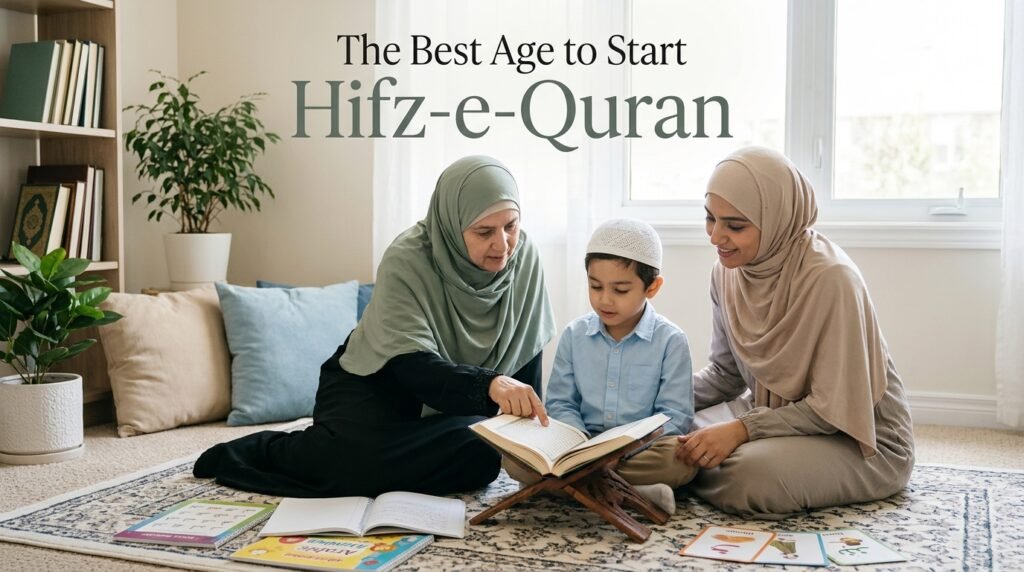
Memorizing the Holy Quran—embarking on the sacred journey of Hifz-e-Quran—is one of the most noble, spiritually rewarding milestones an individual or family can undertake. A Hafiz or Hafiza carries the speech of Allah within their heart, earning immense blessings in this world and elevated status in the Hereafter.
For Muslim parents and prospective students, one question repeatedly arises at the start of this spiritual pursuit: What is the best age to start Hifz-e-Quran?
Is it better to enroll a child during early toddlerhood, wait until primary school maturity, or can adults take on the challenge later in life?
The short answer is that while there is an optimal physiological and cognitive window during childhood—typically between 6 and 12 years of age—the Quran remains accessible, forgiving, and open to sincere hearts at virtually any phase of life.
1. The Golden Window: Ages 6 to 12
Islamic pedagogical history and modern neurodevelopmental science both point to ages 6 through 12 as the “Golden Age” for Quranic memorization.
       [ Ages 4–6 ]           ──►      [ Ages 6–9 ]          ──►       [ Ages 10–13 ]
  Foundations & Nazra                Peak Absorption                  Independent Discipline
(Phonics, Short Surahs)             (Rapid Retentive Power)            (Tajweed & Deep Revision)
Why This Stage Excels
- Unmatched Cognitive Neuroplasticity: During primary school years, children’s brains process auditory data rapidly. Memory consolidation occurs with ease, allowing students to absorb multiple lines or pages of rhythmic Arabic text in a single sitting.
- Flexible Articulation Organs (Makharij): Younger children adapt rapidly to foreign phonemes. The precise throat, tongue, and lip placements required for authentic Tajweed develop much more naturally before speech patterns fully set.
- Fewer Life Distractions: Children within this age bracket do not yet face career pressure, severe exam anxiety, financial obligations, or complex social stresses.
- Natural Routine Discipline: Children thrive on habit and parental guidance. Establishing a consistent schedule of early-morning Sabaq (new lesson) and evening Daur (revision) is far easier to enforce before teenage independence takes root.
2. Early Childhood (Ages 4 to 6): Laying the Groundwork
While some parents attempt full-scale memorization as early as age 4, educators generally advise treating ages 4 to 6 as a preparatory phase rather than intensive Hifz.
Key Focus Areas for Early Childhood
- Auditory Familiarity: Consistent Quranic recitation played in the home or car familiarizes children with Quranic cadence and rhythm.
- Basic Noorani Qaida & Phonics: Mastering Arabic letter recognition, vowel markings (Harakat), and soft pronunciation.
- Nazra (Fluent Reading): Training the eyes and tongue to read straight from the Mus’haf without stumbling.
- Short Surahs of Juz Amma: Memorizing Surah Al-Fatihah, Surah Al-Ikhlas, and nearby short chapters purely through repetitive oral listening.
Caution: Forcing intensive, multi-hour daily memorization before age 6 can cause early academic fatigue, anxiety, or resentment toward religious study. Keep early exposure warm, engaging, and reward-driven.
3. Readiness Checklist: Signs a Child Is Truly Prepared
Age is not the sole determinant of success; individual readiness matters far more. Before enrolling a child in a formal Hifz program, verify these benchmarks:
| Benchmark | Skill Required | Why It Matters |
| Reading Fluency (Nazra) | Can read any standard page of the Mus’haf smoothly without spelling out letters. | Eliminates reading friction so the brain can focus entirely on memorization. |
| Tajweed Precision | Accurately identifies rules like Ghunnah, Qalqalah, and proper vowel lengths. | Prevents ingraining incorrect pronunciation that is difficult to correct later. |
| Attention Span | Can remain seated and focused for 30–45 minutes at a stretch. | Sustains the repetitive drilling required for daily lessons. |
| Emotional Willingness | Expresses curiosity or personal pride in reciting rather than total reluctance. | Intrinsic motivation safeguards against mid-way burnout. |
4. The Teenage Phase (Ages 13 to 18): Cognitive Maturity and Meaning
Starting Hifz in adolescence comes with a distinct advantage: comprehension and cognitive agency.
- Conceptual Grasp: Teenagers can study basic Arabic grammar and Quranic translation alongside their memorization. Understanding the narratives, warnings, and promises in each Ayah reinforces associative memory.
- Personal Accountability: Unlike young children who memorize primarily to please parents or tutors, teenagers who commit to Hifz usually do so out of personal conviction and inner spiritual identity.
- Balancing Secular Demands: The primary obstacle during these years is managing high school coursework and extracurriculars. Teenagers benefit most from structured, hybrid routines (e.g., memorizing half a page a day across 3–4 years instead of full-time madrasah seclusion).
5. Can Adults (19+) Memorize the Quran?
A widespread misconception is that Hifz is impossible once adulthood begins. While neuroplasticity slows, adults possess strengths that young children lack:
- Pure Intention (Ikhlas): Adults embark on Hifz out of deep personal longing, spiritual maturity, and love for Allah.
- Contextual Comprehension: Adults can leverage Tafseer (exegesis) and thematic structure, memorizing through narrative sequences rather than purely by sound.
- Structured Goal-Setting: Self-directed time management, adult learning methods, and personal scheduling tools yield steady progress.
Historical precedent confirms this reality: most Companions of the Prophet Muhammad (peace be upon him) accepted Islam and memorized the Quran in adulthood. If you are 25, 40, or 60 years old, the door to Hifz remains wide open.
6. How to Build a Sustainable Hifz Schedule
Regardless of age, successful memorization rests on the traditional tripartite model of daily Quran learning:
┌─────────────────────────────────────────────────────────────┐
│ 1. Sabaq (New Lesson)                                       │
│    • 1 to 2 new pages memorized daily with pristine Tajweed │
├─────────────────────────────────────────────────────────────┤
│ 2. Sabaqi / Sabqi (Recent Memory)                           │
│    • The last 5 to 10 pages memorized; reviewed daily       │
├─────────────────────────────────────────────────────────────┤
│ 3. Manzil / Daur (Cumulative Revision)                      │
│    • 0.5 to 1 full Juz of older memorization recited daily  │
└─────────────────────────────────────────────────────────────┘
Best Practices for Long-Term Retention
- Use One Mus’haf Edition: Stick strictly to a single visual layout (such as the standard 15-line Pakistani/Indian print or the 15-line Madinah standard). Visual photographic memory of page corners, line beginnings, and endings is essential.
- Protect the Early Morning (Fajr Window): The mind is fresh, ambient noise is minimal, and retention rates are highest directly after Fajr prayer.
- Prioritize Revision Over New Intake: A common pitfall is rushing to finish new pages while neglecting older portions. The golden rule of Hifz is: Revision takes precedence over new lessons.
- Qualified Mentorship: Memorizing in isolation without regular recitation to an authorized, certified Qari often leads to hidden, persistent pronunciation mistakes.
Conclusion
The ideal biological and routine window to begin Hifz-e-Quran is between 6 and 12 years of age, provided the child has mastered fluent reading and sound Tajweed.
However, age should never be treated as a barrier. For a younger child, prioritize fond auditory memories and phonetics; for a teenager, combine memorization with meaning; and for an adult, trust in deliberate, consistent daily effort. With sincere intention (Niyyah), daily discipline, and constant revision, any believer can welcome the words of the Quran into their memory and life.