
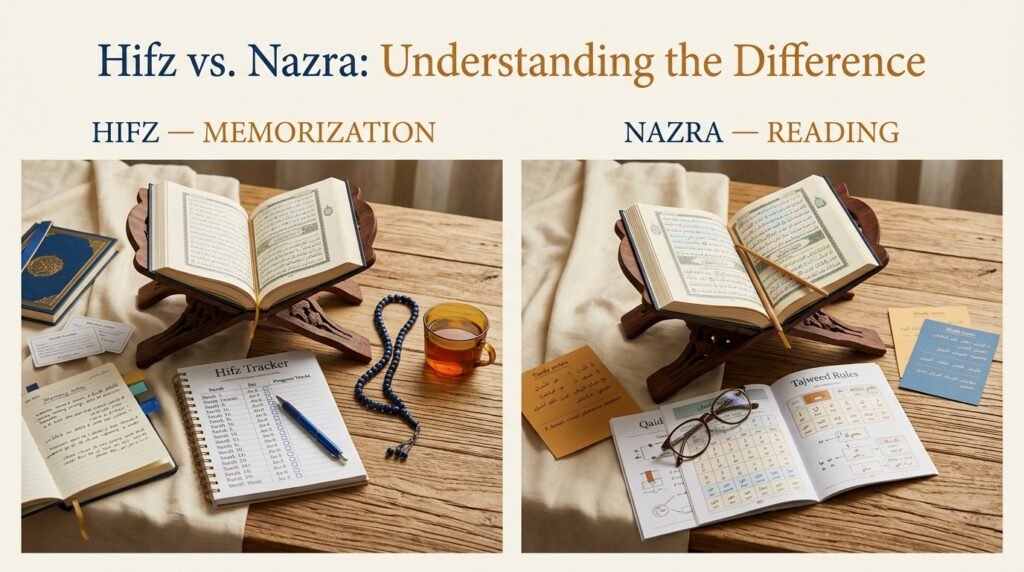
For centuries, Islamic scholarship and tradition have placed paramount emphasis on learning, reciting, and preserving the Holy Quran. When parents introduce their children to Quranic studies—or when adult learners decide to strengthen their relationship with the sacred text—the two most common educational pathways encountered are Nazra and Hifz.
While both disciplines involve deep interaction with the Divine Revelation, they fulfill distinctly different pedagogical functions, require contrasting commitments of time and mental energy, and represent different milestones along the journey of Quranic literacy.
Understanding the fundamental distinctions between Nazra and Hifz is essential for students, parents, and educators seeking to establish realistic goals, appropriate learning environments, and balanced spiritual development.
1. What is Nazra Quran?
Defining Nazra
The term Nazra (ناظرة) originates from the Arabic root n-dh-r (ن-ظ-ر), which translates to looking, observing, or reading by sight. In the context of Quranic studies, Nazra refers to reading the Holy Quran directly from the printed text (the Mushaf) with correct pronunciation and fluency, without committing the entire text to memory.
Foundational Steps of Nazra
Nazra is universally the prerequisite to all advanced Quranic sciences. Before a student can read the Quran fluently, they typically progress through a structured curriculum:
- Qaida Literacy (The Arabic Alphabet): Beginners start with a foundational primer (such as the Noorani Qaida or Madani Qaida). Here, students learn the Arabic letters, their isolated and joined shapes, short vowels (Harakat), tanween, sukoon, and shaddah.
- Makharij (Points of Articulation): Proper pronunciation requires directing sound from specific points of the vocal tract—the throat, tongue, lips, and nasal cavity.
- Basic Tajweed Rules: Students learn the fundamental rules governing recitation, such as elongation (Madd), nasalization (Ghunnah), stops and pauses (Waqf), and letter assimilation (Idgham).
- Gradual Reading (Juza Amma to Complete Recitation): Once comfortable with short words and verses, the learner reads progressively longer passages until they are capable of reading the entire Quran cover to cover directly from the pages.
Primary Goals of Nazra
- Fluency: Enabling the reader to look at any page of the Quran and read it accurately without stumbling.
- Accuracy: Preserving the phonetic integrity of the Arabic language to prevent changing the meaning of words.
- Daily Worship Fulfillment: Empowering Muslims to recite the necessary Surahs during daily prayers (Salah) and engage in regular personal reading (Tilawah).
2. What is Hifz Quran?
Defining Hifz
The word Hifz (حفظ) literally means preservation, guarding, or memorization. In Islamic tradition, Hifz refers to committing the entire text of the Holy Quran—all 114 Surahs, over 6,200 verses—to memory word for word.
A person who successfully accomplishes this monumental feat is titled a Hafiz (male) or Hafiza (female), signifying their role as a guardian of the Divine text.
The Mechanism of Hifz
Memorizing the Quran is an intricate, multi-tiered daily discipline. A conventional Hifz routine typically breaks study sessions into three distinct stages:
- Sabaq (New Lesson): The student memorizes a brand-new portion of text each day (ranging from a few lines to a full page or more, depending on ability).
- Sabqi (Recent Memorization / Sub-Revision): The student recites back the lessons learned over the preceding 5 to 20 days. This stage cements short-term memory into medium-term memory.
- Manzil / Dhor (Cumulative Revision): Because memory fades without systematic recall, students must constantly review older Juz’ (parts). An active Hifz student often reviews anywhere from half a Juz’ to multiple Juz’ daily to ensure retention.
Spiritual Significance of Hifz
From the era of Prophet Muhammad (peace be upon him), the Quran was preserved primarily through human memory and oral transmission before it was compiled into unified codices. Becoming a Hafiz connects a believer directly to an unbroken oral chain stretching back over 1,400 years.
3. Direct Comparison: Nazra vs. Hifz
To clearly visualize how these two forms of study differ, examine their key parameters:
| Aspect | Nazra (Reading by Sight) | Hifz (Memorization) |
|---|---|---|
| Primary Method | Visual tracking, phonetic decoding, and oral reading. | Intensive repetition, mental storage, and continuous active recall. |
| Prerequisites | None; beginners can start directly with the alphabet. | Must achieve fluent Nazra with correct Tajweed first. |
| Typical Duration | 6 months to 2 years (depending on age and frequency). | 2 to 4 years of intensive daily study, followed by lifelong revision. |
| Daily Time Needed | 30 to 60 minutes per session. | 3 to 6+ hours daily of new memorization and revision. |
| Cognitive Focus | Visual recognition and phonetic precision. | Long-term memory consolidation, pattern recognition, and focus. |
| Maintenance | Low to moderate; basic reading skills remain once learned. | Very high; daily, lifelong revision is mandatory to prevent forgetting. |
4. Key Differences in Detail
1. Prerequisite vs. Advanced Specialization
Nazra is foundational; it is mandatory for every Muslim to learn enough reading to practice their faith properly. Hifz, conversely, is considered a communal obligation (Fard Kifayah). If a portion of the community fulfills it, the general community is relieved of the burden. One cannot enter a Hifz program without first mastering Nazra—attempting to memorize verses before reading them properly inevitably leads to memorizing pronunciation mistakes that are remarkably difficult to unlearn later.
2. Time and Lifestyle Demands
Learning Nazra integrates easily into a standard lifestyle. Children attend class for under an hour after regular school, and working adults can study with a tutor several evenings a week without disrupting work or domestic responsibilities.
Hifz, by contrast, is a lifestyle transformation. It demands hours of solitary focus each day. Students must wake up early, dedicate dedicated revision blocks in the morning and afternoon, and strictly manage screen time, distractions, and social schedules.
3. Retention and Maintenance
Once a student achieves fluency in Nazra, the skill is relatively durable. Even if they step away from reading for months, literacy quickly returns with minimal practice.
Hifz functions like a muscle: without constant exercise, it atrophies rapidly. Traditional hadiths describe memorized portions of the Quran as slipping away faster than unmoored camels if not tended to diligently. A Hafiz is bound to a lifelong covenant of daily recitation (Dhor or Muraja’ah).
5. Which Path Should You Choose?
When deciding between continuing with Nazra-level study or embarking on the Hifz journey, consider the following factors:
When to Focus on Nazra
- Beginners of Any Age: Anyone new to the Arabic language must begin here.
- Time-Constrained Individuals: Students navigating heavy academic workloads or professionals with demanding careers who want a consistent, low-stress relationship with the Quran.
- Focus on Comprehension and Application: Learners who want to balance reading with understanding the translation (Tarjuma), classical Arabic grammar (Sarf & Nahw), and exegesis (Tafsir).
When to Embark on Hifz
- Strong Nazra Foundation: The student already reads smoothly with zero hesitation and applies Tajweed instinctively.
- High Discipline and Passion: The desire to memorize must come from personal dedication and love for the Quran, rather than external parental pressure alone.
- Supportive Environment: Success in Hifz requires a stable, quiet home life, a qualified teacher (Mu’allim or Sheikh), and a family routine structured around consistent revision hours.
Conclusion
Neither Nazra nor Hifz stands in opposition to the other; rather, they form sequential, complementary stages of Quranic scholarship. Nazra provides the eyes and voice with the literacy required to interact directly with the written word of Allah. Hifz takes those very words from the page and engraves them permanently upon the heart.
Whether one’s goal is to read a page of the Quran daily with impeccable Tajweed or to complete the memorization of the entire text, both pathways carry immense spiritual rewards, illuminate the mind, and anchor the soul in the timeless guidance of the Quran.