
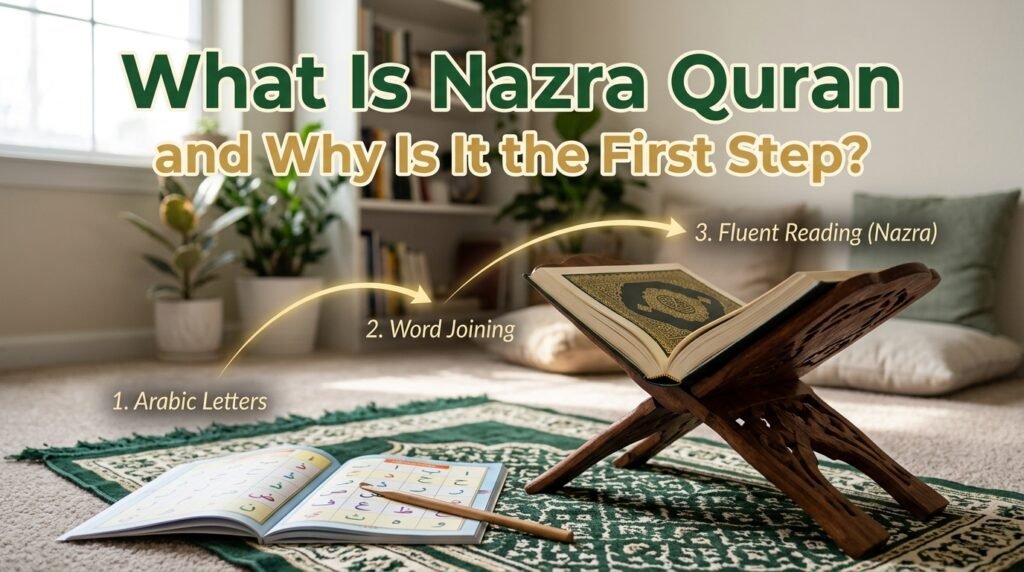
The Holy Quran is the divine word of Allah (SWT), revealed to Prophet Muhammad (PBUH) as a beacon of light, wisdom, and guidance for all humanity. For Muslims worldwide, engaging with the Quran is both a sacred religious duty and an enriching spiritual journey. However, the path to understanding and memorizing the Quran requires a solid starting point.
In traditional Islamic pedagogy, the very first milestone of this lifelong journey is Nazra Quran (reading by sight). Before an individual can memorize the sacred verses, understand classical Arabic grammar, or contemplate deep theological interpretations (Tafseer), they must learn to look at the script and recite the words accurately.
Understanding what Nazra Quran entails, its profound importance, and why it holds the premier position in Quranic education unlocks the key to establishing a lasting relationship with the Book of Allah.
1. Defining “Nazra Quran”: What Does It Mean?
The word “Nazra” (often spelled Nazira or Nazrah) originates from the Arabic root ن-ظ-ر (Na-dha-ra), which primarily means “to look,” “to see,” or “to inspect with vision.”
In Islamic terminology, Nazra Quran refers to:
The act of reading and reciting the Holy Quran directly by looking at the Arabic text from the physical copy of the Quran (Mushaf) or digital scripture, rather than reciting from memory.
In contrast to Hifz (memorization where the reciter recites from the heart without looking at the page), Nazra is the visual and vocal practice of recognizing Arabic letters, combining them into words and sentences, and reading them fluently in their original script.
While it sounds straightforward—akin to reading a book in any other language—reading the Quran carries unique linguistic and sacred dimensions. The script represents the verbatim word of Allah, requiring correct pronunciation (Makharij) and baseline adherence to the rules of recitation (Tajweed).
2. Why Is Nazra Quran the First Step?
Education is inherently sequential. A child cannot write an essay before learning the alphabet, nor can a mathematician solve complex differential equations without grasping basic arithmetic. In Islamic scholarship, Quranic education follows a structured, time-tested framework:
[ Noorani / Madani Qaida ] ➔ [ Nazra Quran ] ➔ [ Advanced Tajweed ] ➔ [ Hifz & Tafseer ]
Nazra Quran sits precisely at the foundational gateway for several critical reasons:
A. The Non-Native Reality of the Muslim Ummah
More than 80% of the world’s Muslim population is non-Arab, living in South Asia, Southeast Asia, Africa, Europe, and the Americas. For a non-native speaker, Arabic phonetics, script, and right-to-left orthography are unfamiliar. Nazra bridges this gap by training the human eye to track Arabic script and the vocal tract to articulate non-native sounds accurately.
B. Correcting Phonetic Ambiguity
Classical Arabic contains sounds that do not exist in English, Urdu, or other languages. For example:
- The difference between ح (Ḥā) and هـ (Hā)
- The distinction between ت (Tā) and ط (Ṭā)
- The nuance between ذ (Dhāl), ز (Zāy), and ظ (Ẓā)
A slight mispronunciation in Arabic can completely distort the meaning of a divine verse. Learning Nazra under a qualified teacher ensures that visual recognition immediately translates to correct phonetic output before bad habits become ingrained.
C. Prevention of Cognitive Overload
Attempting to memorize (Hifz) or interpret (Tafseer) without mastering Nazra forces the brain to struggle simultaneously with letter decoding, pronunciation, and meaning. Mastering Nazra automates reading mechanics, freeing cognitive resources for memorization, reflection, and spiritual absorption later on.
3. The Core Components of Learning Nazra
Mastering Nazra Quran is not accomplished overnight; it is a systematic progression composed of several distinct stages:
1. The Primer Stage (The Qaida)
Before touching the complete Mushaf, students typically study a foundational booklet, such as the Noorani Qaida or Madani Qaida. During this stage, learners master:
- Single Arabic letters in their isolated forms.
- Letter forms when joined at the beginning, middle, and end of words.
- Short vowels (Harakat): Fathah (Zabar), Kasrah (Zer), and Dammah (Pesh).
- Tanween, Sukoon, Shaddah, and Madd rules.
2. Word Formation and Phonics
Once letters and diacritical marks are understood, learners begin piecing together two-letter, three-letter, and compound words. This builds visual fluency, enabling the eyes to scan and segment words effortlessly.
3. Transition to Short Surahs (Juz Amma)
After completing the primer, students begin reading the 30th Juz (Juz Amma) of the Quran. Because these short Surahs are familiar from daily prayers, they serve as an encouraging, low-friction entry point into the complete Mushaf.
4. Reading the Complete Mushaf
From Juz 1 to Juz 30, the student reads the entire Quran cover-to-cover under the supervision of a teacher. The instructor listens actively, pauses the student to fix errors in pronunciation, explains pauses and stop symbols (Waqf), and helps build consistent pace and stamina.
4. The Spiritual and Practical Benefits of Nazra Quran
Beyond its functional role in the learning curriculum, reciting the Quran by sight carries deep theological merit and everyday benefits:
| Dimension | Primary Benefit | Explanation |
| Spiritual Reward | Multiplied Hasanat | The Prophet (PBUH) stated that every recited letter brings a ten-fold reward. Looking at the Mushaf is considered an act of worship in itself. |
| Salah Validity | Accurate Prayer Recitation | Daily prayers (Salah) require reciting Surah Al-Fatiha and additional verses; Nazra ensures those verses are recited without invalidating errors. |
| Gateway to Hifz | Fast, Error-Free Memorization | A student who reads fluently by sight memorizes significantly faster and makes fewer transcription mistakes from memory. |
| Mental Focus | Deepened Mindfulness | Engaging sight, touch, and vocal organs simultaneously grounds the mind, reducing distraction during recitation. |
5. Overcoming Common Challenges in Nazra Learning
Reciting classical Arabic script can present obstacles, particularly for adult learners or children in non-Arabic-speaking environments. Recognizing these hurdles makes overcoming them manageable:
- Patience with Speed: Beginners often feel discouraged by slow, halting recitation. In early stages, accuracy must always take priority over speed. Fluency develops naturally through consistent repetition.
- Distinguishing Similar Letters: Arabic script relies heavily on dots (I’jam) to differentiate letters (e.g., ب, ت, ث, ن, ي). Daily visual drills help make recognition automatic.
- Mastering Stops and Pauses (Waqf): Stopping in the wrong place can unintentionally alter the meaning of a sentence. Learning standard stop markers (such as Meem, Qif, Laa, and Jeem) ensures smooth transitions without running out of breath.
- Finding Qualified Guidance: Self-study via recorded audio or automated apps can assist, but it cannot correct subtle vocal errors. Working with a competent Qari or certified teacher provides the real-time feedback necessary for genuine mastery.
6. Practical Tips for Mastering Nazra Quran
- Set a Consistent Daily Time: Fifteen to twenty minutes of daily, focused reading is far more effective than an irregular two-hour cramming session once a week.
- Use a Clear, Standard Script: Beginners often find Indo-Pak or Uthmani scripts easiest depending on their regional familiarity. Stick to one consistent script until visual recognition is effortless.
- Read Out Loud: Nazra cannot be practiced silently. Reciting at an audible whisper or conversational volume activates auditory feedback, helping catch mispronounced vowels and skipped letters.
- Listen to Expert Reciters: Pair reading practice with listening to renowned reciters (Qurra) known for deliberate, clear recitation (such as Sheikh Mahmoud Khalil Al-Husary or Sheikh Minshawi in Murattal style).
Conclusion
Nazra Quran is not merely an introductory class for young children; it is the vital foundation of every believer’s connection to the Divine Word. By training the eyes to behold the sacred text and the tongue to utter its pristine sounds, Nazra honors the preservation of the Quran as it was revealed over fourteen centuries ago.
Whether one aspires to become a Hafiz, study classical Islamic jurisprudence, or simply recite prayers with clarity and tranquility, the journey begins with this essential first step: opening the Mushaf, fixing one’s gaze upon the verses, and reading with devotion.