
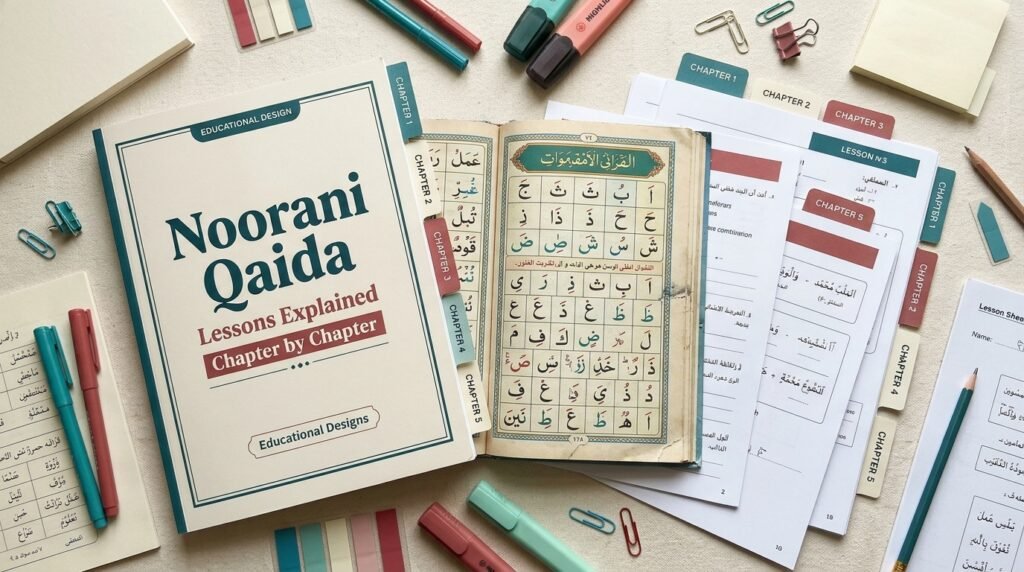
Reading the Holy Quran with correct pronunciation, precise rhythm, and proper articulation is an obligation and spiritual journey for millions of Muslims worldwide. For centuries, scholars have developed foundational curricula to bridge the gap between a non-Arabic speaker or a young beginner and the complex phonetic elegance of Classical Arabic (Fusha). Among all the primers created, none has attained the widespread recognition, pedagogical effectiveness, and time-tested authority of the Noorani Qaida (القاعدة النورانية), originally compiled by Sheikh Noor Muhammad Haqqani.
The Noorani Qaida is systematically structured to take a learner with zero background in Arabic from recognizing isolated letters to reading continuous verses of the Quran with accurate Tajweed (rules of recitation). By breaking down phonetics, vowel length, resting rules, and consonantal interactions into incremental chapters, it builds effortless muscle memory.
Below is an in-depth, chapter-by-chapter breakdown of the Noorani Qaida, designed to clarify the core objectives, rules, common mistakes, and practice techniques for each stage of learning.
What Makes Noorani Qaida So Effective?
Unlike conventional language readers, the Noorani Qaida is engineered entirely around Quranic orthography and Tajweed. Classical Arabic letters alter their acoustic properties depending on their immediate phonetic environment—whether they are followed by an elongated vowel, a nasal sound (Ghunnah), or a stopping point (Waqf).
The curriculum functions through three core teaching methods:
- Rote Visual Recognition (At-Tahajji): Naming each letter and sign explicitly before blending.
- Correct Articulation Points (Makharij): Training the throat, tongue, lips, and nasal cavity to emit authentic sounds.
- Phonetic Blending (Tarkib): Moving step-by-step from isolated syllables to compound words and running sentences.
Chapter 1: The Single Letters (Al-Huroof Al-Mufradah)
The primer begins with the 29 individual letters of the Arabic alphabet, starting from Alif (ا) through to Yaa (ي).
Core Concepts & Tajweed Rules
- Makharij (Articulation Points): Every Arabic letter originates from one of five main anatomical regions: the chest/throat cavity (Al-Jawf), the throat (Al-Halq), the tongue (Al-Lisan), the lips (Ash-Shafatain), and the nasal passage (Al-Khayshum).
- Heavy vs. Light Letters (Tafkheem and Tarqeeq):
- Seven letters are permanently heavy (elevated dorsal tongue): خ, ص, ض, غ, ط, ق, ظ (collected in the mnemonic Khussa Daghtin Qith).
- The remaining letters are light (depressed tongue), with the conditional exceptions of Alif, Lam, and Raa.
Pedagogical Focus
In this initial chapter, students learn to articulate the full, unabbreviated names of the letters rather than their short sounds (e.g., stating “Jeem” instead of just “Ja”). Special attention must be paid to letters that sound similar to non-native ears:
- ت (Taa) vs. ط (Taa)
- س (Seen) vs. ص (Saad)
- د (Daal) vs. ض (Daad)
- ح (Haa) vs. هـ (Haa)
- ك (Kaaf) vs. ق (Qaaf)
Chapter 2: Compound Letters (Al-Huroof Al-Murakkabah)
Arabic is a cursive script; letters change their shapes depending on whether they appear in the initial, medial, or final position within a word. Chapter 2 transitions the student from isolated glyphs to connected multi-letter clusters.
Core Concepts
- Identifying Root Shapes: Learners observe how letters drop their tails when joined (e.g., how ب, ت, and ث share the identical base tooth and are differentiated exclusively by dot placement).
- Vertical and Horizontal Stacking: Script ligatures such as لا (Laam-Alif), نج (Noon-Jeem), and بم (Baa-Meem) are decoded letter by letter.
Pedagogical Focus
Recitation here is conducted strictly by analyzing each constituent glyph in sequence from right to left before pronouncing them together. This ensures the student does not guess words by general appearance but develops keen visual acuity for dots (Nuqat) and ligatures.
Chapter 3: The Disjointed Letters (Al-Muqatta’at)
Placed at the beginning of 29 Surahs of the Quran (such as Al-Baqarah, Maryam, and Ya-Seen), the mysterious abbreviated letters (Al-Huroof Al-Muqatta’at) represent a unique bridge in Tajweed.
Core Concepts
- Full Name Pronunciation: Even though written together like continuous words (e.g., الم or كهيعص), they must be read as their individual long letter names: Alif – Laaam – Meeem.
- Madd Lazim (Compulsory Prolongation): Letters whose names contain a three-letter construction with a central vowel followed by a quiescent consonant (such as Laam and Meem) are prolonged for six counts (Harakat).
- Idgham and Ikhfa: The natural phonetic overlap between adjacent letter names is observed (e.g., the nasal blending between the final m of Laam and the opening m of Meem in Alif-Laaam-Meeem).
Chapter 4: The Short Vowels (Al-Harakat)
Unlike European languages where vowels are letters in their own right, standard Arabic short vowels are diacritical marks placed above or below consonants.
The Three Vowels
- Fathah (ــَـ): A diagonal stroke above the letter, producing a clean, open “a” sound (as in “bat” for light letters, or a deeper “o/uh” resonant tone for heavy letters).
- Kasrah (ــِـ): A diagonal stroke beneath the letter, giving a clear “i/ee” sound (as in “sit”).
- Dammah (ــُـ): A small comma-shaped curl above the letter, producing a rounded “u/oo” sound (as in “put”).
Key Tajweed Note
A crucial rule emphasized across every Noorani Qaida classroom is avoiding the stretch (Tamteet). A short vowel must last precisely one count. Stretching a Fathah into an Alif or a Kasrah into a Yaa alters grammatical meaning in the Quran and constitutes a major error (Lahn Jaliyy).
Chapter 5: Nunation (At-Tanween)
Tanween represents the doubling of short vowels:
- Fathatain (ــًـ): Double Fathah (pronounced -an)
- Kasratain (ــٍـ): Double Kasrah (pronounced -in)
- Dammatain (ــٌـ): Double Dammah (pronounced -un)
The Hidden Noon Rule
Phonetically, a Tanween is simply a short vowel attached to an unwritten, silent-resting Noon Sakinah ($\text{نْ}$). For instance, the written sound بً is acoustically identical to بَ + نْ (Ban). Recognizing this phonetic equivalence is vital, as all subsequent rules governing nasalization and assimilation (Idgham, Ikhfa, Ith-har, and Iqlab) apply equally to Tanween and Noon Sakinah.
Chapter 6: Exercises on Harakat and Tanween
Chapter 6 is an intensive consolidation stage. It features authentic three- and four-letter Quranic words constructed solely out of short vowels and Tanween (e.g., أَبَدًا, عَبَسَ, خَلَقَ).
Objectives
- Analytical Spelling (Hijaa): Students are trained to spell: “Hamzah fathah [A], Baa fathah [Ba] -> [A-Ba], Daal fathatain [Dan] -> [Abadan]”.
- Fluent Reading (Rawaan): Once spelling is firm, students read words swiftly without pauses, maintaining clean vowel boundaries and distinct heavy/light consonants.
Chapter 7: The Soft Vowels (Huroof Al-Leen)
There are two letters of Leen in Arabic: Waw (و) and Yaa (ي) when they carry a Sukun (quiescence) and are preceded specifically by a Fathah:
- Waw Leen (ــَـوْ): Produces a smooth diphthong sound like “ow” in “flow” or “bout” (e.g., خَوْف – Khawf).
- Yaa Leen (ــَيْ): Produces a smooth diphthong sound like “ay” in “say” or “byte” (e.g., بَيْت – Bayt).
These sounds must flow effortlessly from the vocal tract without harshness, excessive prolongation, or abrupt cutting off.
Chapter 8: The Letters of Prolongation (Huroof Al-Madd)
Chapter 8 introduces natural long vowels (Madd Asli / Madd Tabee’ee). These extend the duration of a sound from one vowel count to exactly two counts (approximately the time it takes to open or close a finger evenly).
The Three Madd Conditions
- Alif Maddah: An unvoweled Alif preceded by a Fathah (ـَـ ا).
- Waw Maddah: A quiescent Waw with a Sukun preceded by a Dammah (ـُـ وْ).
- Yaa Maddah: A quiescent Yaa with a Sukun preceded by a Kasrah (ـِـ يْ).
This chapter contrasts short vowels side-by-side with long vowels (e.g., بَ vs. بَا, بِ vs. بِي, بُ vs. بُو), conditioning the ear and mouth to sustain vowel lengths accurately.
Chapter 9: Exercises on Madd, Leen, and Tanween
This chapter brings together Chapters 5, 7, and 8. It presents combinations of long vowels, diphthongs, and nunation across multi-syllabic Quranic vocabulary (e.g., جَاعِلٌ, قَوْلٌ, يَوْمَئِذٍ).
The primary instructional goal is preventing vowel shortening on prolonged letters while preventing accidental elongation on short letters.
Chapter 10: The Quiescent State (As-Sukun / Al-Jazm)
A letter that carries no vowel is in a resting or non-vocalized state marked by the Sukun (ــْـ). A letter with a Sukun cannot be pronounced on its own; it must always be anchored to the voweled letter that precedes it.
Major Rules Introduced
- Qalqalah (Echo / Bouncing Mechanism): When one of the five letters of Qalqalah—ق, ط, ب, ج, د (collected in Qutb Jad)—carries a Sukun, it must be pronounced with a clean, rebounding release of pressure rather than being muffled or swallowed.
- Hams (Whisper of Breath): Letters like ت and ك release a slight, controlled puff of air when stopped upon.
- Tawassut / Bayniyyah: Letters of moderate airflow (such as ل, ن, ع, م, ر) are held for a fraction of a beat to let their voice resonance settle.
Chapter 11: Exercises on Sukun
Chapter 11 tests the learner’s mastery of consonant stops and rhythmic stability. Complex clusters containing guttural throat letters (ء, هـ, ع, ح, غ, خ) resting on a Sukun are practiced (e.g., يَعْلَمُونَ, أَخْرَجَ, إِطْعَامٌ).
Students learn here never to insert an artificial vowel (an “uh” sound or Saktah) between a quiescent letter and the subsequent consonant.
Chapter 12: Doubled Consonants (At-Tashdeed / Ash-Shaddah)
The Shaddah (ــّـ) indicates gemination—a doubled consonant.
Structure of a Mushaddad Letter
Every letter bearing a Shaddah consists of two identical letters compressed into one:
$$\text{Letter with Shaddah} = \text{1st Letter (with Sukun)} + \text{2nd Letter (with Harakah)}$$
For example:
$$\mathbf{رَبِّ} = \mathbf{رَبْ} + \mathbf{بِ} \quad (\text{Rab} + \text{bi} = \text{Rabbi})$$
Core Tajweed Injunctions
- Ghunnah on Noon and Meem: Whenever a Noon or Meem carries a Shaddah (نّ, مّ), it triggers an obligatory nasalization (Ghunnah) sustained for approximately two counts.
- Strong Articulation (Nabr): Doubled consonants require firm, decisive vocal compression without stumbling or delaying the meter of recitation.
Chapters 13 & 14: Exercises on Tashdeed and Sukun Combined
These chapters elevate reading complexity by intertwining resting consonants, long vowels, and doubled consonants in compound arrangements (e.g., يَذَّكَّرُ, مُدَّثِّرُ, تَبَّتْ).
Crucial Focus Areas
- Transitioning immediately from a vowel into a heavy Shaddah without losing tempo.
- Preserving the distinct identity of letters with overlapping articulation points when one is quiescent and the next is doubled.
Chapter 15: Tashdeed with Tashdeed
One of the most advanced technical exercises in the book features sequential doubled letters within a single word (e.g., يَزَّكَّى or عِلِّيّونَ).
The reciter must navigate two consecutive points of vocal tension and release without breaking the cadence of the breath or flattening the syllables.
Chapter 16: Tashdeed After Madd (Madd Lazim)
When a letter bearing a Shaddah immediately follows a letter of Madd (long vowel) within the same word, an exceptional Tajweed event occurs: Madd Lazim Kalimi Muthaqqal (Compulsory Heavy Prolongation in a Word).
- Prolongation Duration: Extended to a full six counts (the longest formal duration in Tajweed).
- Classic Examples: الضَّالِّينَ (Ad-Daallleeeen), دَابَّةٍ (Daabbah), الْحَاقَّةُ (Al-Haaqqah).
- The Transition: The reciter holds the long vowel for six counts, then delivers a firm accent (Nabr) to connect directly onto the doubled consonant with strength.
Chapter 17: Rules of Stopping (Waqf) and Miscellaneous Signs
The concluding section guides the reader from word-level exercises to sentence-level Quranic text, focusing on how to stop properly at the ends of verses (Ayat) and punctuation symbols.
Fundamental Stopping Rules
- Converting Short Vowels to Sukun: Any short vowel (Fathah, Kasrah, Dammah) or Kasratain / Dammatain turns into a silent Sukun upon stopping (e.g., الْعَالَمِينَ becomes Al-‘Aalameen).
- Taa Marbutah (ة / ـة): When pausing on a rounded Taa, it always transforms into a soft resting Haa (هْ).
- Madd ‘Iwad (Substitute Madd): Stopping on a word ending with a double Fathah (Fathatain ــًـ) converts the nunation into a steady two-count Alif Maddah (e.g., عَلِيمًا is read upon stopping as ‘Aleemaa).
Structured Summary of Noorani Qaida Chapters
| Chapter | Title / Topic | Primary tajweed Focus | Key Learning Outcome |
| 1 | Single Letters (Mufradah) | Makharij & Tafkheem/Tarqeeq | Accurate letter identification and distinct vocal origins |
| 2 | Compound Letters (Murakkabah) | Cursive ligatures and dot positions | Visual parsing of joined Arabic script |
| 3 | Disjointed Letters (Muqatta’at) | Madd Lazim (6 counts) & Ghunnah | Deciphering Quranic opening abbreviations |
| 4 | Short Vowels (Harakat) | Single-beat vowels without stretching | Rapid, sharp vocalization without distortion |
| 5 | Nunation (Tanween) | Underlying Noon Sakinah | Identifying double vowel nasal phonetics |
| 6 | Exercises on Harakat & Tanween | Synthesis and fluent reading | Fluid syllable transition in real words |
| 7 | Soft Letters (Huroof Al-Leen) | Smooth diphthong glide (Waw & Yaa) | Fluid speech without harsh breaks |
| 8 | Prolongation (Huroof Al-Madd) | Natural 2-count stretch (Madd Asli) | Distinct ratio between short and long vowels |
| 9 | Exercises on Madd & Leen | Syllabic contrast and rhythm | Consistent vowel measurement |
| 10 | Quiescence (Sukun / Jazm) | Qalqalah, Hams, and Tawassut | Stable consonant stops without added vowels |
| 11 | Exercises on Sukun | Complex consonant clusters | Clean execution of throat and resting letters |
| 12 | Gemination (Tashdeed) | Letter doubling & Ghunnah on نّ / مّ | Muscular vocal closure and nasal timing |
| 13-14 | Combined Tashdeed & Sukun | Alternating stop-and-release patterns | High-precision phonetic articulation |
| 15 | Consecutive Tashdeed | Compounded gemination | Stamina and rhythmic consistency |
| 16 | Madd Followed by Tashdeed | Madd Lazim Muthaqqal (6 counts) | Seamless transition from long pull to firm stop |
| 17 | Stopping Rules (Waqf) | Madd ‘Iwad, ending stops, Taa Marbutah | Authentic Quranic verse endings and breath pauses |
Practical Tips for Teachers and Self-Learners
- Prioritize Quality Over Speed: Moving past Chapter 1 without mastering the articulation points will compound mistakes in every later chapter. Dedicate ample time to isolating guttural and emphatic letters.
- Listen and Repeat (Talqeen): Arabic phonetics cannot be learned purely from the written page. Learners should pair their practice with audio recordings from certified Qaris (such as Sheikh Mahmoud Khalil Al-Husary) who demonstrate authentic Noorani Qaida pacing.
- Daily Five-Minute Articulation Drills: Dedicate short daily sessions to switching back and forth between light and heavy counterparts (e.g., Daal vs. Daad, Taa vs. Taa). This builds the muscular memory needed for effortless reading.
- Transition Gradually to the Mushaf: Once Chapter 11 is mastered, begin reading short chapters of the 30th Juz (Juz ‘Amma)—such as Surah Al-Ikhlas, Al-Falaq, and An-Nas—applying the Qaida’s principles to complete sentences.
Mastering the Noorani Qaida demystifies the Arabic script and instills lifelong confidence in reciting the words of the Quran as they were preserved and recited historically.