
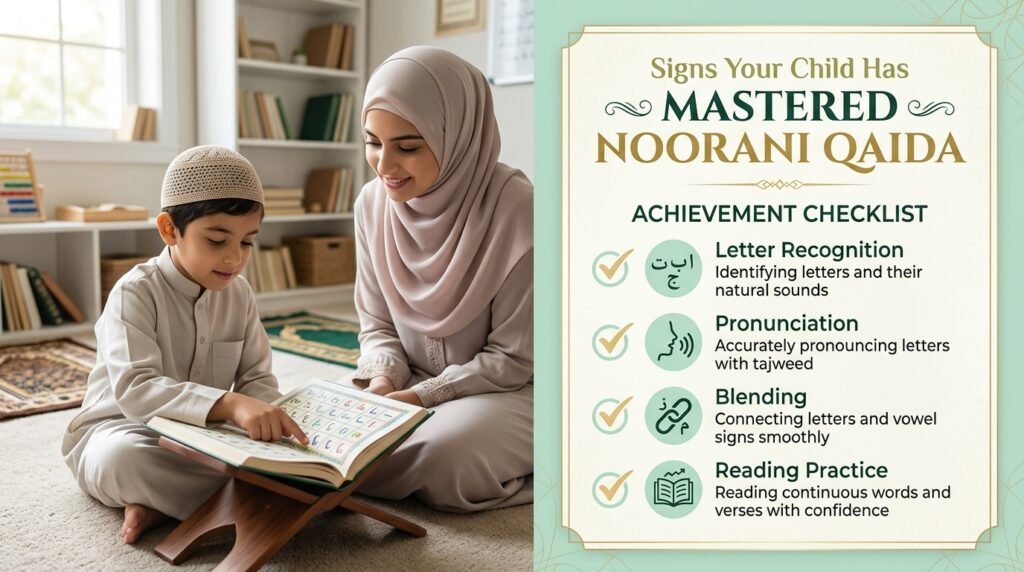
Completing the Noorani Qaida is one of the most celebrated milestones in a young Muslim’s religious education. For centuries, this foundational booklet has served as the universal stepping stone for non-Arabic speakers and young children learning to read the Holy Quran in its original language.
However, finishing the physical pages of the booklet does not automatically equal mastery. Many parents find themselves at a crossroads: their child has reached the final page, but when handed the Mushaf (the Quran), the child stumbles, hesitates, or struggles to read a single verse.
True mastery of Noorani Qaida is not about passive memorization or rushing through lessons; it is about acquiring practical, instinctive phonetic literacy. Below are the definitive signs that your child has genuinely mastered Noorani Qaida and is fully equipped to transition smoothly into reciting the Holy Quran.
1. Flawless Individual Letter Identification and Accurate Makharij
The bedrock of Noorani Qaida lies in its opening lessons (Huruf al-Mufradat). Mastery at this stage goes far beyond reciting the Arabic alphabet in alphabetical sequence from Alif to Yaa.
Random Identification Without Hesitation
A child who has mastered this stage can identify any isolated letter shown at random. If you point to خ, ض, or غ out of order, they should name it instantly without having to mentally sing through the alphabet to find it.
Precision in Makharij (Points of Articulation)
Arabic contains many letters that share similar English equivalents but require distinct vocal mechanisms. A master of the Qaida produces distinct sounds effortlessly:
- Differentiating clearly between ح (throat H) and هـ (chest H).
- Separating ق (deep uvular Qaf) from ك (palatal Kaf).
- Distinctly pronouncing ع (deep pharyngeal Ain) without turning it into an Alif (أ).
- Accurately articulating the interdental letters: ث, ذ, and ظ.
2. Effortless Recognition of Compound Letters (Huruf al-Murakkabat)
Arabic script is cursive; letters morph, lose their full tails, and connect to form compound words. One of the most challenging hurdles for early learners is identifying letters when they appear in initial, medial, or final forms.
Dissecting Visual Ligatures
In compound forms such as بج, نحت, or يس, letters overlap and share common bases. A child who has mastered Qaida can visually dissect these combinations without confusion.
The “Dot Logic” Instinct
A child with true comprehension relies on dot positioning and stroke shapes rather than guessing:
- Knowing that one dot below is ب (Baa), two dots above is ت (Taa), and three dots above is ث (Thaa).
- Differentiating between ن (one dot above) and ي (two dots below) in the medial form.
- Recognizing letters with similar head shapes, such as ج, ح, and خ, purely by dot placement.
3. Instant Decoding of Short Vowels (Harakat)
The Harakat—Fathah (Zabar), Kasrah (Zair), and Dammah (Pesh)—breathe phonetic life into Arabic consonants. Mastery here is marked by two distinct features: purity of sound and timing discipline.
Avoiding Stretching (Imalah and Lengthening)
A frequent error among beginner students is dragging short vowels into long vowels (e.g., pronouncing a simple Fathah on بَ as “Baaa” instead of a crisp “Ba”). A child who has mastered the Qaida maintains short, sharp, distinct vowel bursts without dragging.
Absolute Rejection of “Majhool” Accent
In classical Tajweed, vowel sounds must remain pure (Ma’roof):
- A Kasrah must sound like the clean “ee” sound (as in “bit” or “meet”), never flattening into an ambiguous “ay” sound (Majhool).
- A Dammah must sound like a rounded “oo” (as in “boot”), never relaxing into an open “oh” sound.
If your child produces sharp, rounded, and pure Harakat across every letter, their foundation is solid.
4. Mastery of Vowel Elongation: Maddah and Leen Letters
Once short vowels are understood, the Qaida introduces long vowels (Huruf al-Maddah) and soft diphthongs (Huruf al-Leen).
Accurate Harakah Duration (Natural Madd)
Mastery means the child intuitively doubles the count of a short vowel when accompanied by an Alif preceded by Fathah, a Yaa Sakinah preceded by Kasrah, or a Waw Sakinah preceded by Dammah. They consistently hold the elongation for exactly two counts (approximately the time it takes to open or close a finger) without over-stretching or clipping the sound.
Natural Handling of Huruf al-Leen
When a Waw Sakinah or Yaa Sakinah is preceded by a Fathah (ـَوْ and ـَيْ), the sound must flow smoothly and softly without abruptness or excessive lengthening. A child with mastery articulates words like خَوْف and صَيْف with natural, soft resonance.
5. Confident Application of Sukoon (Jazm) and Shaddah (Tashdeed)
The transition from independent sounds to joint, rhythmic reading hinges entirely on how well a student grasps the Sukoon (rest mark) and the Shaddah (doubling mark).
Letter + Harakah ──► Smooth Connection ──► Sukoon (Rest) / Shaddah (Pressure)
Clean Connection on Sukoon
A child who has mastered Sukoon understands how to connect an active letter to a resting letter without introducing an accidental vowel (e.g., pronouncing أَبْ cleanly without turning it into “Aba”).
Execution of Qalqalah (Echoing Mechanism)
The five letters of Qalqalah (ق, ط, ب, ج, د — summarized in the mnemonic Qutb Jad) require a crisp bouncing or echoing release when carrying a Sukoon. If your child naturally bounces these consonants without adding a vowel sound to the end, they have internalized one of the core elements of Tajweed.
Precision with Shaddah (Tashdeed)
The Shaddah requires a slight vocal emphasis, holding the letter firmly before releasing its accompanying vowel:
- The child divides the doubled letter mentally into two parts: the first bearing a Sukoon and the second carrying the Harakah.
- They apply appropriate pressure without awkward pauses or robotic breaks.
6. Intuitive Grasp of Tanween and Noon Sakinah Rules
Tanween (double Harakat: Fathatayn, Kasratayn, Dammatayn) introduces a hidden Noon Sakinah sound to the end of a word. A child ready for the Quran displays complete clarity here:
- Tanween Recognition: Instantly understanding that ً, ٍ, and ٌ create “-an”, “-in”, and “-un” endings.
- Basic Ghunnah Application: Naturally producing a nasal resonance (Ghunnah) of two counts when encountering a Noon Mushaddadah (نّ) or Meem Mushaddadah (مّ).
- Izhar vs. Ikhfa Awareness: While a young child may not always recite the technical definitions of these rules from memory, their pronunciation reveals their mastery. They naturally articulate a clear Noon before throat letters (Izhar) and soften the sound into a nasal hum before non-throat letters (Ikhfa).
7. Fluid Reading: Moving Beyond Letter-by-Letter Spelling (Hija)
During early Qaida lessons, children rely heavily on spelling out each component (Rawaan vs. Hija):
“Baa-Zabar-Ba, Taa-Zair-Ti… Bati”
While spelling is an essential pedagogical tool in the beginning, it must be outgrown before entering the Quran.
Direct Sight Reading (Rawaan)
The most visible indicator of Qaida mastery is the ability to read words and phrases directly by sight. When looking at a word like خَلَقَكَ, the child no longer spells each letter aloud; their eyes scan the letters, their brain processes the vowels simultaneously, and they pronounce the complete word fluidly.
Breath and Pace Consistency
A child who has completed the foundation reads with an even tempo. They do not sprint through easy single-vowel words only to freeze entirely on a word featuring a Shaddah or Sukoon.
8. Navigating Stopping Marks (Waqf) and Word Endings
The Quran is composed of verses that require deliberate stops. The final exercises of Noorani Qaida introduce the mechanics of stopping (Waqf).
A child who has mastered the Qaida demonstrates:
- The Silent Ending Rule: Automatically changing a final short vowel (Fathah, Kasrah, Dammah) into a Sukoon when stopping at the end of a word or sentence.
- Taa Marbutah Transformation: Naturally converting a round Taa (ة / ـة) into a breathy Haa (ه) sound upon pausing.
- Tanween Fathah Handling: Converting double Fathah (ـً) into a single two-count Alif Madd when bringing the recitation to a halt.
Summary Checklist: Is Your Child Ready for the Quran?
Use this quick evaluation matrix to verify your child’s readiness:
| Skill Area | Beginner Level | Mastered Level |
| Letter Recognition | Needs sequential recitation (A to Z) | Identifies any isolated or compound letter instantly |
| Makharij | Confuses similar sounds (e.g., ت vs ط) | Distinct, clean articulation across all throat and heavy letters |
| Vowels (Harakat) | Stretches short vowels into long vowels | Produces crisp, un-dragged, non-Majhool sounds |
| Compound Letters | Confused by shared stems and ligatures | Accurately identifies letters via dot positioning and shape |
| Sukoon & Shaddah | Stumbles over connections or pauses awkwardly | Smooth connections; accurate Qalqalah and Tashdeed pressure |
| Reading Method | Spells out every letter manually (Hija) | Reads multi-syllable words directly by sight (Rawaan) |
| Stopping Rules | Ignores pause mechanics entirely | Accurately applies Sukoon, Haa conversions, and pauses |
Moving Forward: The Next Step After Noorani Qaida
If your child demonstrates these markers consistently, they have achieved true mastery of Noorani Qaida. The booklet has served its purpose: it has transformed foreign symbols into an intuitive phonetic map.
The ideal transition path is to begin with the 30th Juz (Juz Amma) of the Holy Quran, starting with short, repetitive Surahs like Surah An-Nas, Surah Al-Falaq, and Surah Al-Ikhlas. This allows your child to apply their hard-earned Qaida mechanics to actual Quranic verses, building confidence and spiritual connection with every step.