
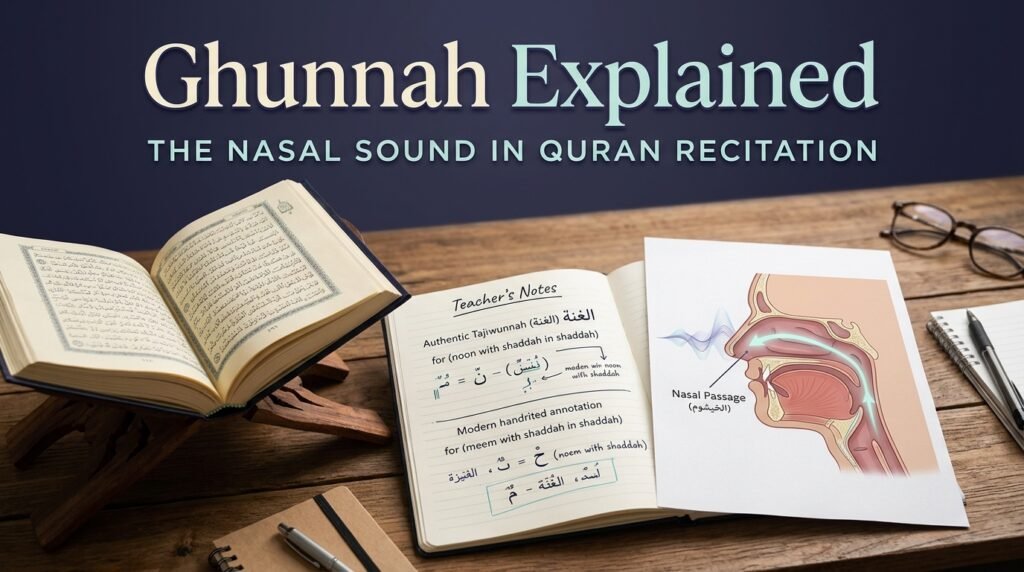
The recitation of the Holy Quran is unlike any other vocal performance or speech. It is governed by Tajweed—the science of articulating every Arabic letter from its precise point of origin (Makhraj) while granting it all of its inherent and conditional characteristics (Sifat). Among the most melodic, distinctive, and foundational attributes in the art of Tajweed is Ghunnah (الغُنَّة).
Often described in English as nasalization, resonance, or the “nasal sound,” Ghunnah gives Quranic recitation its rhythmic cadence and spiritual resonance. Whether listening to the recitation of classic masters or learning to recite Surah An-Nas for the first time, Ghunnah is omnipresent.
However, mastering Ghunnah requires more than simply humming through the nose. It involves understanding vocal anatomy, letter mechanics, varying levels of duration, and the rules of Noon and Meem. This comprehensive guide breaks down everything you need to know about Ghunnah to elevate your recitation.
1. What is Ghunnah? (Linguistic and Technical Definition)
To understand Ghunnah, classical scholars of Tajweed examined it from both a linguistic and a technical phonetic perspective:
- Linguistic Meaning: In classical Arabic lexicons, Ghunnah refers to a pleasant, sonorous sound that echoes within the nasal cavity. It was historically compared to the gentle humming sound of a dove or the cry of a young deer calling to its mother.
- Technical Tajweed Definition: Technically, Ghunnah is defined as:“An inherent, involuntary, sweet sound produced entirely from the nasal cavity (Al-Khayshoom), without any functional participation of the tongue.”
While the tongue or lips may form the initial shape of the letter, the acoustic resonance that constitutes the Ghunnah originates exclusively inside the nasal passage.
2. The Articulation Point: Al-Khayshoom (الخَيْشُوم)
In Tajweed, the five major areas of articulation (Makhaarij al-Aammah) are:
- Al-Jawf (The oral and chest cavity)
- Al-Halq (The throat)
- Al-Lisaan (The tongue)
- Ash-Shafataan (The lips)
- Al-Khayshoom (The nasal cavity)
Al-Khayshoom is the hollow opening connecting the top of the pharynx to the nostrils. It is unique among articulation points because no individual letter has its primary physical origin in the Khayshoom.
Instead, the Khayshoom produces a characteristic (Sifah): Ghunnah itself. The letters Noon (ن) and Meem (م) physically originate at the tongue and the lips, respectively, but their complete acoustic identity relies on the simultaneous acoustic release of sound through Al-Khayshoom.
3. The Two Letters of Ghunnah: Noon (ن) and Meem (م)
Ghunnah belongs intrinsically and exclusively to two letters:
- Noon (ن)
- Meem (م)
Phoneticians and Tajweed scholars explain that both Noon and Meem are dual-part letters:
- Noon (ن):
- Oral part: The tip of the tongue touching the upper gums/palate.
- Nasal part: The resonant sound flowing through the Khayshoom.
- Meem (م):
- Oral part: The upper and lower lips closing together.
- Nasal part: The resonant sound flowing through the Khayshoom.
Because of this dual nature, if you pinch your nostrils tightly while attempting to pronounce an ordinary Noon or Meem, the sound will choke and cut off completely.
4. The Duration and Measure of Ghunnah
When Ghunnah is fully extended (such as in Noon Mushaddadah or Idghaam), it requires a specific duration.
- In classical texts, this duration is measured as two Harakahs (vowel counts).
- One Harakah roughly equates to the time it takes to open or close a finger at an average pace, or the duration of pronouncing a standard short vowel (Fathah, Kasrah, or Dammah).
- Therefore, a complete Ghunnah is held for the approximate length of an Alif of elongation (Madd Asli)—roughly 1.5 to 2 seconds, calibrated to the overall tempo of your recitation (whether reciting at a fast pace like Hadr, moderate like Tadweer, or slow and deliberate like Tahqeeq).
Crucially, Ghunnah is an acoustic sound, not an elongation of an underlying vowel. It must be held with a stable, steady hum rather than a wavering or vibrating pitch.
5. The Levels of Ghunnah (Maratib al-Ghunnah)
One of the most nuanced aspects of Tajweed is understanding that Ghunnah exists in Noon and Meem at all times, but its audible strength and duration vary depending on the grammatical state of the letter.
Most scholars categorize Ghunnah into four or five hierarchical levels (Maratib). The widely taught 4-level scale (from strongest and longest to weakest and shortest) is as follows:
| Level | State of the Letter | Rules Involved | Examples | Relative Duration |
| 1. Akmal ma Takoon (Most Complete / Longest) | Mushaddad (doubled with Shaddah) & Complete Idghaam with Ghunnah | • Noon Mushaddadah • Meem Mushaddadah • Idghaam of Noon/Tanween into Noon or Meem | • إِنَّ (Inna) • عَمَّ (‘Amma) • مِن مَّال (Mim-maalin) | Full ~2 Harakahs |
| 2. Kaamilah (Complete) | Incomplete Idghaam (Naaqis) & Ikhfaa / Iqlab | • Noon/Tanween into Waw (و) or Yaa (ي) • Ikhfaa Haqeeqi (Noon into 15 letters) • Ikhfaa Shafawi (Meem before Baa) • Iqlab (Noon turning to Meem before Baa) | • مَن يَقُولُ (May-yaqool) • مِّن قَبْلُ (Min qabl) • تَرْمِيهِم بِحِجَارَةٍ (Tarmeehim bi-hijarah) • مِن بَعْدِ (Mim ba’d) | Full ~2 Harakahs (held duration) |
| 3. Naaqisah (Incomplete / Short) | Saakinah with Ith-har (Clear/Apparent) | • Noon Saakinah / Tanween before 6 throat letters • Meem Saakinah before letters other than Baa & Meem | • مَنْ آمَنَ (Man aamana) • أَنْعَمْتَ (An’amta) • هُمْ فِيهَا (Hum feehaa) | Natural body of the letter (no extra holding) |
| 4. Anqas ma Takoon (Most Incomplete / Shortest) | Mutaharrikah (Voweled with Fathah, Dammah, or Kasrah) | • Any Noon or Meem with a dynamic vowel | • نَصَرَ (Nasara) • مَلِكِ (Maliki) | Inherent acoustic origin only (instantaneous) |
Key Rule of Thumb: In Levels 1 and 2, the Ghunnah is deliberately prolonged for two counts. In Levels 3 and 4, the Ghunnah is not given extra time; it is simply heard as an indispensable phonetic part of the letter’s normal articulation.
6. Detailed Tajweed Rules Featuring Ghunnah
To apply Ghunnah accurately in daily recitation, one must look at how it manifests across the standard chapters of Tajweed:
A. Noon and Meem Mushaddadah (The Doubled Letters)
Whenever a Noon (نّ) or Meem (مّ) carries a Shaddah (w-shaped symbol of doubling), making a prolonged Ghunnah of two counts is mandatory (Wajib), regardless of whether you stop on the word or continue reciting.
- Examples:
- An-Naas: قُلْ أَعُوذُ بِرَبِّ النَّاسِ
- Thumma: ثُمَّ كَلَّا سَوْفَ تَعْلَمُونَ
B. Rules of Noon Saakinah and Tanween
When a Noon Saakinah (نْ) or Tanween (ً ٍ ٌ) meets other Arabic letters, Ghunnah behaves in three distinct ways:
- Idghaam with Ghunnah (الإدغام بغنة): When followed by one of the letters in the mnemonic يَنْمُو (Yaa, Noon, Meem, Waw), the Noon merges into the following letter accompanied by a prominent Ghunnah:
- Example: مِن وَالٍ (Miw-waal).
- Ikhfaa Haqeeqi (الإخفاء الحقيقي – Real Concealment): When followed by any of the 15 Ikhfaa letters (e.g., ت, ث, ج, د, ذ, ز, س, ش, ص, ض, ط, ظ, ف, ق, ك), the tongue prepares near the point of articulation of the upcoming letter while the sound resonates through the nose for two counts:
- Example: كُنتُمْ (Kuntum), مِن شَرِّ (Min sharri).
- Iqlab / Qalb (الإقلاب – Conversion): When followed by the letter Baa (ب), the Noon sound is completely transformed into an uncompressed Meem with a prolonged Ghunnah:
- Example: أَنۢبِئْهُم (Ambi’hum).
C. Rules of Meem Saakinah
When a silent Meem (مْ) appears:
- Idghaam Shafawi (Oral Merging): When followed by another Meem:
- Example: لَهُم مَّا يَشَاءُونَ (Lahum-maa yashaa’oon) — Full Ghunnah.
- Ikhfaa Shafawi (Oral Concealment): When followed by the letter Baa (ب):
- Example: وَمَا هُم بِمُؤْمِنِينَ (Wa maa hum bi-mu’mineen) — Full Ghunnah with light contact of the lips.
7. Tafkheem (Heavy) vs. Tarqeeq (Light) in Ghunnah
A common misconception among beginner students is that Ghunnah is always light and sweet in tone. In reality, the Ghunnah of Ikhfaa mirrors the phonetic nature of the letter that follows it:
- Heavy Ghunnah (Tafkheem): If the Ikhfaa letter following Noon Saakinah is an elevated, emphatic letter (Huroof al-Isti’laa: ص, ض, ط, ظ, ق), the mouth takes the internal shape of that heavy letter. The resulting nasal sound sounds deep, full, and dark.
- Examples:
- مِن قَبْلُ (Min qabl — resonant and deep due to Qaf)
- عَن طَبَقٍ (‘An tabaq — thick due to Taa)
- Examples:
- Light Ghunnah (Tarqeeq): If the following letter is flat/lowered (Istifaal), such as ت, س, or د, the Ghunnah remains thin, clear, and bright.
- Examples:
- إِنسَان (Insaan — light and soft)
- مَن ذَا (Man dhaa — bright and thin)
- Examples:
8. Common Mistakes to Avoid
Even dedicated students frequently fall into subtle traps regarding Ghunnah. Here are four common errors and how to correct them:
1. Nasalizing Normal Vowels (Rannat al-Khayshoom)
- The Mistake: Allowing the nasal cavity to engage when pronouncing standard vowel letters (Alif, Waw, Yaa) or general letters (like Raa or Laam). For example, pronouncing Ar-Rahmaan with a nasalized “aa” sound.
- The Fix: Practice pinching your nose while reciting words without Noon and Meem (e.g., Qaaloo, Al-Hamdu). The sound should remain completely unchanged. If the sound cuts off, your soft palate is leaking air into the nasal passage.
2. Excessive Pressing of the Lips during Meem Ikhfaa
- The Mistake: Squeezing the lips tightly during Ikhfaa Shafawi or Iqlab, causing unnatural tension.
- The Fix: The lips should meet gently and naturally without clamping (Kazz al-Shafatayn), allowing the sound to resonate smoothly.
3. Fluctuating or Rhythmic Trilling of the Voice
- The Mistake: Shaking the voice or creating an artificial melodic vibrato during the two counts of Ghunnah.
- The Fix: Keep the airflow and pitch dead flat and sustained. Treat the Ghunnah as a stable stream of sound.
4. Over-extending or Under-extending Duration
- The Mistake: Holding an Ikhfaa for three or four counts like a major Madd, or rushing through a Noon Mushaddadah in a single quick count.
- The Fix: Maintain a disciplined two-count duration consistent with your overall recitation tempo.
Conclusion
Ghunnah is far more than a simple nasal hum; it is a meticulously calibrated science that bridges physical anatomy, phonetic balance, and vocal aesthetics. By understanding where Ghunnah originates (Al-Khayshoom), learning its varying degrees (Maratib), and honoring its tonal colors (heavy vs. light), reciters can preserve the authentic, divine beauty of the Quran as revealed to the Prophet Muhammad ﷺ.
To perfect your Ghunnah, listen closely to authorized reciters (Qurraa), practice with conscious control of your nasal airflow, and read before a qualified Tajweed teacher who can detect and correct subtle nasal leaks.