
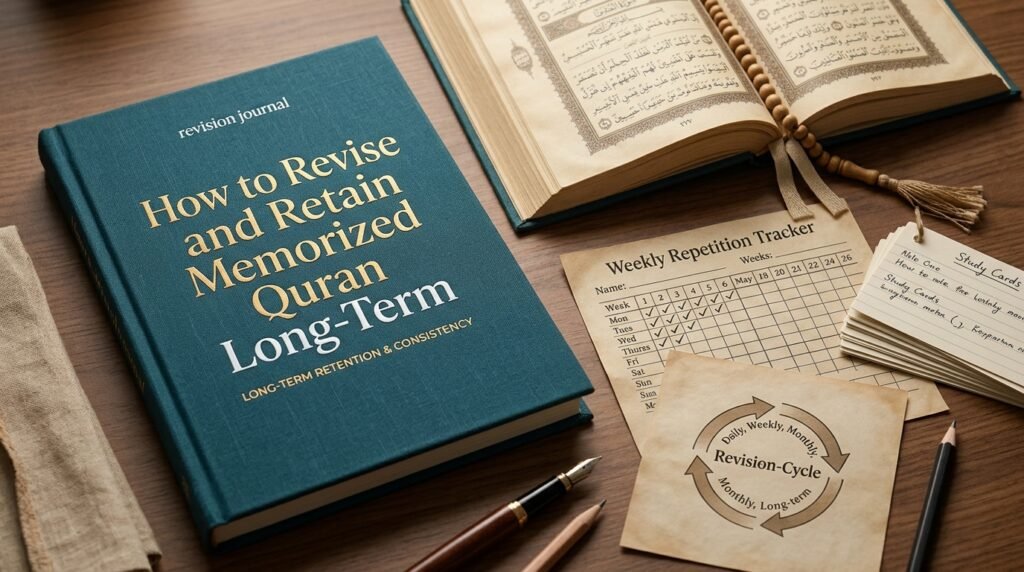
Completing the memorization of the Holy Quran (Hifz) is a profound spiritual achievement, but it marks the beginning of an equally demanding endeavor: retention. Classical Islamic scholarship and modern cognitive science converge on a single reality—human memory decays without deliberate, structured reinforcement.
The Prophet Muhammad ﷺ emphasized this dynamic nature of memorization, comparing it to an untethered camel:
“Keep refreshing your knowledge of the Quran, for by Him in Whose Hand is my soul, it slips away faster than a camel from its binding.” (Sahih al-Bukhari)
Safeguarding the Quran in your heart for decades requires moving beyond ad-hoc reading. It demands a systematic framework built on structured revision tiers, cognitive retrieval practices, and psychological endurance.
1. The Anatomy of Quranic Memory Decay
To build an effective retention system, you must first understand why memorized portions (ajza) fade. Quranic memory loss typically stems from three structural issues:
- Passive Review vs. Active Retrieval: Reading directly from the Mushaf while reviewing creates an illusion of competence. Your brain recognizes the text visually, leading you to believe it is firmly stored. Real retention only occurs during the strain of reciting from memory (ghayb).
- The “Mutashabihat” Trap: The Quran contains thousands of similar verses (Mutashabihat), where wording varies by a single preposition, letter, or sequence. Without deliberate comparative study, the brain conflates these verses, leading to hesitation and errors across different Surahs.
- Disproportionate Focus on New Portions: A common pitfall during and immediately following Hifz is prioritizing newly learned verses while neglecting older portions. Memory consolidates into long-term storage only through spaced retrieval over months and years.
2. The Core Three-Tier Revision System
A sustainable revision routine divides daily work into three distinct categories. This structure ensures that both recently acquired and older memorization receive the exact depth of reinforcement they need.
+-------------------------------------------------------------+
|                     DAILY HIFZ ROUTINE                      |
+------------------------------+------------------------------+
| 1. Sabaq (New Memorization)  | Recent verses / pages        |
+------------------------------+------------------------------+
| 2. Sabqi (Recent Revision)   | Last 5–20 pages memorized    |
+------------------------------+------------------------------+
| 3. Manzil / Dhor (Old Rev.)  | Fixed cycle of the full text |
+------------------------------+------------------------------+
Tier 1: Sabaq (The New Memorization)
If you are still memorizing new sections, this is your daily target (typically 1 to 2 pages). It requires deep phonetic focus, understanding the meaning, and repeating each verse 20 to 30 times until it flows without hesitation.
Tier 2: Sabqi / Amukhta (The Near Revision)
This covers the verses memorized in the last 15 to 30 days—typically the preceding half-Juz’ to one full Juz’.
- This is where memory is most fragile. It has not yet migrated into permanent long-term storage.
- The Rule: You must recite this section entirely from memory daily to a teacher, a partner, or into a voice recorder before touching any new portion.
Tier 3: Manzil / Dhor (The Cumulative Cycle)
This is your master revision cycle covering the entire portion of the Quran you have memorized to date.
- For a full Hafiz, the minimum standard for solid retention is one Juz’ per day (completing a full cycle every 30 days).
- For exceptional fluency, aim for two to three Ajza’ per day, recycling the entire Quran every 10 to 15 days.
- If you have memorized 5, 10, or 15 Ajza’, scale the cycle proportionally so you review your entire memorization at least twice a month.
3. Designing a Sustainable Daily Schedule
Consistency outperforms volume. A fragmented, unsustainable routine of 3 hours per day that collapses after two weeks is vastly inferior to an unbreakable 60-minute daily commitment.
| Time Slot | Segment | Target Material | Practical Application |
| Post-Fajr (45–60 mins) | Primary Manzil (Dhor) | 1 full Juz’ (or your primary quota) | Mental clarity is at its peak. Recite aloud from memory in a quiet room. |
| Midday / Asr (20–30 mins) | Error Correction & Mutashabihat | Problematic passages identified at Fajr | Open the Mushaf. Inspect every mistake, check root causes, and write down differences. |
| Maghrib / Isha / Sunnah | Application in Salah | Portions reviewed that morning | Recite your daily Manzil during Tahajjud, Sunnah, and Nawafil prayers. |
4. Evidence-Based Revision Strategies
To maximize retention while minimizing wasted time, integrate these proven cognitive techniques into your Quranic study.
Use a Single Mushaf Edition
Visual memory (eidetic mapping) plays a massive role in Quranic retention. Your mind unconsciously notes whether an Ayah begins at the top, middle, or bottom of a page, as well as the page number and neighboring text.
- Stick strictly to one print layout throughout your life—most commonly the 15-line standard Madinah Mushaf.
- Avoid switching between digital fonts, multi-translation layouts, and varying physical print sizes.
Active Recall in Voluntary Prayers (Nawafil)
Reciting while sitting comfortably at a desk is far easier than reciting standing upright in prayer. Incorporating your daily revision into Sunnah, Tahajjud, and Qiyam al-Layl forces your brain to retrieve verses under genuine focus:
- Split your daily Juz’ across the 12 daily Sunnah Mu’akkadah prayers and night prayers.
- Standing in prayer eliminates casual physical distractions, exposing subtle hesitations in your memorization that you might otherwise overlook.
The Auditory Loop (Record and Self-Audit)
When reciting to yourself, your brain often auto-corrects mistakes in real time, skipping syllables or vowels without your conscious awareness.
- Record your recitation on your phone while reciting strictly from memory.
- Play back the recording while holding the Mushaf and tracking along with a pen.
- Note every misplaced Harakah (vowel marker), dropped Waw, or missed Ghunnah.
5. Master the Mutashabihat (Similar Verses)
The greatest test of long-term retention is resolving similar passages across different Surahs. Unresolved Mutashabihat lead to accidental transitions—jumping mid-Ayah from Surah Al-Baqarah into Surah Al-A’raf without realizing it.
Practical Rules for Navigating Mutashabihat:
- Anchor Points: When two verses are nearly identical with a slight variation, anchor the first occurrence firmly. Master its exact wording before analyzing the second.
- Contextual Linking: Understand why the wording differs based on the surrounding story or grammatical theme of the Surah. For example, note where an extra adjective matches the thematic emphasis of that specific chapter.
- Dedicated Marginal Notes: Use a dedicated study Mushaf to lightly pencil cross-references in the margin (e.g., write “See Surah Al-Imran 3:137” beside an Ayah in Al-An’am).
- Compile a Personal Mutashabihat Notebook: Whenever you stumble between two similar verses, stop immediately. Write both verses side-by-side in a physical journal, highlighting the diverging word or letter in a distinct color.
6. Overcoming the Psychological and Spiritual Hurdles
Maintaining Hifz is a marathon that spans decades. Experiencing periods of sluggishness, forgetfulness, and frustration is universal.
Decouple Guilt from Practical Action
Discovering that you have forgotten a Juz’ you previously knew well can trigger deep shame. However, paralysis through guilt only widens the gap in your memory. Treat forgotten portions as an administrative task: schedule them into your Sabqi block, rebuild them page by page, and cycle through them systematically. The neural pathways are still there; reactivating them takes a fraction of the time required to learn them initially.
Find an Accountability Partner (Mu’allim or Peer)
Human accountability is irreplaceable. Self-revision will inevitably overlook minor errors.
- Partner with another Hafiz to listen to your daily revision.
- Recite alternately: you recite one page, they recite the next.
- Maintain a regular weekly or bi-weekly check-in with a qualified teacher who holds an Ijazah to preserve precision in Tajweed alongside pure recall.
The Lifetime Mindset
The Quran is not meant to be memorized once, certified, and left on a shelf. The need for constant revision is an intentional feature of the text, designed to keep you in daily, lifelong communion with the words of Allah.
Structure your revision tiers clearly, commit to your daily Manzil without compromise, verify your Mutashabihat deliberately, and embed your memorization into your daily prayers. With systematic discipline, retaining the entire Quran becomes an effortless, natural part of your daily rhythm for the rest of your life.