
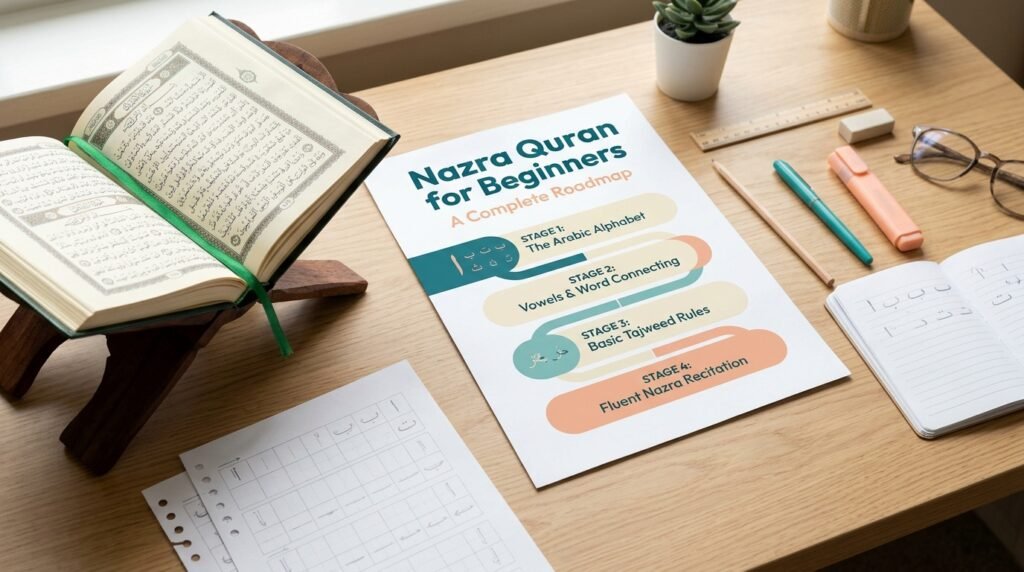
Learning to recite the Holy Quran in its original Arabic language is one of the most spiritually rewarding journeys a Muslim can embark upon. For many non-native Arabic speakers, children, and adult reverts, opening the Quran for the first time can feel overwhelming. The flowing script, unique diacritical marks, and distinct phonetic rules seem complex.
However, reciting the Quran does not require prior fluency in the Arabic conversational language. This foundational reading practice is known as Nazra Quran—the art and discipline of reading the Quran by looking directly at the text with correct pronunciation.
Whether you are starting from zero or helping your child take their first steps, this comprehensive roadmap outlines every phase needed to progress from letter recognition to fluent, beautiful recitation.
What Is Nazra Quran?
The term Nazra (ناظرہ) derives from the Arabic root word meaning “to look” or “to view.” In Islamic educational tradition, Nazra Quran refers specifically to reading the Quran by sight directly from the printed Mushaf (or digital display), as distinguished from Hifz (حفظ), which is memorizing the text by heart.
The core objective of Nazra is accurate decoding and recitation:
- Recognizing each of the 28 Arabic letters in all their connected shapes.
- Applying Arabic short and long vowels accurately.
- Joining syllables smoothly to pronounce full words and sentences.
- Observing essential pausing (Waqf) and phonetic rules (Tajweed).
Reciting the Quran correctly holds immense spiritual value. The Prophet Muhammad (peace be upon him) said:
“The one who recites the Quran proficiently will be with the noble, obedient scribes (angels), and the one who recites the Quran and falters in it, finding it difficult, will have a double reward.” (Sahih Muslim)
Phase 1: Mastering the Arabic Alphabet (Al-Mufradat)
Every language begins with phonetics, and Arabic is no exception. The Holy Quran is written in Classical Arabic (Fus’ha), which consists of 28 distinct consonants.
1. Isolated Letter Recognition
Beginners must first learn the isolated forms of each letter from Alif (ا) to Yaa (ي). Do not rush this phase. Many letters share identical structural shapes and are differentiated only by the placement and count of dots (Nuqta):
- Baa (ب), Taa (ت), and Thaa (ث)
- Jeem (ج), Haa (ح), and Khaa (خ)
- Daal (د) and Dhaal (ذ)
- Raa (ر) and Zaa (ز)
- Seen (س) and Sheen (ش)
- Saad (ص) and Daad (ض)
- Taa (ط) and Zaa (ظ)
- Ayn (ع) and Ghayn (غ)
- Faa (ف) and Qaaf (ق)
2. Articulation Points (Makharij al-Huroof)
Arabic features several guttural and emphatic sounds that do not exist in the English alphabet. It is essential to understand the point of origin (Makhraj) for each letter:
- Throat Letters (Huroof al-Halqiyyah): ء, هـ, ع, ح, غ, خ
- Tongue Letters (Huroof al-Lisaan): ق, ك, ج, ش, ي, ض, ل, ن, ر, ط, د, ت, ص, ز, س, ظ, ذ, ث
- Lip Letters (Huroof ash-Shafawiyyah): ف, ب, م, و
- Nasal Cavity (Al-Khayshoom): Used for nasalization (Ghunnah).
Distinguishing between pairs like Haa (ح) vs. Haa (هـ), Taa (ت) vs. Taa (ط), and Seen (س) vs. Saad (ص) early on prevents deeply ingrained mispronunciations later.
Phase 2: Letter Connections and Compounds (Al-Murakkabat)
Unlike English printed text, Arabic is written in cursive script from right to left. Letters change their visual shapes depending on their position within a word:
- Initial: At the start of a word.
- Medial: Connected between two letters in the middle.
- Final: At the end of a word.
- Non-connecting letters: Six letters never connect to the letter that follows them: Alif (ا), Daal (د), Dhaal (ذ), Raa (ر), Zaa (ز), and Waw (و).
Using classic pedagogical primers like the Noorani Qaida or Madani Qaida, learners practice compound formations (Murakkabat) such as:
- Lam-Alif (لا)
- Baa-Alif (با)
- Noon-Khaa-Taa (نخت)
Learning to identify letters by their distinctive heads, stems, and dots rather than their full isolated tails is the primary breakthrough in this phase.
Phase 3: Short and Long Vowels (Harakat and Maddah)
Arabic letters themselves represent consonants. To produce continuous speech, diacritical vowel marks (Harakat) are placed above or below the letters.
       Arabic Vowel Overview
  ┌───────────────────────────────┐
  │  Short Vowels (Harakat)       │
  │  - Fathah (ـَ)  -> /a/ sound  │
  │  - Kasrah (ـِ)  -> /i/ sound  │
  │  - Dammah (ـُ)  -> /u/ sound  │
  └──────────────┬────────────────┘
                 │
  ┌──────────────▼────────────────┐
  │  Long Vowels (Huroof al-Madd) │
  │  - Fathah + Alif  -> /aa/     │
  │  - Kasrah + Yaa   -> /ee/     │
  │  - Dammah + Waw   -> /oo/     │
  └───────────────────────────────┘
1. Short Vowels (Harakat)
- Fathah (ـَ): A small diagonal stroke placed above a letter, making a short “a” sound (as in “cup”).
- Kasrah (ـِ): A small diagonal stroke placed below a letter, making a short “i” sound (as in “fit”).
- Dammah (ـُ): A small apostrophe-like loop above a letter, making a short “u” sound (as in “put”).
Rule of thumb: Never stretch short vowels; they are pronounced quickly and crisply without elongation.
2. Tanween (Double Vowels)
Tanween indicates an unwritten final “N” sound produced at the end of a noun:
- Fathatayn (ـً): Double Fathah, pronounced “-an”.
- Kasratayn (ـٍ): Double Kasrah, pronounced “-in”.
- Dammatayn (ـٌ): Double Dammah, pronounced “-un”.
3. Sukoon / Jazm (Rest / Absence of Vowel)
Represented by a small crescent or circle (ـْ) above a letter, the Sukoon denotes that the consonant carries no vowel. It connects directly to the preceding voweled letter, forming a single closed syllable (e.g., مَنْ = Man).
4. Shaddah / Tashdeed (Emphasis)
Represented by a small “w” shape (ـّ) above a letter, Tashdeed doubles the consonant. The first instance of the letter carries an implied Sukoon, while the second carries the accompanying vowel (e.g., رَبِّ = Rab-bi).
5. Letters of Elongation (Huroof al-Madd)
When an unvoweled letter of elongation (Alif, Yaa Sakinah, or Waw Sakinah) follows a corresponding short vowel, the sound is stretched for two counts (Harakat):
- Fathah followed by Alif: بَا (Baa)
- Kasrah followed by Yaa: بِي (Bee)
- Dammah followed by Waw: بُو (Boo)
Phase 4: Foundational Rules of Tajweed
Tajweed literally means “beautification” or “doing something with excellence.” In the context of the Quran, it refers to reciting every letter according to its inherent rights and characteristics. While comprehensive Tajweed study takes years, beginners must master a few core rules during their Nazra training:
1. Rules of Noon Sakinah and Tanween
When an unvoweled Noon (نْ) or Tanween meets another letter, it takes one of four forms:
- Izhar (Clear Expression): Pronounce clearly if followed by a throat letter (ء, هـ, ع, ح, غ, خ).
- Idgham (Assimilation): Merge into the next letter if followed by any letter in the word يرملون (Yaa, Raa, Meem, Laam, Waw, Noon).
- Iqlab (Conversion): Convert the Noon sound into a gentle “Meem” with nasalization if followed by Baa (ب).
- Ikhfaa (Concealment): Soften and hide the Noon sound inside the nasal passage for all remaining 15 letters.
2. Rules of Meem Sakinah (مْ)
- Idgham Shafawi: Merging into another Meem.
- Ikhfaa Shafawi: Soft closure of lips if followed by Baa.
- Izhar Shafawi: Clear pronunciation before all other 26 letters.
3. Qalqalah (Echoing / Bouncing Sound)
When any of the five letters of ق, ط, ب, ج, د (memorized by the mnemonic Qutb Jad) carry a Sukoon, their release must produce an echoing bounce rather than an abrupt full stop.
4. Heavy and Light Letters (Tafkheem and Tarqeeq)
Seven letters are always pronounced with a full, heavy mouth: خ, ص, ض, غ, ط, ق, ظ (grouped as Khussa Daghtin Qizh). Letters like Laam (ل) and Raa (ر) alternate between heavy and light depending on the surrounding vowels.
Phase 5: Pausing Marks and Quranic Orthography (Waqf)
The printed Quran features punctuation and pause symbols placed above the script to guide the reader on where to pause, continue, or stop:
| Symbol | Name | Meaning | Action to Take |
| مـ | Waqf Lazim | Compulsory Stop | You must stop; continuing can alter the intended meaning. |
| ط | Waqf Mutlaq | Recommended Stop | Excellent place to take a breath. |
| ج | Waqf Ja’iz | Permissible Stop | You may stop or continue freely. |
| ز | Waqf Mujawwaz | Permissible but Better to Continue | Continuing is preferred. |
| ص | Waqf Murakh-khas | Conditional Stop | Stop only if running out of breath. |
| لا | Laa | Do Not Stop | Do not stop here unless at the end of an Ayah. |
| ∴ ∴ | Mu’anaqah | Embracing Stop | Two sets of three dots. You may stop at one, but never at both. |
How to pause on a word: When stopping at the end of an Ayah or a Waqf mark, the final vowel of the word is generally dropped and pronounced with a Sukoon, except for Fathatayn (ـً), which transitions into a two-count Alif elongation (Madd Iwad).
Phase 6: Transitioning to the Full Mushaf
After successfully finishing a foundation primer (like the Noorani Qaida), it is time to transition into the Quran itself:
1. Start with the 30th Juz (Juz Amma)
Do not start at Surah Al-Baqarah. Begin with Surah Al-Fatihah, followed by the shortest Surahs at the end of Juz 30 (from Surah An-Nas upward through Surah Al-Fil). These short verses make it easier to practice breath control, repetitive rhyming structures, and fundamental rules without fatigue.
2. Choose the Right Script Type
There are two major Quranic scripts in circulation:
- Indo-Pak / Persian Script: Characterized by bold, dark calligraphy with extensive helper symbols. Highly popular in South Asia.
- Uthmani / Madinah Script: The standard script published by the King Fahd Quran Printing Complex. Elegant, spacious, and common worldwide.
Tip: Pick one script and stick with it consistently throughout your beginner phase to avoid visual confusion.
3. Use Color-Coded Tajweed Qurans
Color-coded Mushafs visually highlight Tajweed rules directly on the page (e.g., green for Ghunnah, orange for Ikhfaa, red for long elongations, blue for Qalqalah). This provides instant visual feedback while you read.
Practical Daily Study Routine for Beginners
Consistency is far more impactful than marathon study sessions. A focused 30-minute daily routine produces rapid, noticeable progress:
                  Daily 30-Minute Schedule
  ┌────────────────────────────────────────────────────────┐
  │  00 - 05 min : Vocal Warm-up & Makharij Review         │
  │  05 - 15 min : Reading New Verses (Slow Pace)          │
  │  15 - 22 min : Audio Verification (Listening to Qari)   │
  │  22 - 30 min : Repetitive Review of Previous Pages     │
  └────────────────────────────────────────────────────────┘
- Minutes 0–5 (Warm-up): Recite Surah Al-Fatihah slowly. Practice stretching long vowels and engaging the throat letters cleanly.
- Minutes 5–15 (New Reading): Read 3 to 5 new verses. Point your finger or a pointer pencil underneath each letter as you pronounce it. Decode word by word.
- Minutes 15–22 (Listen & Compare): Listen to a world-renowned Murattal reciter (such as Sheikh Mahmud Khalil Al-Husary or Sheikh Minshawi). Pause after each verse and repeat it out loud, mirroring their exact pitch and articulation.
- Minutes 22–30 (Review & Consolidation): Re-read the previous day’s verses. Fluency comes from reading familiar text repeatedly until the eye recognizes word patterns instantly.
Common Beginner Mistakes to Avoid
- Rushing Before Decoding: Trying to read fast too early leads to skipping diacritics and slurring short vowels. Read slowly, deliberately, and rhythmically.
- Breathing In Mid-Word: Never take a breath in the middle of a word or between closely linked grammatical compounds. If you run out of breath, stop on the word cleanly, catch your breath, and backtrack one or two words before continuing.
- Relying on English Transliterations: Latin letters cannot accurately represent sounds like ع, ح, ط, or ص. Relying on romanized text hinders authentic Arabic letter recognition and harms pronunciation.
- Studying Solely in Isolation: The Quran is fundamentally an oral tradition passed down through recitation. While mobile apps and videos are helpful supplements, reading out loud to a qualified Quran teacher (Qari or Ustadha) for periodic correction is irreplaceable.
Conclusion
Learning Nazra Quran is a sacred, rewarding milestone. While the initial weeks require patient concentration to decipher unfamiliar shapes and sounds, each letter brings you closer to the words of your Creator. Celebrate your small daily wins—from mastering your first compound letter to finishing your first short Surah with complete Tajweed.
Establish your daily routine, stay patient through the learning curves, and let your journey of Quranic recitation begin today.