
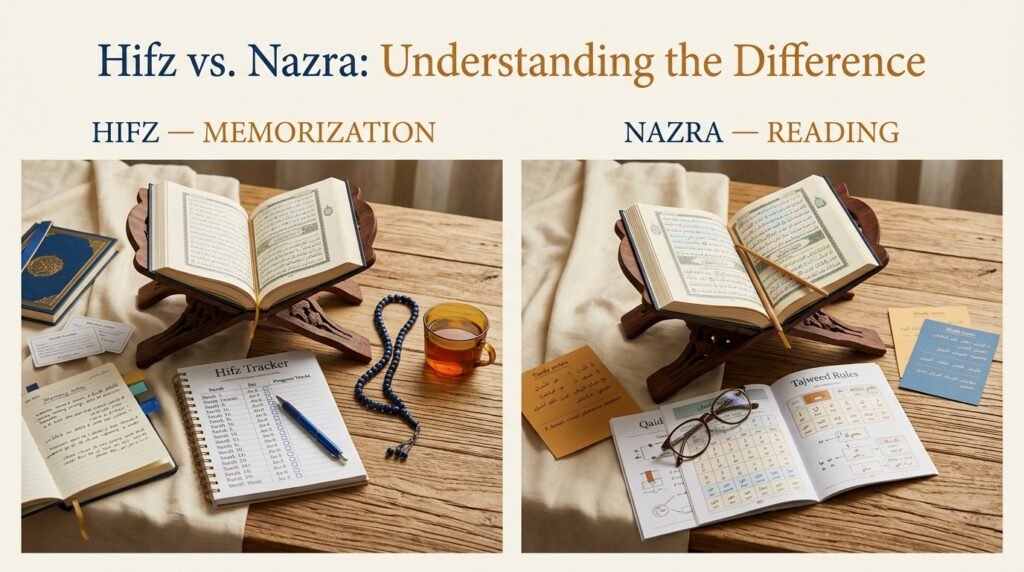
Embarking on the journey of Quranic education is one of the most rewarding endeavors a Muslim—child or adult—can undertake. Yet, parents and new students often face an immediate dilemma: Where should we begin? Should a learner start by reciting the Quran by sight (Nazra) or dive straight into complete memorization (Hifz)?
While the desire to have a child become a Hafiz (guardian/memorizer of the Quran) early in life is deeply cherished, Quranic pedagogy follows a clear, progressive path. Attempting to accelerate memorization without laying the foundational groundwork often leads to pronunciation errors, frustration, and burnout.
This comprehensive guide breaks down the core distinctions between Nazra and Hifz, explores cognitive and spiritual prerequisites, and outlines the recommended sequence to build a sustainable, lifelong relationship with the Book of Allah.
1. Defining the Terms: Nazra vs. Hifz
To understand the correct progression, we must first clarify what each discipline entails.
What is Nazra Quran?
Nazra (ناظرة) translates literally to “looking” or “viewing.” In the context of Quranic education:
- It refers to reading the Quran by looking at the Arabic text directly.
- The primary focus is not rote recall, but phonetic accuracy, fluency, recognition of script, and practical application of Tajweed (the science of correct pronunciation and recitation).
- Before reading the full Mus’haf, students typically master the Noorani Qaida or equivalent phonetic primers, learning Arabic letterforms, vowel markings (Harakat), elongation rules (Madd), and stop signs (Waqf).
What is Hifz Quran?
Hifz (حفظ) translates to “preserving” or “protecting.” In Islamic tradition:
- It refers to the complete memorization of the Quranic text by heart.
- A student who memorizes all 30 Juz (114 Surahs) earns the title of Hafiz (male) or Hafiza (female).
- Hifz requires a disciplined, multi-layered system involving new lessons (Sabaq), recent revisions (Sabqi), and cumulative long-term retention (Manzil or Dhor).
2. Core Differences at a Glance
| Factor | Nazra Quran | Hifz Quran |
|---|---|---|
| Primary Goal | Flawless reading by sight with Tajweed | Complete mental retention and recall |
| Prerequisites | Arabic alphabet recognition & basic vowels | Fluent Nazra, Tajweed mastery, disciplined memory |
| Daily Time Commitment | 20 to 45 minutes | 2 to 5+ hours (including rigorous revision) |
| Typical Duration | 6 to 18 months | 2 to 4+ years |
| Cognitive Demand | Visual decoding and phonetic articulation | Heavy memory consolidation, pattern recall, focus |
| Role in Islamic Practice | Obligatory foundation for daily prayers (Salah) | Communal obligation (Fard Kifayah); high spiritual virtue |
3. Which Should You Start First?
The definitive pedagogical and scholarly consensus is clear: Nazra must always precede Hifz.
Attempting Hifz without first mastering Nazra is like attempting to write essays before learning the alphabet and basic spelling. Here is why Nazra is an absolute prerequisite:
1. Correct Tajweed Prevents Ingrained Mistakes
The Arabic language is phonetically sensitive. Altering a slight sound—such as confusing ح (Haa) with هـ (Haa), or ع (‘Ayn) with أ (Alif)—can fundamentally change the meaning of a verse:
- Saying Qalb (قلب) means “heart.”
- Saying Kalb (كلب) means “dog.”
When a child attempts to memorize without sight-reading and Tajweed rules firmly established, they memorize phonetic errors. Unlearning an incorrectly memorized verse requires three times the effort of learning it correctly the first time. Nazra equips the tongue to produce sounds accurately from their points of articulation (Makharij).
2. Visual Memory Accelerates Retention
Memorization is not purely auditory; it relies heavily on visual anchoring. A student who can fluidly read the script forms a mental photograph of the page (the layout of lines, verse markers, and chapter transitions). Without fluent Nazra, a learner relies entirely on audio imitation, which is far slower and prone to lapses.
3. Independence and Confidence
A child who knows Nazra can practice Hifz independently. They can sit with the Mus’haf, read the new portion repeatedly, and prepare their lesson before reciting it to their teacher. A child lacking Nazra remains entirely dependent on a tutor repeating each phrase word by word.
4. When Is a Student Ready to Transition to Hifz?
Completing a single read-through of the Quran does not automatically mean a student is ready for intensive Hifz. Before enrolling a child or embarking on the journey yourself, assess the following criteria:
The Readiness Checklist
- [ ] Effortless Sight-Reading: Can the student open any random page of the Mus’haf and read half a page without stumbling or stuttering?
- [ ] Automatic Tajweed: Are basic Tajweed rules (e.g., Ghunnah, Ikhfa, Qalqalah, elongation) applied instinctively without the teacher needing to point them out?
- [ ] Retention of Short Surahs: Can the student easily memorize and retain a short Surah (such as Surah Al-Mulk or selections from Juz Amma) within a couple of days?
- [ ] Emotional and Mental Maturity: Does the student have the attention span to sit focused for at least 45 to 60 minutes at a time?
- [ ] Personal Motivation: Does the student express a genuine interest or willingness, or is the process entirely forced? (Forced Hifz often results in resentment and eventual loss of memorization).
5. Ideal Age Guidelines and Staged Roadmap
Quranic mastery is best approached in systematic phases:
[Phase 1: Ages 4–6]   Basic Arabic Foundations (Qaida & Phonetics)
          ↓
[Phase 2: Ages 6–8]   Nazra Mastery & Basic Memorization (Juz Amma)
          ↓
[Phase 3: Ages 8–14]  Full Hifz Program (Intensive Memorization & Revision)
          ↓
[Phase 4: Lifelong]   Dhor (Maintenance), Tafseer, and Implementation
Phase 1: Foundational Literacy (Ages 4 to 6)
- Goal: Letter recognition, vowel signs, and short word formation.
- Material: Noorani Qaida, Madani Qaida, or similar introductory primers.
- Focus: Engaging, stress-free exposure to sounds and rhythm. Memorize short daily supplications (Duas) and the final 10 Surahs through listening.
Phase 2: Nazra and Fluency (Ages 6 to 8)
- Goal: Completing the entire Quran by sight once or twice.
- Focus: Developing speed and phonetic confidence. Memorize Juz 30 (Juz Amma) to test retention capacity and routine building.
Phase 3: The Golden Window for Hifz (Ages 8 to 14)
- Goal: Full Quran memorization.
- Why this window? Children in this age bracket have heightened neuroplasticity, strong auditory and visual recall, and fewer academic or life responsibilities.
- Format: Enrolling in a structured Madrasah, full-time program, or dedicated daily online tutoring.
6. What About Adults? Can You Start Hifz Later?
A common misconception is that Hifz is only for children. While children memorize faster, adults possess superior conceptual understanding, intrinsic motivation, and conscious spiritual dedication.
For an adult asking whether to start Nazra or Hifz:
- Start with a Tajweed & Nazra Audit: Spend 3 to 6 months with a qualified Qari to evaluate your recitation. Correct subtle pronunciation mistakes.
- Begin Partial Memorization: Focus on selected chapters with special virtues (e.g., Surah Al-Baqarah, Al-Kahf, Ya-Sin, Al-Mulk) before deciding whether a full 30-Juz Hifz is realistic alongside work and family obligations.
- Consistency Over Volume: Memorizing 3 to 5 verses daily with rock-solid retention is vastly superior to rushing through pages that are forgotten the following week.
7. Common Pitfalls to Avoid
- Rushing into Hifz Too Early: Pushing a 5-year-old into full memorization before they can read independently usually backfires, creating anxiety and a negative association with the Quran.
- Neglecting Revision (Dhor): Memorizing new verses is only 20% of Hifz; 80% of the effort must go toward retaining previously learned sections. Without a system for daily review, memorized portions fade quickly.
- Using Multiple Mushaf Prints: Always use a single, standardized edition (such as the standard 15-line or 16-line Medina/South Asian script). Switching prints disrupts visual memory.
- Treating Completion as the Finish Line: Hifz is not a temporary project with an end date; it is a lifetime commitment to daily revision and reflection.
Conclusion: The Balanced Approach
The question is rarely an “either/or” choice, but rather a matter of order and timing.
Nazra is the vehicle; Hifz is the destination.
Prioritize mastering Nazra first. Ensure the tongue flows naturally with correct Tajweed, the eyes recognize the script effortlessly, and the heart feels at ease with the rhythm of the text. Once that foundation is solid, the transition into Hifz becomes smoother, faster, and infinitely more fruitful.