
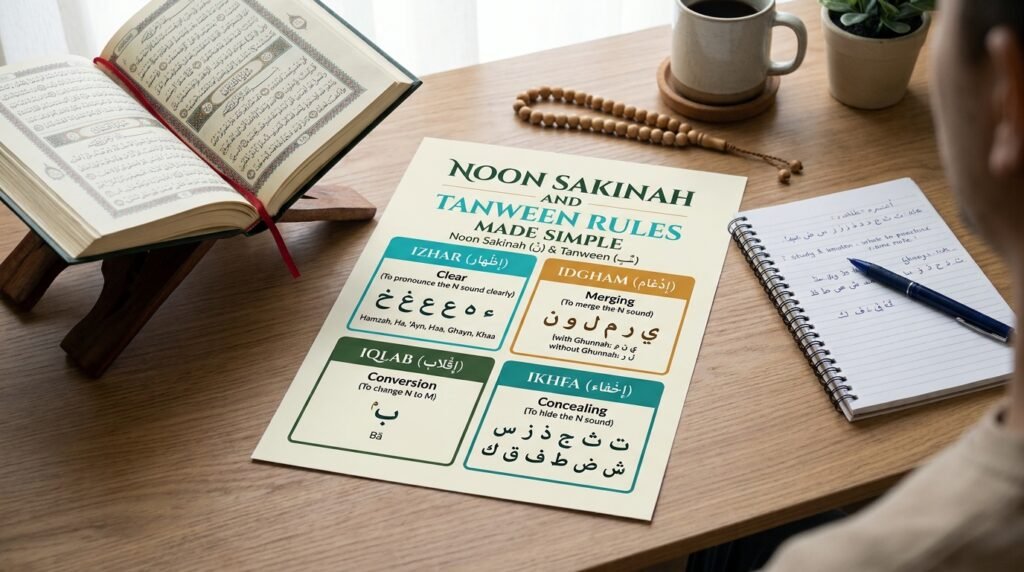
Reciting the Quran with correct pronunciation and rhythm—known as Tajweed—is essential for preserving the meaning and sanctity of the divine text. Among the first foundational concepts every learner encounters are the rules of Noon Sakinah and Tanween.
Though Arabic grammar and phonetics can seem intimidating at first glance, these rules follow systematic vocal mechanics. Once you understand the sound changes that occur when an unvoweled Noon meets other Arabic letters, reciting fluently becomes second nature.
1. What Are Noon Sakinah and Tanween?
Before diving into the four rules, we must understand the two sounds at the center of this chapter of Tajweed:
Noon Sakinah (نْ)
Noon Sakinah is a letter Noon that carries a Sukun (a symbol indicating the absence of a short vowel: Fathah, Kasrah, or Dammah). It is an unvoweled N sound ($N$).
- It is permanent: written in the text and pronounced both when continuing recitation and when stopping.
- It can occur in nouns, verbs, or particles, either in the middle or at the end of a word.
Tanween (ً ٍ ٌ)
Tanween consists of double vowel markings:
- Fathatayn (ـً) producing an “-an” sound.
- Kasratayn (ـٍ) producing an “-in” sound.
- Dammatayn (ـٌ) producing an “-un” sound.
Phonetically, a Tanween is simply a short vowel followed immediately by an extra, unwritten Noon Sakinah sound. Because Tanween produces the exact same acoustic profile as an unvoweled Noon, it shares the exact same rules of pronunciation.
The Mechanism
Whenever a Noon Sakinah (نْ) or a Tanween appears, your pronunciation will depend entirely on the letter immediately following it. Depending on that succeeding letter, the N sound will undergo one of four transformations:
- Izhar (Clear Pronunciation)
- Idgham (Merging / Assimilation)
- Iqlab (Conversion to Meem)
- Ikhfa (Concealment / Nasal Hiding)
2. Rule 1: Izhar (الإظهار) – Making It Clear
Meaning and Concept
Linguistically, Izhar means “clarity” or “to make apparent.” In Tajweed, it means pronouncing the Noon Sakinah or Tanween from its natural point of articulation (Makhraj) cleanly, sharply, and distinctly, without elongating the nasal hum (Ghunnah).
The Letters of Izhar (The Throat Letters)
There are 6 letters of Izhar, often called the Huroof al-Halq (Throat Letters), because they originate from the vocal cords, middle throat, and upper throat:
- Hamzah (ء)
- Haa (هـ)
- ‘Ayn (ع)
- Haa (ح)
- Ghayn (غ)
- Khaa (خ)
A classic Arabic mnemonic to memorize these letters is:
أَخِي هَاكَ عِلْمًا حَازَهُ غَيْرُ خَاسِرٍ
(The first letter of each word represents one of the six throat letters).
How to Pronounce It
Simply pronounce the clean “N” sound by touching the tip of your tongue to the roof of your mouth behind your upper front teeth. Do not linger, stretch, or suppress the sound. Move briskly to the throat letter.
Quranic Examples
- Noon Sakinah in one word:
- يَنْهَوْنَ (Yan-hawna) – The Noon Sakinah is followed by هـ (Haa). Pronounce the “n” crisply.
- الأَنْعَامَ (Al-An‘aam) – The Noon Sakinah is followed by ع (‘Ayn).
- Noon Sakinah between two words:
- مِنْ خَوْفٍ (Min khawf) – The Noon Sakinah at the end of Min meets خ (Khaa).
- Tanween:
- عَلِيمٌ حَكِيمٌ (‘Aleemun Hakeem) – The Tanween meets ح (Haa).
- كُفُوًا أَحَدٌ (Kufuwan Ahad) – The Tanween meets ء (Hamzah).
3. Rule 2: Idgham (الإدغام) – Merging and Blending
Meaning and Concept
Linguistically, Idgham means “insertion” or “merging.” Technically, it is the merging of an unvoweled letter into a voweled letter, turning them into a single, emphasized letter carrying a Shaddah (ّ).
When a Noon Sakinah or Tanween is followed by an Idgham letter, the N sound is dropped, and your tongue transitions directly into the sound of the following letter.
Crucial Exception: Idgham only occurs between two separate words. If a Noon Sakinah is followed by an Idgham letter within the same single word, it must be pronounced clearly (Izhar Mutlaq). This occurs in only four words across the entire Quran:
الدُّنْيَا (Ad-Dunya), بُنْيَانٌ (Bunyan), قِنْوَانٌ (Qinwan), and صِنْوَانٌ (Sinwan).
The Letters of Idgham
There are 6 letters of Idgham, combined in the Arabic mnemonic word:
يَرْمَلُون (Y-R-M-L-W-N)
Representing: Ya (ي), Raa (ر), Meem (م), Laam (ل), Waw (و), Noon (ن).
Idgham is split into two distinct categories based on whether a nasal resonance (Ghunnah) accompanies the merging.
A. Idgham with Ghunnah (الإدغام بِغُنَّة)
This is an incomplete merger where the sound of the Noon blends into the next letter while holding a 2-count nasal humming sound (Ghunnah).
The 4 Letters: ي – ن – م – و (Grouped in the mnemonic يَنْمُو – Yanmoo).
Examples:
- مَن يَقُولُ is recited as May-yaqool (holding the nasal sound on the Y for 2 counts).
- مِن وَالٍ is recited as Miw-waal (holding the nasal resonance into the W).
- خَيْرًا يَرَهُ is recited as Khayray-yarah.
B. Idgham without Ghunnah (الإدغام بِغَيْرِ غُنَّة)
This is a complete merger where the Noon sound disappears entirely into the following letter without any nasal hum.
The 2 Letters: ل (Laam) and ر (Raa).
Examples:
- مِن رَّبِّهِمْ is recited directly as Mir-rabbihim (no trace of “n” or nasal sound).
- مِن لَّدُنْهُ is recited directly as Mil-ladunhu.
- غَفُورٌ رَّحِيمٌ is recited as Ghafoorur-Raheem.
4. Rule 3: Iqlab (الإقلاب) – Flipping to Meem
Meaning and Concept
Linguistically, Iqlab means “conversion” or “turning over.” In Tajweed, when Noon Sakinah or Tanween meets the letter Baa (ب), the N sound is flipped completely into the sound of a Meem (م), recited with a slight nasalization (Ghunnah) of approximately 2 counts.
In standard printed copies of the Quran (Mushaf), this rule is visually marked by a tiny letter Meem (مـ) placed above the Noon Sakinah or replacing one of the dual diacritics of the Tanween.
The Single Letter of Iqlab
- Baa (ب)
How to Pronounce It
- Transform the unvoweled N sound into an unvoweled M sound.
- Close your lips gently without pressing them together too forcefully.
- Hold the nasal hum (Ghunnah) for 2 counts before releasing your lips into the letter Baa (ب).
Quranic Examples
- Within a single word:
- أَنبِئْهُم (Ambi’hum) – Written with a Noon followed by Baa, but pronounced as a Meem.
- Between two words:
- مِن بَعْدِ (Mim-ba‘d) – Recited as Mim-ba‘d with a 2-count hum.
- Tanween:
- عَلِيمٌ بِذَاتِ الصُّدُورِ (‘Aleemum-bi-dhaatis-sudoor).
- كِرَامٍ بَرَرَةٍ (Kiraamim-bararah).
5. Rule 4: Ikhfa (الإخفاء) – Concealment and Hiding
Meaning and Concept
Linguistically, Ikhfa means “hiding” or “concealment.” In Tajweed, it is defined as reciting the Noon Sakinah or Tanween in a state halfway between Izhar (full clarity) and Idgham (full merging), without a Shaddah, while maintaining a 2-count Ghunnah (nasal sound).
Instead of resting your tongue flat against the upper palate as you do for a normal N, your tongue hovers near the point of articulation of the upcoming letter while directing the sound through your nasal cavity.
The 15 Letters of Ikhfa
Ikhfa covers all the remaining letters of the Arabic alphabet after removing the letters of Izhar (6), Idgham (6), and Iqlab (1). The 15 letters are:
ت, ث, ج, د, ذ, ز, س, ش, ص, ض, ط, ظ, ف, ق, ك
They are traditionally collected in the opening letters of this famous poetic verse:
صِفْ ذَا ثَنَا كَمْ جَادَ شَخْصٌ قَدْ سَمَا
دُمْ طَيِّبًا زِدْ فِي تُقًى ضَعْ ظَالِمَا
(Sif dhaa thanaa kam jaada shakhsun qad samaa / Dum tayyiban zid fee tuqan da‘ zaalimaa)
Heavy vs. Light Ikhfa (Tafkheem and Tarqeeq)
A nuance of Ikhfa is that the timbre of the nasal hum adapts to the letter that follows it:
- Heavy Ikhfa (Tafkheem): If followed by one of the 5 heavy letters of Ikhfa (ص, ض, ط, ظ, ق), the nasal sound becomes deep, rich, and full-mouthed.
- Example: مِن قَبْلُ (Min qablu) – The nasal hum sounds thick and deep.
- Example: مِن طِينٍ (Min teen).
- Light Ikhfa (Tarqeeq): If followed by any of the remaining 10 light letters (ت, ث, ج, د, ذ, ز, س, ش, ف, ك), the nasal sound remains flat and bright.
- Example: مِن دُونِ (Min doon).
- Example: إِنسَان (Insaan).
6. Quick Reference Summary Table
The entire system of Noon Sakinah and Tanween can be referenced at a glance:
| Rule | Meaning | Count of Letters | Letters Involved | Pronunciation Style |
| Izhar | Clarity | 6 | ء , هـ , ع , ح , غ , خ | Clear, clean “N” sound; no extra hum. |
| Idgham with Ghunnah | Merging with Hum | 4 | ي , ن , م , و | Blend into next letter with a 2-count nasal hum. |
| Idgham without Ghunnah | Complete Merging | 2 | ل , ر | Merge completely; skip the “N” entirely. |
| Iqlab | Conversion | 1 | ب | Turn “N” into a gentle “M” sound with a 2-count hum. |
| Ikhfa | Concealment | 15 | ت, ث, ج, د, ذ, ز, س, ش, ص, ض, ط, ظ, ف, ق, ك | Hide the “N” sound near the next letter with a 2-count hum. |
7. Practical Tips for Application and Retention
- Spot the Marks in the Mushaf: Modern prints of the Quran use specific diacritical cues to help you. For instance, when a Tanween has aligned parallel slashes (ً ٍ), it indicates Izhar. When the slashes are staggered or offset, it signals Idgham or Ikhfa. A tiny مـ over a letter always indicates Iqlab.
- Listen to Murattal Recitations: Theoretical study must be paired with active listening. Listen closely to masters like Sheikh Mahmoud Khalil Al-Husary or Sheikh Minshawi, following along with the text to hear how these 4 rules manifest in real time.
- Practice Word Pairs: When you finish a verse, inspect each Noon Sakinah or Tanween you passed. Ask yourself: What letter follows it? Which category does that letter belong to?
By breaking down the Arabic alphabet into these four logical groups, mastering the rules of Noon Sakinah and Tanween becomes an accessible step toward reciting the Holy Quran with precision and beauty.