
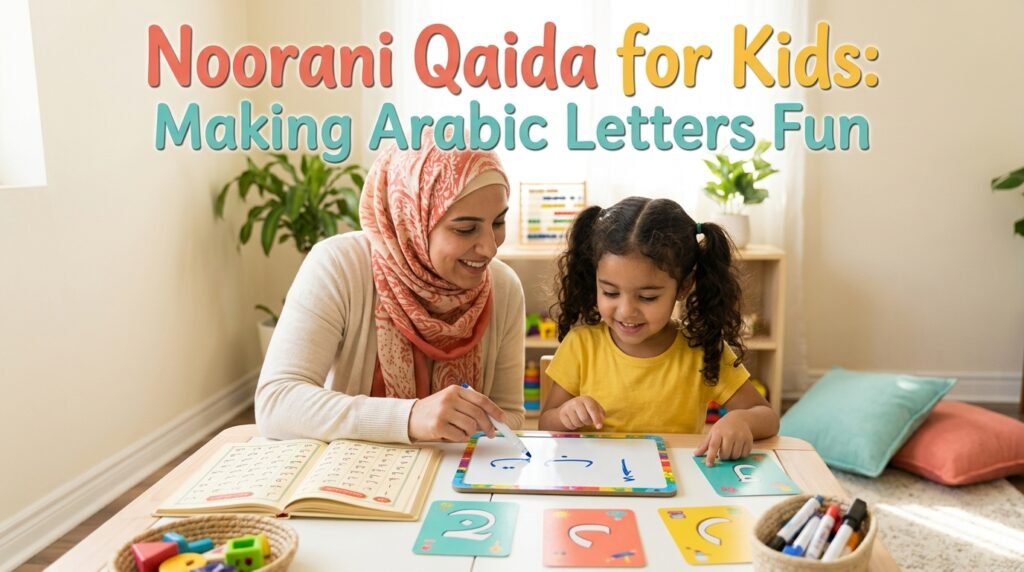
Introducing young children to the Arabic language and Quranic recitation is one of the most rewarding milestones for Muslim families and educators. At the center of this foundational journey lies the Noorani Qaida—a time-tested, systematic curriculum designed to take a non-Arabic speaker from basic letter recognition all the way to fluent, correct Quranic reading with Tajweed rules.
However, for a young child, opening a traditional booklet packed with unfamiliar black-and-white symbols, abstract vocal points, and unfamiliar sounds can feel intimidating. Rote repetition and rigid drills often turn what should be an inspiring spiritual and linguistic experience into a chore.
The secret to raising confident, enthusiastic readers does not lie in abandoning the classical Noorani Qaida, but in reimagining how it is taught. By blending classical pedagogy with modern, child-centered learning principles—multisensory play, gamification, storytelling, and positive reinforcement—learning Arabic letters can become the highlight of your child’s day.
1. What is Noorani Qaida and Why Is It the Gold Standard?
Compiled by Sheikh Noor Muhammad Haqqani, the Noorani Qaida is carefully engineered around progressive phonics. Unlike unstructured methods, it follows a strict developmental sequence:
- Individual Letters (Huroof Mufradat): Learning the shapes, names, and articulation points (Makharij) of the 29 Arabic letters.
- Compound Letters (Huroof Murakkabat): Identifying letters when joined together at the beginning, middle, or end of words.
- Short Vowels (Harakat): Introducing Fatha, Kasra, and Damma (the foundational short sounds: a, i, u).
- Soft Letters and Tanween: Mastering nunation (two Fathas, two Kasras, two Dammas) and diphthongs (Leen letters).
- Sukoon (Jazm) and Shaddah (Tashdeed): Learning stops, resting points, and letter doubling.
- Maddah and Long Vowels: Extending vowel sounds accurately without over-stretching.
When children master the Qaida, they do not just memorize words; they crack the phonetic code of the Arabic script. Because the Holy Quran is written in this precise classical orthography, completing the Qaida bridges the gap straight into reciting the Mus’haf smoothly.
2. Why Traditional Rote Learning Falls Short for Young Minds
Children between the ages of 3 and 8 learn through concrete experiences, visual association, rhythm, and physical movement.
When lessons rely entirely on “sit still, look at the page, and repeat after me,” several hurdles arise:
- Visual Confusion: Arabic letters change shape depending on their position in a word (e.g., initial, medial, isolated, and final forms of Baa, Taa, Thaa). For a child, this visual variability can cause cognitive overload.
- Subtle Sound Distinctions: Letters like Seen ($\text{س}$) vs. Saad ($\text{ص}$), or Dhal ($\text{ذ}$) vs. Zay ($\text{ز}$) vs. Dha ($\text{ظ}$) sound almost identical to an untrained ear unless taught with sensory cues.
- Short Attention Spans: Demanding 45 minutes of static focus often leads to frustration, burnout, and negative associations with learning sacred texts.
To overcome these hurdles, we must transform the learning environment from passive repetition to active discovery.
3. Creative Strategies to Make Arabic Letters Fun
Here are actionable, field-tested techniques to bring the Noorani Qaida to life at home or in the classroom:
A. Sensory Play: Building the Letters
Young children understand physical objects long before they interpret flat ink on paper.
- Play-Dough Letter Sculpting: Give your child non-toxic play-dough and challenge them to roll “snakes” to form the curve of a Noon ($\text{ن}$) or the belly of a Jeem ($\text{ج}$). Have them roll a tiny sphere for the dot (Nuqtah). Ask: “Where does the dot go for Jeem? In the belly! Where does it go for Khaa? On top of its head!”
- Sand and Rice Trays: Pour colored sand, kinetic sand, or uncooked rice into a shallow baking tray. Call out a letter and encourage your child to draw the letter using their index finger. This builds motor memory directly connected to letter formation.
- Finger-Painting & Shaving Cream: Spray a washable table with shaving foam or provide washable finger paints. Let them draw broad strokes for Alif, Baa, and Taa. Tactile friction cements the shape in their brain.
B. Gamification: Turning Lessons into Quests
Gamification transforms abstract practice into engaging challenges.
- The Letter Hunt (Flashcard Scavenger Hunt): Hide Arabic letter flashcards around the living room. Give clues: “Can you find the letter with three dots on top like a crown? That’s Thaa ($\text{ث}$)!” When they find it, have them shout out its sound three times.
- Hopscotch Phonics: Draw Arabic letters on the sidewalk using chalk, or place foam floor mats printed with Arabic letters in a pathway. Call out a letter sound, and your child must hop onto the correct tile.
- Flyswatter Smack: Tape 5–6 letter cards to a wall or lay them flat on a table. Give your child a clean plastic flyswatter. Say: “Quick, smack the Daal ($\text{د}$)!” The burst of physical action keeps energy high and focus sharp.
- Dot Matching Games: Create cardboard cutouts of Baa, Taa, Thaa, and Noon without dots. Hand the child colorful buttons, pompoms, or marbles. Let them place the correct number of dots in the proper spots.
C. Character Storytelling and Visual Mnemonics
Children remember narratives far better than isolated symbols. Assign playful, memorable personalities to the letters:
- The Boat Letters Family:Baa, Taa, and Thaa share the same “boat-shaped” hull.
- Baa has an anchor dropped below the boat (1 dot underneath).
- Taa has two happy sailors smiling inside (2 dots side-by-side on top).
- Thaa has three treasure chests piled up high (3 dots like a pyramid).
- The Thirsty Throat Letters: For deep guttural sounds like ‘Ayn ($\text{ع}$) and Haa ($\text{ح}$), explain that these letters live deep down in the throat where cool water splashes, guiding them to feel the throat muscle with their hand.
4. Step-by-Step Guide: Teaching Through the Qaida Phases
| Stage | Qaida Focus | Fun Activity / Learning Hook | Key Milestone |
| Phase 1 | Mufradat (Single Letters) | Play-dough shaping, sand trays, letter matching games | Instant identification of all 29 letters and their dots |
| Phase 2 | Murakkabat (Connected Shapes) | “Train Car” puzzle (hooking letter carriages together) | Recognizing letters by their “heads” and dot counts |
| Phase 3 | Harakat (Short Vowels) | Body movements (hands up for Fatha, down for Kasra, rounded lips for Damma) | Reading short consonant-vowel combinations quickly |
| Phase 4 | Tanween & Sukoon | “Bouncing Ball” for Sukoon (sudden stop); rhythm claps for Tanween | Blending syllables smoothly without adding extra vowels |
| Phase 5 | Madd & Simple Words | Rubber band stretching (stretch the band as long as the vowel lasts) | Transitioning into small words and short Surahs (Juz Amma) |
5. Teaching Proper Tajweed and Makharij Without Overwhelming Them
Tajweed—the rules governing correct pronunciation—is essential, but introducing heavy technical terminology (Idghaam, Ikhfaa, Qalqalah) will dishearten a five-year-old. Instead, teach the mechanics using sensory feedback:
1. Echo and Bounce (Qalqalah: ق، ط، ب، ج، د)
Call these the “Bouncy Letters.” When a Sukoon lands on one of them, tell the child the sound behaves like a basketball hitting the court: it bounces right back (Ab! Aj! At!).
2. The Heavy vs. Light Sound System (Tafkheem vs. Tarqeeq)
- Light Letters: Tell the child to give a sweet, gentle smile when pronouncing letters like Seen ($\text{س}$) or Taa ($\text{ت}$).
- Heavy Letters: Tell them to puff their cheeks like a friendly bear or make a royal, full mouth for Saad ($\text{ص}$), Taa ($\text{ط}$), and Qaaf ($\text{ق}$).
3. Feeling the Vibration
Place the child’s gentle fingers on the side of their neck or under their chin. Show them how the sound resonates differently between throat letters (Hamzah, Haa, ‘Ayn, Haa, Ghayn, Khaa) and lip letters (Baa, Meem, Waw, Faa). This tactile awareness builds natural precision without stress.
6. Creating a Consistent, Joyful Daily Routine
Consistency beats duration every single time. A grueling one-hour session once a week yields far less progress than 15 minutes of joyful daily practice.
Recommended 15-Minute Daily Schedule:
- Minutes 0–3 (Warm-Up): Sing the Arabic alphabet song or do a quick 3-card lightning round to refresh yesterday’s concept.
- Minutes 3–10 (Core Qaida Focus): Introduce 1 to 2 new letters or a single line of vowel blends from the booklet. Focus on precision, clear pointing with the finger, and repetition.
- Minutes 10–13 (Interactive Game): Consolidate the new letters using flashcards, physical hopping, or drawing in the sand tray.
- Minutes 13–15 (Wrap-Up & Reward): Mark progress on a colorful sticker chart. End with warm hugs, high fives, and sincere praise: “Masha’Allah, your pronunciation of Raa was so strong today!”
7. Useful Tools and Modern Resources to Pair with Noorani Qaida
While the physical booklet is central, supplementing it with well-designed modern tools reinforces independent learning:
- Digital Interactive Apps: Look for vetted Noorani Qaida apps with tap-to-listen audio recited by qualified Qaris. This allows children to practice independently while hearing the correct accentuation.
- Wooden Arabic Alphabet Puzzles: Chunky wooden boards allow toddlers and preschoolers to practice shape fitting, fine motor skills, and letter orientation simultaneously.
- Smart Audio Pens: Modern editions of the Qaida come with digital sensor pens. When the child taps any word or letter, the pen recites it clearly with Tajweed, building self-correction habits.
Conclusion: Planting the Seeds of Lifelong Love for the Quran
Teaching Noorani Qaida to children is more than a literacy lesson—it is laying the foundation for a lifetime connection with the words of Allah.
When parents and teachers introduce Arabic letters with patience, creativity, and joy, children do not just learn how to decode symbols; they look forward to every session. By swapping pressure for playfulness and frustration for positive reinforcement, you ensure that your child’s first steps along the path of Quranic learning are filled with light, laughter, and lasting love.