
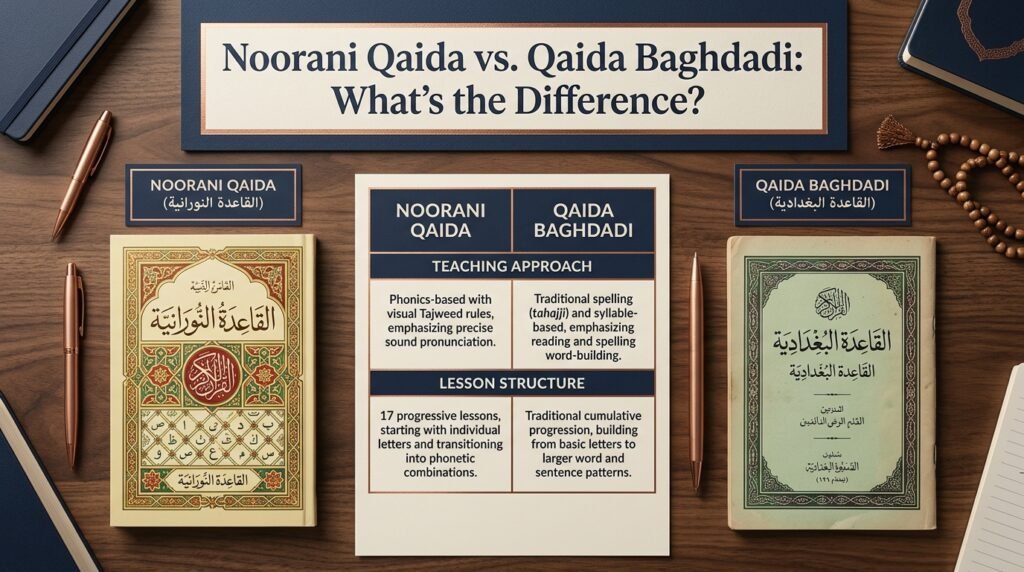
Learning to read the Holy Quran with correct pronunciation, flow, and adherence to Tajweed rules is one of the most rewarding pursuits for any Muslim. For centuries, Islamic scholars have developed structured pedagogical primers—commonly known across the Islamic world as a Qaida (from the Arabic word Qā‘idah, meaning “foundation” or “rule”)—to take non-Arabic speakers and young learners from basic alphabet recognition to fluent Quranic recitation.
Among the wide variety of introductory primers available today, two traditional texts stand out as monumental benchmarks in Quranic education: Noorani Qaida and Qaida Baghdadi (often called Al-Baghdadiyyah).
While both books pursue the identical noble goal—teaching the correct phonetic articulation and reading of the Arabic Quranic script—they approach pedagogy, layout, regional adoption, and Tajweed methodology from distinct angles. Understanding their structural differences, historical backgrounds, and instructional approaches will help teachers, parents, and self-learners determine which curriculum best suits their learning objectives.
1. Origins and Historical Background
To appreciate why these two books are arranged differently, it is helpful to explore where and why they were created.
Noorani Qaida: A South Asian Masterpiece for Tajweed
Noorani Qaida was authored in the late 19th / early 20th century by the renowned Indian scholar Sheikh Noor Muhammad Haqqani (1856–1925) from Ludhiana, Punjab (British India). Sheikh Haqqani was an Islamic educator deeply devoted to the preservation of Quranic phonetics among populations whose native tongues were non-Semitic (such as Urdu, Punjabi, Persian, and Bengali).
Observing that regional accents often distorted Arabic sounds, Sheikh Haqqani designed a systematic, rule-oriented primer that bridged basic literacy directly with classical Tajweed rules. His primer quickly spread across the Indian subcontinent and remains the primary introductory text in Deobandi, Barelvi, and broader South Asian madrasas, as well as modern Western mosques serving the South Asian diaspora.
Qaida Baghdadi: The Ancient Standard of the Arab World
Qaida Baghdadi, or Al-Qaida Al-Baghdadiyyah, has far older, classical roots tracing back to the classical scholastic centers of Baghdad, Iraq. Traditionally attributed to classical Arab grammarians and Quranic tutors, this primer represents an ancient, time-tested framework originally used to teach Arabic literacy and Quranic phonetics across the Middle East, North Africa, East Africa (such as Somalia and Sudan), and parts of Central Asia.
Unlike modern primers designed specifically to counter non-Arab phonetic deficiencies, Qaida Baghdadi was initially developed within an Arabophone or culturally classical milieu. Its primary aim was clean syllabic construction and fluent decoding of the language, making it a foundational reading primer for both general Arabic literacy and early Quranic recitation.
2. Pedagogical Approach and Progression
The core distinction between the two primers lies in how they introduce letters, sounds, and word formation.
Progression in Noorani Qaida
Noorani Qaida uses a micro-step, highly granular pedagogical ladder. Each lesson focuses on a single, isolated phonetic or orthographic rule before combining it with others:
- Individual Alphabet (Mufradat): Thorough practice on individual letter recognition and distinct articulation points (Makharij).
- Compound Letters (Murakkabat): How letters join in initial, medial, and final forms.
- Abbreviated Letters (Muqatta’at): Specific practice on the mystic opening letters of Quranic Surahs (e.g., Alif-Lam-Meem).
- Short Vowels (Harakat): Fathah, Kasrah, Dammah introduced with rapid, crisp pronunciation (teaching that short vowels must not be stretched).
- Tanween and Nunation: Double vowels (two Fathahs, two Kasrahs, two Dammahs) and their nasalized sound (Ghunnah).
- Maddah / Long Vowels (Huruf Maddiyyah & Leen): Rules for stretching sounds for 2, 4, or 6 counts.
- Sukun (Jazm) and Tashdeed (Shaddah): Resting consonants, consonant doubling, and advanced Tajweed (Idgham, Ikhfa, Iqlab, Izhar).
This strict compartmentalization makes Noorani Qaida exceptionally easy for complete beginners because each lesson introduces only one variable at a time.
Progression in Qaida Baghdadi
Qaida Baghdadi approaches literacy through an organic, phonetic, and syllabic construction method. Rather than isolating letters into abstract drills for extended chapters, Baghdadi rapidly connects letters into phonetic syllables:
- Letter Foundations: Presentation of the alphabet, often emphasizing the names and fundamental sounds together.
- Immediate Vowel Application: Introducing letters directly with short vowels in rapid succession (e.g., A – I – U, Ba – Bi – Bu, Ta – Ti – Tu).
- Rapid Blending: Students are introduced to two-letter and three-letter words early in the text.
- Rhythmic Syllabification (Tahjiah): Baghdadi heavily emphasizes traditional spelling aloud—spelling out each letter and vowel mark before pronouncing the full word (e.g., “Baa Fathah [Ba], Seen Sukun [Bas], Meem Kasrah [Mi] -> Basmi”).
Where Noorani Qaida isolates rules analytically, Qaida Baghdadi focuses on immediate vocal rhythm, dynamic syllable blending, and oral drilling.
3. Focus on Tajweed Rules
While both books prepare a student for the Quran, the depth and explicitness of Tajweed instruction differ considerably.
| Feature | Noorani Qaida | Qaida Baghdadi |
| Primary Focus | Explicit Quranic Tajweed rules and precise articulation | Syllabic blending, reading fluency, and rapid literacy |
| Makharij (Articulation Points) | Emphasized from Lesson 1; distinguishes subtle throat and tongue sounds | Taught implicitly through teacher correction |
| Ghunnah, Ikhfa, Idgham | Dedicated chapters with extensive Quranic examples | Basic introduction; detailed rules left for secondary study |
| Waqf (Stopping Rules) | Explains pause symbols, stopping on Ta Marbuta, etc. | Focuses more on continuous reading and simple stops |
| Target Audience | Non-Arab speakers needing phonetic precision | Arab and non-Arab students seeking fluent word formation |
Noorani Qaida functions almost as an applied Tajweed handbook disguised as an alphabet book. By the time a student reaches the end of Noorani Qaida, they have directly encountered examples containing complex Tajweed mechanisms: subtle elongation (Madd Munfasil/Muttasil), throat letters (Huruf Halqi), silent letters, and assimilation (Idgham with/without Ghunnah).
Qaida Baghdadi, on the other hand, prioritizes speed of word assembly. It teaches students how to decipher Arabic words quickly. Detailed rules of Tajweed are often expected to be learned in the next stage of education (such as studying introductory poetry texts like Tuhfat al-Atfal alongside direct recitation of the Mus’haf).
4. Script Style and Typography
Another critical distinction visible at first glance is the calligraphy style (Khatt) used in printings of each book.
Nastaliq / Indo-Pak Script in Noorani Qaida
Traditionally, Noorani Qaida is printed in the Indo-Pak script (a variant heavily influenced by Naskh and Nastaliq styles common in Pakistan, India, Bangladesh, and Afghanistan).
- The letters feature rounded flourishes, distinct diacritical placement, and explicit visual aids (such as color-coded Tajweed markers).
- While modern publishers have created “Uthmani Script” editions of Noorani Qaida to cater to global audiences, the classic edition remains formatted according to the 13-, 15-, or 16-line South Asian Mus’haf layout.
Classical Naskh / Uthmani Script in Qaida Baghdadi
Qaida Baghdadi is traditionally published in classical Naskh script, mirroring the standard Medina Mus’haf (calligraphed by Uthman Taha and printed by the King Fahd Complex).
- The letter ligatures, spacing, vowel marks, and Sukun symbols (which often appear as an unclosed crescent or small Khaa head in the Uthmani script) match what a student will see when opening an Arab-world Quran.
- This eliminates the visual friction many students experience when transitioning from a South Asian script primer to an Arabic standard Mus’haf.
5. Summary Comparison Table
| Attribute | Noorani Qaida | Qaida Baghdadi |
| Author / Origin | Sheikh Noor Muhammad Haqqani (British India, late 19th c.) | Classical scholars of Baghdad (Classical Islamic Era) |
| Regional Dominance | South Asia, UK, North America, South Asian diaspora | Middle East, North/East Africa, Turkey, Central Asia |
| Learning Methodology | Rule-based, analytical, isolated exercises | Syllabic, rhythmic, synthetic blending (Huroof-o-Harkat) |
| Spelling Method (Tahji) | Often uses silent decoding or direct phonetic pronunciation | Uses rhythmic vocal spelling (Tahjiah) extensively |
| Transition to Quran | Prepares directly for strict Tajweed recitation | Prepares directly for rapid reading and phonetic assembly |
| Visual Design | Modular tables, often color-coded for Tajweed | Continuous line format, traditional script layout |
6. Which Qaida Should You Choose?
Neither primer is objectively “better” than the other; rather, each serves specific student profiles and pedagogical environments.
Choose Noorani Qaida if:
- You are a non-native Arabic speaker: If your primary challenge is distinguishing between sounds that do not exist in English or other languages (such as distinguishing between ح and ه, or ع and أ, or ص and س), Noorani Qaida provides rigorous drills targeting these exact pitfalls.
- You want Tajweed embedded from Day 1: If you want your child or yourself to master Ghunnah, Qalqalah, and elongation counts before reading actual Quranic Surahs, Noorani Qaida is built specifically for that outcome.
- You are learning under a South Asian instructor: Tutors trained in the subcontinent madrasa tradition possess unmatched mastery over the sequence of Noorani Qaida.
Choose Qaida Baghdadi if:
- You want faster reading fluency: If the student struggles with connecting letters into cohesive words and needs a fluid, rhythmic reading pace, Baghdadi’s syllable-blending approach accelerates word recognition.
- You are learning Arabic language alongside Quran: Because Qaida Baghdadi stems from classical Arabic literacy traditions, it offers better synergy for students studying spoken or classical Arabic grammar concurrently.
- You read the Medina / Uthmani Mus’haf: If your household or local community exclusively recites from the standard Arab-world print (Mushaf al-Madinah), Baghdadi aligns naturally with that orthography from the first page.
Final Thoughts
Both Noorani Qaida and Qaida Baghdadi have guided millions of believers over generations to read the words of Allah with clarity and reverence.
While Noorani Qaida provides an analytical, Tajweed-intensive framework tailored to overcome phonetic barriers, Qaida Baghdadi delivers a classical, time-tested method of rhythmic syllable assembly and natural literacy. The best choice ultimately depends on your native language, your teacher’s familiarity with the material, and whether your immediate priority is strict phonetic Tajweed mastery or fluid reading speed. Under the guidance of a qualified, patient Quran tutor, either primer will lay a rock-solid foundation for a lifetime of beautiful recitation.