
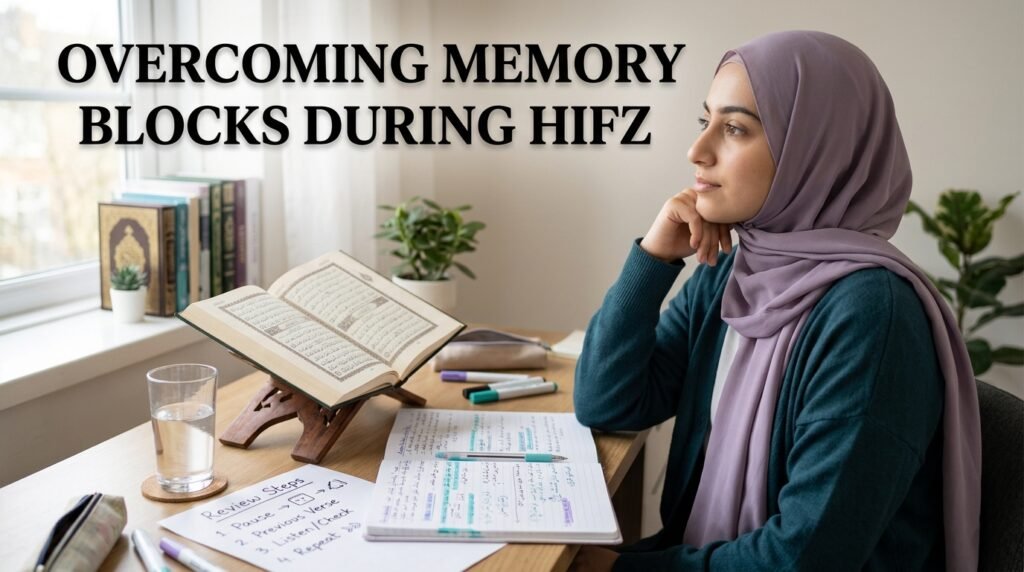
Memorizing the Holy Quran is among the highest spiritual and cognitive endeavors a Muslim can undertake. The Prophet Muhammad (peace be upon him) said: “The best among you are those who learn the Quran and teach it” (Sahih al-Bukhari). Yet, despite sincere intentions, rigorous daily routines, and deep devotion, virtually every talib al-ilm (student of knowledge) encounters the dreaded memory block.
A memory block during Hifz—often experienced as sudden blankness on a well-rehearsed ayah, constant confusion between similar verses (Mutashabihat), or a persistent feeling of cognitive stagnation—can be intensely discouraging. Students frequently interpret these episodes as personal failure, lack of spiritual purity, or intellectual inadequacy.
In reality, memory blocks are a natural intersection of human neurobiology, psychological stress, and spiritual testing. By addressing their root causes through systematic memorization techniques, lifestyle adjustments, and profound spiritual anchors, any student can break through these plateaus and build a resilient, enduring recitation.
1. Understanding the Anatomy of a Memory Block
To solve a problem, one must first diagnose it accurately. In Quranic memorization, mental blocks typically manifest in three distinct forms:
A. The “Blank Wall” Phenomenon
You recite an ayah with ease, but upon reaching a specific juncture, your mind goes entirely blank. Even glancing at the Mushaf provides only fleeting clarity; the moment you close your eyes, the void returns. This occurs when the associative links between neural pathways have fractured, usually due to shallow encoding or auditory fatigue.
B. Mutashabihat Cross-Wiring
The Quran features recurring themes, identical sentence beginnings, and subtle phrasing shifts across different surahs. A cognitive cross-wire happens when the brain defaults to a more familiar pathway—for instance, accidentally pivoting from Surah Al-Baqarah into Surah Ali ‘Imran because both contain overlapping phrasing.
C. Cognitive Overload & Neural Exhaustion
Hifz is an intensive cognitive exercise requiring sustained attention, working memory, and motor speech coordination. When the brain is starved of restorative sleep or overwhelmed by excessive daily targets, information processing stalls. The brain simply refuses to encode new data until its current reserves are consolidated.
2. Neurological & Practical Solutions to Reset the Mind
Modern cognitive science offers remarkable insight into how memory consolidation works, directly complementing classical Hifz pedagogy.
1. Break the Loop with Contextual “Anchoring”
When an ayah causes repeated stumbling, brute-force repetition often reinforces the mistake. Instead of repeating the exact same phrase fifty times:
- Isolate the Transition: Identify the single word before the stumble and the word immediately after. Practice this two-to-three-word bridge repeatedly.
- Understand the Linguistic Meaning (Tafsir): Memory thrives on meaning. If you understand why Allah mentions a specific Divine attribute (e.g., ‘Azizun Hakim vs. Ghafurur Rahim) at the end of the verse, semantic memory steps in where mechanical memory failed.
- Trace the Visual Map: Take note of the verse’s position on the page. Is it at the top right, middle, or bottom left? Classical scholars advised sticking to a single layout (such as the standard 15-line Medina Mushaf) throughout one’s entire Hifz journey because visual memory (dhaakirah basariyyah) strongly stabilizes recall.
2. Implement the “Chunking” Method
If an entire quarter-juz (hizb) feels insurmountable, dismantle it into micro-chunks.
- Divide a long passage into distinct thematic units of 2–3 ayahs.
- Master Chunk A independently.
- Master Chunk B independently.
- Merge Chunk A and B before touching Chunk C.
- Never proceed to new memorization (Sabaq) until the bridge connecting the previous day’s portion is completely seamless.
3. Embrace Deliberate Spaced Repetition (The 3-Tier System)
A robust Hifz system relies on three separate tiers of revision:
- Sabaq (New Lesson): Today’s freshly memorized verses.
- Sabqi / Amokhta (Recent Memorization): The current Juz or the last 5–10 pages leading up to the new lesson. This is where memory consolidation is actively solidified.
- Manzil / Dhor (Old Memorization): Full revision of previously perfected Juz on a rolling weekly or bi-weekly cycle.
Most memory blocks occur when students prioritize Sabaq over Sabqi. If the recent foundation is brittle, the new verses have nothing stable to rest upon.
3. Physical Hygiene: Nutrition, Sleep, and Focus
The brain is a biological organ governed by physiological rules. Neglecting physical well-being directly degrades cognitive function.
| Factor | Impact on Hifz | Practical Action |
| Sleep Architecture | Memory consolidation occurs during deep REM sleep. Lack of sleep impairs short-term recall. | Target 7–8 hours of consistent sleep. Prioritize the Qaylulah (afternoon nap) for 20–30 minutes. |
| Hydration & Electrolytes | Dehydration shrinks brain tissue volume and triggers mental fatigue. | Keep a water bottle near your desk; sip consistently while reciting aloud. |
| Digital Distraction | Rapid task-switching (social media reels, constant notifications) ruins sustained focus. | Implement “deep work” recitation blocks: phone in airplane mode in another room. |
| Physical Movement | Prolonged sitting leads to lethargy and sluggish cerebral blood flow. | Stand up and pace while revising older portions; recite while taking a light walk. |
4. The Spiritual Dimensions of Memory Blocks
While psychological and biological factors play a central role, the Quran is ultimately a Divine light (Nur). Imam al-Shafi’i famously composed verses recounting his dialogue with his teacher, Imam Waki’:
“I complained to Waki’ about my poor memory,
So he advised me to abandon sins,
And informed me that knowledge is a light,
And the light of Allah is not bestowed upon a sinner.”
When encountering a persistent memory block, turn inward and re-examine your spiritual state:
Purify Intentions (Ikhlas)
Ask yourself: Why am I memorizing this book? Is it for external prestige, family expectations, or genuine devotion to Allah? A block can sometimes serve as Divine mercy—a pause designed to realign your heart and strip away vanity (Riya’).
Tawbah and Istighfar
Sins of the tongue, eyes, and heart weigh heavily upon the mind. Excessive gossip, listening to idle speech, or looking at impermissible content dulls spiritual sensitivity. Spend 10–15 minutes before opening the Quran seeking sincere forgiveness:
- Recite Sayyid al-Istighfar.
- Offer two units of Salat al-Tawbah (Prayer of Repentance).
- Make heartfelt Dua for clarity:“Rabbi ishrah li sadri, wa yassir li amri, wahlul ‘uqdatan min lisani, yafqahu qawli” (O my Lord! Expand for me my breast, ease for me my task, and remove the knot from my tongue, that they may understand my speech – Surah Ta-Ha 20:25–28).
Recite in Tahajjud
Reciting newly memorized ayahs during the night prayer (Qiyam al-Layl) anchors them like no daytime revision can. Standing in the stillness of the night with nothing between you and your Creator tests true recall while securing Divine assistance.
5. Daily Protocol to Dissolve a Persistent Block
When a block feels unshakeable, adopt this exact step-by-step reset protocol:
- Step Away for 15 Minutes: Close the Mushaf. Prolonged frustration produces cortisol, which physically impedes hippocampal recall. Drink water, perform fresh Wudu, and do light stretching.
- Listen to a Master Reciter: Listen to a measured, deliberate reciter (e.g., Sheikh Mahmud Khalil al-Husari or Sheikh Muhammad Siddiq al-Minshawi) repeating the troublesome verse at least ten times. Pay close attention to rhythm, breathing stops (Waqf), and articulation.
- Write It Down by Hand: Writing engages kinesthetic memory. Write the verse from memory onto a blank piece of paper or mini-whiteboard. When you reach the blank spot, look at the text, complete the word in red ink, and finish the verse.
- Recite Aloud to a Partner: Reciting internally in your head masks flaws. Reciting aloud to a teacher or peer forces complete clarity and identifies weak transitions immediately.
Conclusion: Patience in the Path of Allah
Memorizing the Quran is not a sprint; it is a lifelong companionship. The Prophet Muhammad (peace be upon him) reassured us: “The one who recites the Quran and stammers over it, finding it difficult, will have a double reward” (Sahih Muslim).
The struggle itself—the very friction of forgetting and relearning—is where spiritual elevation occurs. A memory block is not a sign that you cannot become a Hafiz; it is an invitation to refine your habits, deepen your sincerity, and lean wholly upon Allah’s grace. Approach each hurdle with patience, strategic adjustments, and an unwavering heart, and the words will once again flow with ease.