
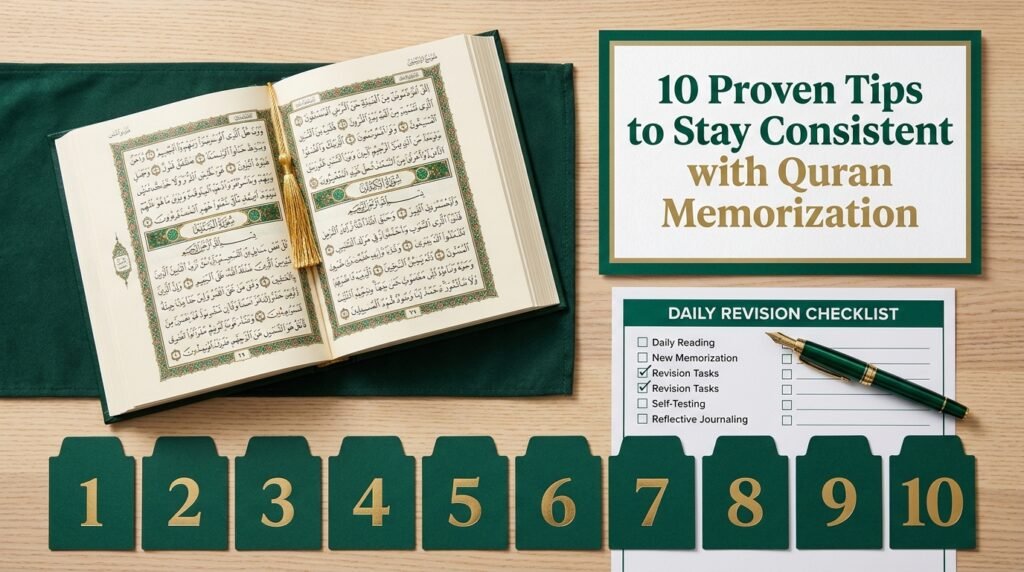
Beginning the journey of memorizing the Holy Quran (Hifz) is one of the most spiritually elevated commitments a believer can make. The early days are almost always marked by profound zeal: notebooks are bought, schedules are drafted, and pages turn swiftly. Yet, as weeks turn into months, initial motivation invariably wanes. Fatigue sets in, verses begin to blur, and daily responsibilities compete fiercely for mental bandwidth.
The challenge of Hifz is rarely raw intellectual capacity. Rather, it is a test of sustained consistency. The Prophet Muhammad (peace be upon him) emphasized the delicate nature of memorization, stating that the Quran slips away faster than untethered camels. Retaining it requires not sporadic bursts of marathon effort, but an unbreakable, structured system.
Whether you are starting from Juz ‘Amma or working through the middle portions of the Mus’haf, here are ten proven, practical strategies to maintain unwavering consistency throughout your memorization journey.
1. Fix a Non-Negotiable Time Slot (The Fajr Advantage)
Inconsistency thrives when memorization is left to “whenever there is free time.” In a modern schedule, free time rarely appears on its own. To stay consistent, your Quran session must become an immovable anchor in your calendar.
The most effective window for memorizing new verses (Sabaq) is immediately following the Fajr prayer. At this hour:
- The mind is rested and clear of daily operational noise.
- The world is quiet, minimizing notifications, messages, and household interruptions.
- The early hours carry divine barakah (blessing).
If post-Fajr is strictly impossible due to work shifts, pick a single alternative window—such as 30 minutes before sleep or directly after ‘Asr—and guard it fiercely. Consistency depends far more on the regularity of the timing than on the length of the session.
2. Prioritize Revision (Muraja’ah) Over New Pages
The most common trap for students of Hifz is the urge to sprint forward while neglecting what lies behind. Rushing through new pages without consolidating earlier chapters leads quickly to panic, confusion, and eventual burnout.
A golden rule practiced in traditional institutions: Revision always precedes new lessons.
Structure your daily effort into three clear components:
- Sabaq (New Lesson): The fresh lines or page you are committing to memory today.
- Sabqi / Manzil-e-Qareeb (Recent Memorization): The last 5 to 10 pages memorized. Because these pathways are fresh, they are the most fragile and require daily recitation without error.
- Manzil / Dhor (Old Memorization): A rolling cycle covering all older portions (e.g., half a Juz to a full Juz daily, depending on how much you have memorized).
If on any given day you find yourself short on time, drop the new lesson entirely and focus solely on revision. Preserving what you have already gained is vastly more critical than accumulating fragile, half-remembered lines.
3. Use One Single Physical Mus’haf Edition
Human memory relies heavily on spatial and visual anchors. When you memorize a page of the Quran, your mind records not only the sounds of the words, but also:
- The exact position of a verse (top, middle, or bottom of the page).
- The line breaks.
- The visual layout of the page corners.
Switching between different print layouts, different font types, or toggling arbitrarily between paper and various mobile phone apps disrupts this visual blueprint.
Commit to one specific physical copy—the standard 15-line Madinah Mus’haf is the global benchmark for Hifz students because every page ends cleanly with an ayah. Keep this copy at your primary desk, and use the exact same digital layout on your tablet or phone when traveling.
4. Shrink the Daily Target to Avoid Burnout
Ambition often tempts students to commit to memorizing a full page or two every single day. While this pace may hold for a week, it frequently collapses when work stress, illness, or family obligations intervene. A missed day easily cascades into a missed week, accompanied by guilt and abandonment.
Instead, lower your daily target to a volume you can sustain even on your worst, most exhausting days. Memorizing half a page, three lines, or even a single ayah every single day without interruption produces vastly superior results compared to memorizing three pages in one weekend and doing nothing for the next fortnight.
Small, unbroken habits compound into massive achievements over time.
5. Anchor Verses Through Deep Understanding (Tafheem)
Memorizing Arabic purely as phonetic sounds turns the process into mechanical strain. The human brain retains information far more reliably when the words correspond to narrative, logical progression, and emotional meaning.
Before you begin memorizing a passage:
- Read a clear, faithful translation of the verses.
- Review brief commentary (Tafseer) to understand the context of revelation (Asbab al-Nuzul).
- Identify connectors: observe why a verse transitions from a legal ruling to a reminder of divine mercy, or how stories of past prophets parallel one another.
When you understand the meaning, your brain anticipates the next ayah naturally through context rather than struggling to recall detached words.
6. Recite Your Daily Memorization in Sunnah and Nawafil Prayers
A foolproof way to test whether an ayah is truly settled in long-term memory is to recite it within Salah. When standing in prayer without the Mus’haf before you, hesitation and gaps become immediately obvious.
Integrate your daily portion directly into your prayer life:
- Recite your newly memorized verses during the Sunnah prayers before or after the obligatory prayers.
- Dedicate the night prayer (Tahajjud) or Qiyam to reciting your recent revisions.
This practice serves two functions: it continuously reviews your Hifz under conditions that demand full recall, and it shifts memorization from an academic task into an act of direct, intimate worship.
7. Form an Accountability Partnership
Hifz is an arduous journey, and traversing it entirely in isolation is rarely successful. Even the Prophet Muhammad (peace be upon him) reviewed the Quran annually with the Angel Jibril.
You need external ears to catch errors you are blind to:
- Qualified Teacher: Ideally, read daily or several times a week to a certified teacher who enforces correct Tajweed and stops subtle errors before they become habits.
- Study Partner: If an instructor is unavailable every day, pair up with a peer pursuing the same goal. Commit to calling each other daily for 15 minutes solely to hear one another’s revision.
The simple knowledge that another person is waiting to listen to your page is often the exact nudge required to prevent procrastination.
8. Leverage Passive Audio Immersion
Your auditory memory is an exceptionally powerful ally. Modern commute times, household chores, and light physical exercise present hours of underutilized listening opportunities.
Select a renowned Qari whose recitation is slow, deliberate, and precise in articulation (such as Sheikh Mahmoud Khalil Al-Husary, Sheikh Muhammad Siddiq Al-Minshawi, or Sheikh Ali Al-Hudhaify). Loop the specific passage you plan to memorize tomorrow or next week while driving, cooking, or walking.
By the time you sit down with the physical book, the rhythm, vowel endings, and vocal inflections will already be familiar, drastically reducing the active memorization time required.
9. Systematically Tackle the Mutashabihat (Similar Verses)
As your memorization expands across multiple Juz, you will run into the Mutashabihat—verses that are almost identical across different Surahs, differing only by a single letter, preposition, or word order (for example, variations between Surah Al-Baqarah and Surah Al-Imran).
These similarities can cause severe hesitation and doubt. To navigate them:
- Keep a dedicated notebook specifically for similar verses.
- Whenever you confuse two passages, write them down side-by-side. Highlight the exact word or particle that distinguishes them.
- Learn or create simple mnemonic devices to tie the specific phrasing to its respective Surah.
Treating confusing verses as targeted analytical puzzles rather than random stumbling blocks restores confidence and prevents revision sessions from stalling.
10. Safeguard the Heart and Seek Sincere Intent (Ikhlas)
Traditional scholars consistently reminded their students that the Quran is sacred knowledge (‘Ilm), and divine knowledge settles only in a heart uncluttered by persistent misdeeds and spiritual neglect.
Imam Al-Shafi’i famously recounted complaining to his teacher Waki’ about a weakness in his retention, to which Waki’ advised him to abandon sin, explaining that knowledge is light, and the light of God is not granted to those who persist in wrongdoing.
To maintain your spiritual momentum:
- Continually renew your intention (Niyyah). Remind yourself that this effort is not for social recognition, titles, or speed records, but solely to seek the pleasure of Allah.
- Guard your eyes, speech, and consumption from vanity and distraction.
- Make continuous, earnest Dua—particularly the supplication: “Rabbi zidni ‘ilma” (My Lord, increase me in knowledge)—asking for steadfastness, an open chest, and ease in carrying the words of the Quran throughout your life.
The Path Forward
The journey of Quran memorization is not a standard sprint with a definite endpoint; it is the establishment of a lifelong relationship with the divine text. Consistency is not the absence of difficult days, but the decision to return to the Mus’haf the very next morning, regardless of how slowly the pages turn. Set a modest daily target, anchor it with rigorous revision, rely on accountability, and take comfort in knowing that every single repeated letter carries its own profound reward.