
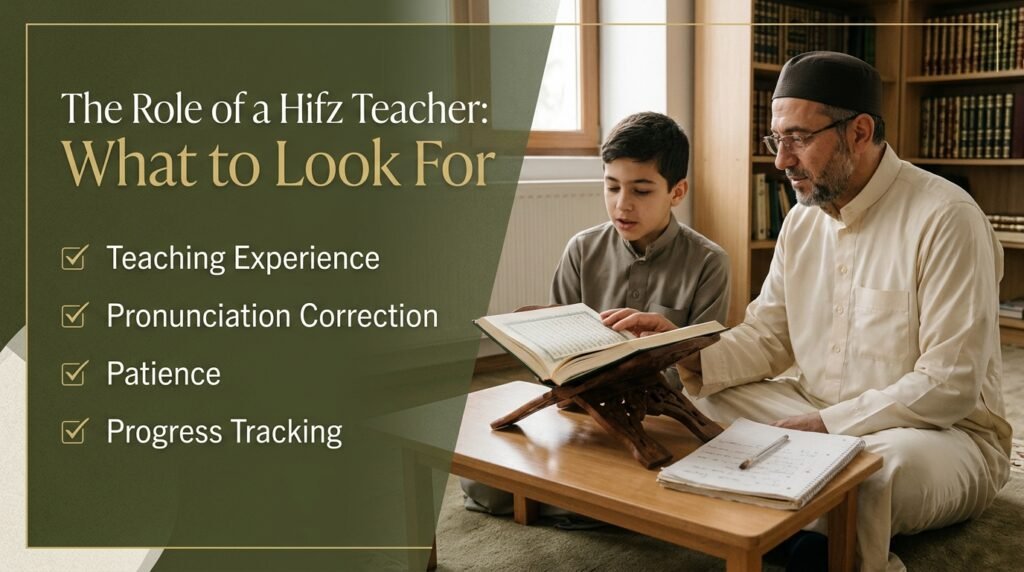
Embarking on the path of memorizing the Holy Quran is a life-altering spiritual, intellectual, and psychological journey. Committing more than 6,000 verses across 114 surahs to heart requires sustained discipline, emotional resilience, and sharp memory. While the student’s personal commitment is foundational, the guide steering the journey often determines whether memorization becomes a joyful, lasting pursuit or an overwhelming, anxious chore.
A Hifz teacher (often referred to as an Ustadh, Mu’allim, or Sheikh) is never merely an auditor who checks recitation mistakes. They function as a spiritual mentor, a vocal and articulation coach, an educational strategist, and an emotional pillar. Selecting the right teacher for yourself or your child is one of the most critical decisions you will make along this sacred road.
1. Mastery of Tajweed and Authentic Sanad (Chain of Transmission)
At the most fundamental level, a Hifz teacher must have impeccable recitation. Memorizing the text of the Quran without proper Tajweed (the rules governing pronunciation and phonetic cadence) can solidify phonetic errors that take years to unlearn.
Precision in Makharij and Sifat
The teacher should demonstrate flawless command over Makharij al-Huroof (points of articulation) and Sifat (characteristics of letters). Subtleties—such as distinguishing clearly between Dhad (ض) and Zha (ظ), maintaining appropriate nasalization (Ghunnah), or calibrating elongation rules (Madd)—must be second nature. More importantly, they must possess an ear trained to catch slight mispronunciations instantly before repetition bakes them into muscle memory.
Authorized Certification (Ijazah)
While formal paper credentials alone do not guarantee teaching excellence, an Ijazah with a connected Sanad (an unbroken chain of oral transmission leading back to the Prophet Muhammad ﷺ) provides objective verification of competency. A teacher who holds an Ijazah in Qira’at (such as the widespread recitation of Hafs ‘an ‘Asim) has had their own recitation thoroughly scrutinized and certified by a recognized scholar, giving you confidence in the authenticity of what they transmit.
2. Pedagogical Acumen: Structured Memorization Methodologies
A common misconception in traditional settings is that an accomplished memorizer automatically makes an accomplished teacher. Effective teaching requires distinct pedagogical skill: diagnosing learning styles, pacing lessons intelligently, and balancing new input with long-term retention.
When assessing a Hifz instructor, look for a systematic framework covering the three pillars of Hifz:
| Component | Traditional Term | Purpose & Teacher’s Role |
|---|---|---|
| New Memorization | Sabaq | Ensuring new verses are read with zero errors before home practice begins. |
| Recent Revision | Sabqi / Dhor | Testing the last 5 to 10 recently memorized pages daily to prevent short-term decay. |
| Cumulative Revision | Manzil / Muraja’ah | Rotating through older, mastered sections across a fixed schedule (e.g., half a Juz’ to a full Juz’ daily). |
An adept teacher does not rush students through Sabaq simply to mark progress. They understand that retention (Itqan) takes precedence over speed. If a teacher constantly pushes forward while allowing previous Ajza’ (parts) to fade, the student is building on sand. Look for an instructor who insists that cumulative revision is the anchor of the daily routine.
3. Empathy, Patience, and Modern Child Psychology
The classical paradigm of Quranic instruction was sometimes associated with stern, fear-driven discipline. Today, educational research and practical experience demonstrate that fear-based methods induce stress, elevate cortisol, and impair cognitive recall—often causing students to abandon their studies entirely.
Emotional Equilibrium and Encouragement
Memorizing the Quran involves inevitable plateaus. There will be days when a student struggles with similar verses (Mutashabihat), mixes up endings, or simply feels mentally exhausted. An exceptional teacher responds to these hurdles with steady encouragement rather than frustration or belittlement. They know how to calibrate constructive critique so that students leave sessions motivated to improve rather than defeated.
Adapting to Differing Cognitive Paces
Every mind processes information differently:
- Auditory learners internalize verses fastest through listening and repetition.
- Visual learners rely on memorizing the visual layout of the Mushaf page (often using a standard 15-line Quran format).
- Kinesthetic and analytical learners benefit from writing verses down or understanding basic vocabulary links.
A skilled teacher observes the student’s natural cognitive strengths and adapts memorization strategies to fit their specific profile, rather than forcing a rigid, one-size-fits-all model.
4. Exemplary Character and Spiritual Mentorship (Tarbiyah)
The Holy Quran was described by Aisha (may Allah be pleased with her) as the living character of the Prophet Muhammad ﷺ: “His character was the Quran.” Consequently, memorization cannot be divorced from character development (Tarbiyah).
Students, especially young children and adolescents, absorb the behavioral habits of their mentors more quickly than verbal reminders. A Hifz teacher should embody:
- Humility and Modesty: Free from arrogance regarding their knowledge or status.
- Integrity and Punctuality: Starting and ending lessons on time, honoring commitments, and treating student time with respect.
- Adab (Manners) with the Sacred Text: Demonstrating reverence for the Mushaf, instilling cleanliness, proper posture, and a mindful heart (Khushu’).
A teacher whose personal interactions reflect the ethics of the verses they impart leaves a lifelong positive mark on a student’s worldview and personal conduct.
5. Navigating mutashabihat (Similar Verses) Strategically
As students advance past the halfway mark of the Quran (around Juz’ 15), they encounter a dense web of Mutashabihat—verses with identical or slightly modified phrasing across different chapters (such as phrasing variations between Surah Al-Baqarah and Surah Al-Imran, or Surah Ash-Shu’ara and Surah Al-Qasas).
A novice teacher often tells the student to simply “repeat it fifty more times.” An experienced teacher, however, brings clear diagnostic frameworks:
- Teaching associative memory techniques and phonetic cues.
- Highlighting grammatical differences that explain why a specific word appears in one context versus another.
- Recommending specialized classical works on Mutashabihat (such as Kashf al-Ma’ani or Durrat al-Tanzil).
When evaluating an instructor, ask how they tackle these crossover points. Their answer will reveal whether they understand the structural mechanics of the text or rely purely on brute-force repetition.
6. Communication with Parents and Measurable Tracking
For parents enrolling children, transparent communication is indispensable. The memorization journey takes between two to four years on average, requiring tight alignment between home and classroom environments.
Look for teachers who provide structured operational visibility:
- Daily or Weekly Logbooks: Documenting the exact lines learned, revision scores, and specific areas needing reinforcement.
- Open Dialogue on Fatigue: Communicating proactively if the child shows signs of academic burnout, allowing for strategic rest periods.
- Guidance for Home Support: Advising non-Arabic-speaking parents on how to structure a quiet revision environment, optimize nutrition, and manage sleep routines for cognitive clarity.
Checklist: Key Questions to Ask Before Choosing a Hifz Teacher
To make a well-informed choice, keep this checklist handy during your initial evaluation or trial lessons:
- Recitation & Lineage: Do they hold an unbroken Ijazah with Tajweed, and can they clearly articulate phonetic rules in simple terms?
- Prioritization of Revision: Does their curriculum allocate equal or greater time to past retention (Manzil) compared to new lessons (Sabaq)?
- Patience & Demeanor: How do they react when a student stumbles repeatedly over the same line? Is the tone patient and instructive, or irritable?
- Consistency: Are they punctual and dependable in scheduling? Irregular lessons break the momentum critical for memorization.
- Holistic View: Do they contextualize verses with brief stories or reflections (Tadabbur), helping the student form an emotional connection to what they memorize?
Conclusion: A Companion for Life
A Hifz teacher is not merely an educator; they are a companion on a sacred, transformative journey. The right mentor shields a student from discouragement, demystifies complex texts, nurtures healthy recitation habits, and cultivates an abiding love for the Divine Word.
Take the time to observe lessons, request trial sessions, and assess not just vocal competence, but emotional intelligence and moral integrity. When you find an instructor who pairs rigorous classical standards with compassionate, individualized pedagogy, you provide the student with the best foundation to carry the Quran in their heart for life.