
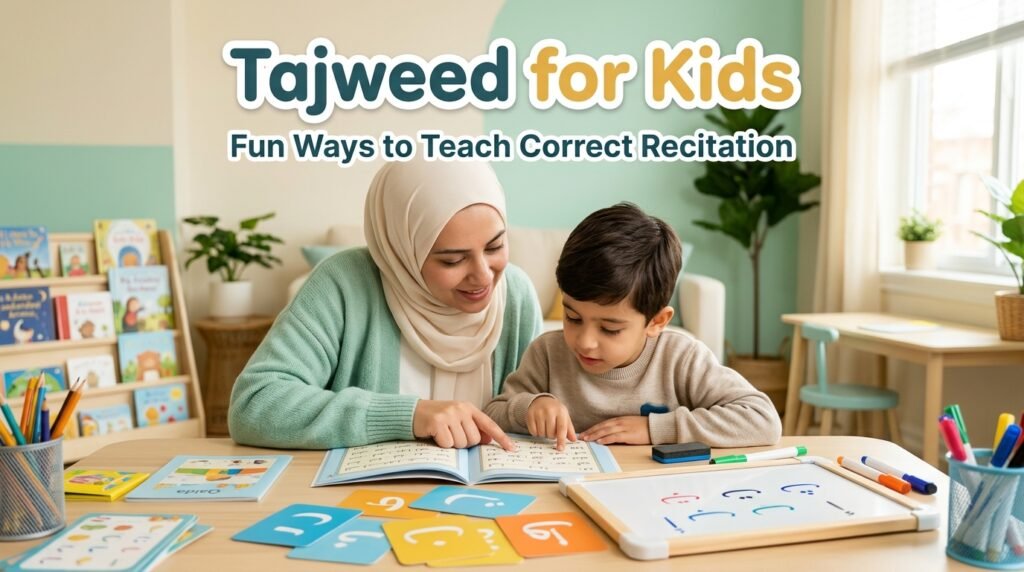
Teaching the Holy Qur’an to young children is one of the most spiritually rewarding responsibilities an educator or parent can undertake. The Prophet Muhammad (peace be upon him) said: “The best among you are those who learn the Qur’an and teach it.” (Sahih al-Bukhari).
However, introducing Tajweed—the set of phonetic rules governing the correct pronunciation and rhythmic recitation of the Qur’an—can sometimes feel intimidating for young minds. Abstract linguistic concepts like Makharij (articulation points), Ghunnah (nasalization), Qalqalah (echoing sounds), and Madd (elongation) can quickly lead to boredom or frustration if taught solely through repetitive rote memorization.
Children learn best through play, sensory immersion, storytelling, and positive reinforcement. By blending classical pedagogical rigor with modern, interactive teaching methods, you can transform Tajweed lessons into an anticipated, joyful highlight of your child’s day.
1. Demystifying Tajweed: Speak Their Language
Before diving into rules, children need to understand why Tajweed matters. To a seven-year-old, distinguishing between a soft ت (Taa) and an emphatic ط (Taa) or between ح (Haa) and هـ (Haa) might feel like unnecessary nitpicking.
The “Meaning Changer” Game
Teach children that Arabic letters are like musical instruments or secret keys—changing how a letter sounds changes what the word means.
- Example: Show them how a subtle shift transforms a word:
- Qalb (قلب) with a deep, throaty ق means heart.
- Kalb (كلب) with a light ك means dog. Children find this hilarious and illuminating. Once they realize that mispronunciation alters the sacred meaning of Allah’s words, they naturally develop a desire to master exact articulation.
2. Sensory Makharij: Exploring the Anatomy of Sound
The rules of Makharij al-Huroof (points of articulation) describe where each sound originates: the chest/throat, the tongue, the lips, the nasal cavity, and the empty space inside the mouth. Rather than using dry anatomical diagrams, make the mouth an interactive laboratory.
The Mirror and Flashlight Game
Equip your child with a handheld mirror and a small flashlight. When practicing throat letters (Huroof al-Halq: ء, هـ, ع, ح, غ, خ), let them look inside their mouth. Have them gently place two fingers on their throat:
- Feel the lower throat vibrate for ء and هـ.
- Feel the constriction in the middle throat for ع and ح.
- Compare it to the rasping sensation at the top of the throat for خ.
The Tissue Test for Light vs. Heavy Letters
To demonstrate air release (Hams) in letters like ت or ك:
- Hold a lightweight tissue paper directly in front of the child’s lips.
- When they pronounce a light, aspirated letter properly, the tissue will flutter.
- When practicing heavy (Tafkheem) letters like ص, ض, ط, ظ, have them puff out their cheeks slightly like a cheerful pufferfish so they feel the sound resonate in the roof of the mouth without blowing unnecessary air forward.
3. Physicalize the Rules: Movement and Kinetic Tajweed
Children are naturally kinesthetic; sitting perfectly still for thirty minutes while reading small script causes restlessness. Incorporate body movement to anchor abstract concepts in muscle memory.
The “Bouncing Ball” for Qalqalah
Qalqalah (the echoing or bouncing sound produced on the letters ق, ط, ب, ج, د when carrying a Sukoon) is tailor-made for physical play.
- Give your child a small rubber bouncy ball.
- Every time they pronounce a Qalqalah letter (e.g., in Surah Al-Ikhlas: Qul huwa Allahu Ahad ➔ da-ba!), have them bounce the ball against the floor or clap their hands in an explosive bounce.
- This reinforces that the sound does not stop dead; it rebounds energetically.
The Rubber Band for Madd (Elongation)
Counting Harakāt (counts/beats) can be abstract. Use an elastic exercise band or a large colorful rubber band:
- Normal Madd (2 counts): Gentle stretch.
- Madd Wajib/Ja’iz (4–5 counts): Medium stretch across both hands.
- Madd Lazim (6 counts): Full stretch over their head. Pairing physical extension with vocal elongation helps children internalize timing without rushing or over-stretching the vowel.
The Pinched Nose for Ghunnah
To teach nasalization (Ghunnah in Noon and Meem Mushaddadah):
- Have them recite the sound normally with their nose free.
- Then have them pinch their nostrils shut mid-recitation. If the sound suddenly cuts off or buzzes funny, explain: “Aha! That means the sound was traveling through your nose, right where it belongs!”
4. Visual Aids: Color-Coding and Story-Driven Rules
Visual learners benefit immensely from vibrant cues and narrative memory hooks.
| Tajweed Rule | Sensory Metaphor | Visual/Color Cue |
| Qalqalah (Echo) | Bouncing tennis ball / Trampoline | Bright Orange |
| Ghunnah (Nasalization) | Busy bumblebee buzzing in the garden | Honey Yellow |
| Madd (Elongation) | Stretchy train / Pulling taffy | Sky Blue |
| Idgham (Merging) | Two colors mixing in watercolor | Purple |
| Ikhfa (Hiding) | A friendly ninja hiding behind a tree | Forest Green |
Storytelling: “The Sneaky Noon Sakinah and the 15 Ninjas”
Instead of forcing children to memorize the 15 letters of Ikhfa by rote list, turn them into characters. The Noon Sakinah (نْ) is shy; whenever it runs into one of the 15 “Ninja letters” (like ت, ث, ج, د, ذ…), it hides part of its sound behind a mask, humming quietly with a Ghunnah instead of showing its full, clear face!
5. Gamification: Turning Practice into Play
Transform drilling into games where mistakes are simply part of the adventure.
- Tajweed Hopscotch: Draw a hopscotch grid outside with sidewalk chalk. In each square, write a letter or short word containing a specific Tajweed rule. To jump forward, the child must recite the word with the correct rule.
- The “Spot the Mistake” Detective: Kids love catching adults making mistakes. Purposely mispronounce a clear letter (e.g., skip the Qalqalah in Surah Al-Falaq or say a soft Seen instead of a thick Saad). Give them a small bell or buzzer to “catch” you. When they correct you and explain the rule, they demonstrate deep mastery.
- Flashcard Memory Match: Create pairs of cards where one card has the rule name (e.g., Idgham with Ghunnah) and the matching card has the letters (ي, ن, م, و).
6. Curate Short, High-Frequency Practice Habits
Long, grueling lessons inevitably backfire, building negative associations with the Qur’an. A predictable, micro-learning routine yields far better retention and emotional connection.
- Keep it under 15–20 minutes: For young children (ages 4–9), a focused 15-minute daily session is exponentially more effective than an hour-long weekend marathon.
- Focus on Short Surahs (Juz ‘Amma): Start from Surah An-Nas and work backward. These short chapters provide immediate gratification, allowing children to recite what they have mastered during their daily Salah.
- Listen to Melodious, Clear Reciters: Play recordings of renowned reciters who recite at an instructional pace (Tahqiq or Tarteel), such as Sheikh Mahmoud Khalil Al-Hussary (specifically his Mushaf Al-Mu’allim, where a child repeats after him) or Sheikh Mishary Rashid Alafasy. Children are natural mimics and absorb proper cadence effortlessly through auditory exposure.
7. Nurturing the Heart: Patience and Encouragement
Above all tactical strategies, the emotional environment surrounding the Qur’an leaves the deepest imprint.
A child who struggles with tongue placement or slips into habituated mispronunciations does not need scolding—they need encouragement. Remind them of the beautiful narration of Aisha (may Allah be pleased with her), who reported that the Messenger of Allah said:
“The one who is proficient with the Qur’an will be with the noble and righteous scribes (angels), and the one who reads it and stumbles over it, finding it difficult, will have a double reward.” (Sahih Muslim).
Celebrate milestones: reward them with a favorite activity, a colorful sticker chart, or an evening family celebration when they complete a Surah with perfected Tajweed.
Final Thoughts
Teaching Tajweed to kids is not about turning them into perfectionist phoneticians overnight. It is about planting a seed of love, curiosity, and reverence for the divine words of the Creator. When we use engaging metaphors, physical movements, and warm encouragement, we lay down a foundation of flawless recitation that will beautify their worship for the rest of their lives.