
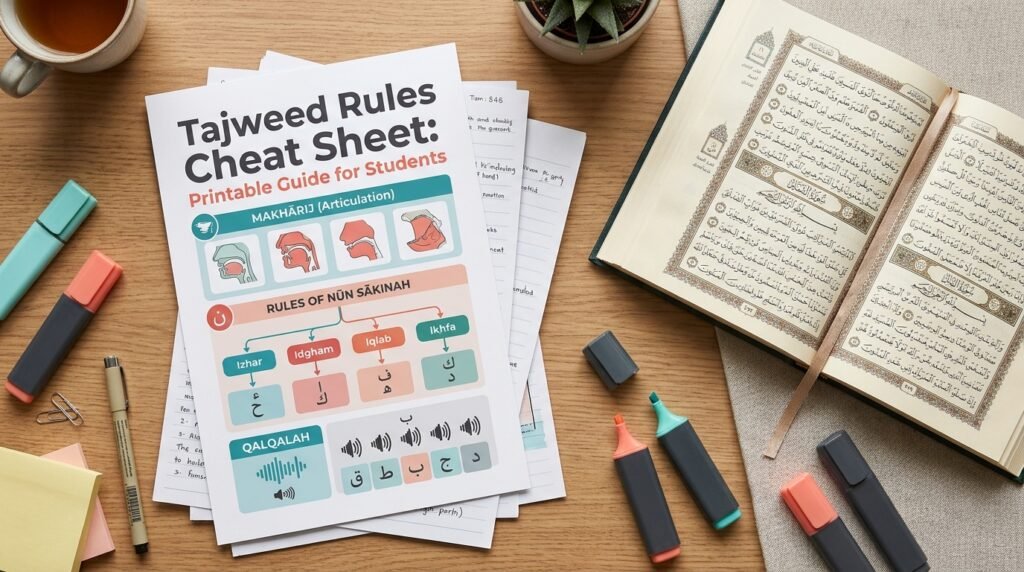
Introduction: Why a Tajweed Cheat Sheet Matters
Reciting the Holy Quran with proper pronunciation and rhythm is not merely a linguistic discipline; it is an act of spiritual devotion. The word Tajweed (تجويد) linguistically stems from the Arabic root j-w-d (جود), meaning “to make good, beautify, or improve.” In an Islamic context, Tajweed refers to the precise science of giving every Arabic letter its rightful articulation points (Makharij) and its inherent and acquired characteristics (Sifat).
Allah commands in Surah Al-Muzzammil (73:4):
وَرَتِّلِ الْقُرْآنَ تَرْتِيلًا
“And recite the Quran with measured, rhythmic recitation.”
For non-native Arabic speakers and beginners, the sheer breadth of Tajweed terminology—from Ikhfa and Idgham to Qalqalah and Madd—can feel intimidating. A structured, color-coded, or categorized cheat sheet bridges the gap between complex classical manuals (such as the Tuhfat al-Atfal or Al-Jazariyyah) and everyday recitation practice.
Whether you are preparing to print this guide for your binder, stick it beside your mus-haf, or use it in a madrasah classroom, this cheat sheet organizes the core rules of Tajweed into clear, digestible, and reference-ready sections.
1. Quick Reference: Core Tajweed Summary Table
Before diving into detailed mechanics, keep this high-level summary at your fingertips:
| Rule Category | Sub-Rules | Total Letters Involved | Key Audible Effect |
| Noon Sakinah & Tanween | Izhar, Idgham, Iqlab, Ikhfa | All 28 Arabic letters | Clear pronunciation, merging, flipping to Meem, or nasal concealment (Ghunnah). |
| Meem Sakinah | Idgham Shafawi, Ikhfa Shafawi, Izhar Shafawi | All 28 Arabic letters | Lip-merging, gentle concealment with hum, or crisp clearance. |
| Qalqalah | Sughra (minor), Kubra (major), Akbar (maximum) | 5 letters: ق, ط, ب, ج, د (Qutb Jad) | Distinct echoing or bouncing resonance when bearing a Sukoon. |
| Madd (Elongation) | Asli (Natural – 2 counts), Far’i (Secondary – 2 to 6 counts) | 3 vowels: ا, و, ي | Measured stretching of long vowel sounds. |
| Tafkheem & Tarqeeq | Heavy vs. Light letters | 7 inherently heavy (خ, ص, ض, غ, ط, ق, ظ), plus conditioned ر and ل | Full-mouth resonance versus thin, flat tone. |
2. Noon Sakinah (نْ) and Tanween (ً ٍ ٌ)
The rules governing Noon Sakinah (a Noon with a Sukoon / no vowel) and Tanween (double fat-hah, double kasrah, or double dammah) are foundational in Tajweed. Because Tanween phonetically ends in an unwritten Noon Sakinah sound, both follow the exact same four rules depending on the letter that immediately follows.
       ┌───────────────────────────────┐
       │   Noon Sakinah & Tanween     │
       └───────────────┬───────────────┘
         ┌─────────────┼─────────────┬─────────────┐
         ▼             ▼             ▼             ▼
     1. Izhar      2. Idgham      3. Iqlab      4. Ikhfa
   (6 Throat)     (6 YARMALOON)     (1: ب)     (15 Letters)
1. Izhar Halqi (إظهار حلقي) – Clarity of the Throat
- Meaning: “Clarity” or “Manifestation.” Pronouncing the Noon sound crisply and distinctly without any added nasal hum (Ghunnah).
- Trigger Letters (6 Throat Letters):
- ء (Hamzah), هـ (Haa) — Deep throat
- ع (‘Ayn), ح (Haa) — Mid throat
- غ (Ghayn), خ (Khaa) — Upper throat
- Mnemonic: Akhi Haaza ‘Ilman Haazahu Ghayru Khasir (أخي حاز علماً حازه غير خاسر).
- Recitation Key: Touch the tip of your tongue firmly behind the upper front teeth, pronounce the “N” cleanly, and move immediately to the throat letter.
- Examples:
- مِنْ خَوْفٍ (Min khawf)
- أَنْعَمْتَ (An’amta)
2. Idgham (إدغام) – Merging / Assimilation
- Meaning: “Insertion” or “Merging.” Blending the Noon Sakinah or Tanween completely into the following letter, causing the following letter to be doubled (pronounced with a Shaddah).
- Trigger Letters (6 Letters): Combined in the word يَرْمَلُونَ (Yarmaloon): ي, ر, م, ل, و, ن.
- Sub-Categories:
- Idgham with Ghunnah (إدغام بغنة / Naqis – Incomplete): Retains a 2-beat nasal resonance. Occurs with letters: ي, ن, م, و (Yanmoo / يَنْمُو).
- Example: مَن يَقُولُ (May-yaqool)
- Example: مِن وَالٍ (Miw-waal)
- Idgham without Ghunnah (إدغام بغير غنة / Kamil – Complete): Completely swallows the Noon sound with no nasal residue. Occurs with letters: ل, ر.
- Example: مِن رَّبِّهِمْ (Mir-rabbihim)
- Example: هُدًى لِّلْمُتَّقِينَ (Hudal-lil-muttaqeen)
- Idgham with Ghunnah (إدغام بغنة / Naqis – Incomplete): Retains a 2-beat nasal resonance. Occurs with letters: ي, ن, م, و (Yanmoo / يَنْمُو).
- Important Exception (Izhar Mutlaq): If a Noon Sakinah and an Idgham letter appear inside the same single word, Idgham is forbidden to prevent altering word roots. It must be recited clearly as Izhar. There are only four such words in the entire Quran:
- دُنْيَا (Dunya)
- بُنْيَانٌ (Bunyan)
- قِنْوَانٌ (Qinwan)
- صِنْوَانٌ (Sinwan)
3. Iqlab / Qalb (إقلاب) – Conversion
- Meaning: “Transforming” or “Turning.”
- Trigger Letter: Only 1 letter: ب (Baa).
- Rule: Whenever Noon Sakinah or Tanween is followed by ب, the “N” sound is flipped into a hidden م (Meem) accompanied by Ghunnah (nasal sound) for 2 counts, before closing into the “Baa”.
- Printable Mushaf Marker: A tiny upright Meem (مۨ) printed directly over the Noon or Tanween.
- Example:
- مِن بَعْدِ (Mim-ba’di)
- عَلِيمٌ بِذَاتِ الصُّدُورِ (‘Aleemum-bi-dhaatis-sudoor)
4. Ikhfa Haqiqi (إخفاء حقيقي) – Concealment
- Meaning: “Hiding” or “Concealment.” Pronouncing a sound halfway between Izhar (clarity) and Idgham (complete merging), while maintaining a 2-count Ghunnah.
- Trigger Letters (15 Letters): Any letter that is not used in Izhar, Idgham, or Iqlab:
- ت, ث, ج, د, ذ, ز, س, ش, ص, ض, ط, ظ, ف, ق, ك
- The Classical Poem Verse (First letter of each word):صِفْ ذَا ثَنَا كَمْ جَادَ شَخْصٌ قَدْ سَمَا — دُمْ طَيِّبًا زِدْ فِي تُقًى ضَعْ ظَالِمَا
- How to Execute: Instead of locking your tongue against the roof of the mouth for the “N”, position your tongue at the articulation point of the upcoming letter while letting the breath stream through your nose for 2 beats.
- Heavy vs. Light Ghunnah:
- If the following letter is Heavy (Tafkheem) (ص, ض, ط, ظ, ق), make the nasal hum thick and full: e.g., مِن قَبْلُ (Min qabl).
- If the following letter is Light (Tarqeeq), keep the nasal hum thin and bright: e.g., أَنتُمْ (Antum).
3. Rules of Meem Sakinah (مْ)
When a Meem carries a Sukoon (مْ), it interacts with subsequent letters via the lips (Shafawi). It has only three straightforward rules:
                  ┌──────────────────────────────┐
                  │      Meem Sakinah (مْ)        │
                  └──────────────┬───────────────┘
         ┌───────────────────────┼───────────────────────┐
         ▼                       ▼                       ▼
  1. Ikhfa Shafawi        2. Idgham Shafawi       3. Izhar Shafawi
   Followed by: ب          Followed by: م         All remaining 26 letters
  (Conceal + Ghunnah)     (Merge + Ghunnah)       (Clear, no added hum)
- Ikhfa Shafawi (Oral Concealment):
- Followed by: ب (Baa).
- Action: Softly close the lips on the Meem without pressing forcefully; hold a 2-count nasal hum (Ghunnah) before opening onto the Baa.
- Example: تَرْمِيهِم بِحِجَارَةٍ (Tarmeehim bi-hijarah).
- Idgham Shafawi / Idgham Mithlayn Sagheer (Oral Merging):
- Followed by: another م (Meem).
- Action: Merge the first unvoweled Meem into the second voweled Meem with a complete Shaddah and 2 counts of Ghunnah.
- Example: لَهُم مَّا يَشَاءُونَ (Lahum-ma yasha’oon).
- Izhar Shafawi (Oral Clarity):
- Followed by: All remaining 26 letters.
- Action: Pronounce the Meem sharply and cleanly with no extra lengthening or humming.
- Critical Caution: Pay special attention when Meem Sakinah is followed by و (Waw) or ف (Faa) (e.g., عَلَيْهِمْ وَلَا). Because these letters share nearby lip articulation points, learners often mistakenly hide or nasalize the Meem. Keep it strictly clear.
4. Qalqalah (The Echoing / Bouncing Letters)
Qalqalah (قلقلة) literally means “shaking” or “disturbance.” In Tajweed, it refers to a clean, rhythmic bouncing or vibration of sound produced at the articulation point when a specific letter carries a Sukoon (either inherent or caused by stopping).
The 5 Qalqalah Letters:
Grouped in the classic phrase: قُطْبُ جَدٍّ (Qutb Jad):
- ق (Qaf)
- ط (Taa)
- ب (Baa)
- ج (Jeem)
- د (Dal)
        Qalqalah Levels
  ┌─────────────────────────┐
  │ 1. Akbar (Strongest)    │  Stopping on an active Shaddah: الْحَجّ / تَبّ
  ├─────────────────────────┤
  │ 2. Kubra (Major)        │  Stopping at an Ayah end on a single letter: الفَلَقْ
  ├─────────────────────────┤
  │ 3. Sughra (Minor)       │  In the middle of a word or continuous speech: يَطْمَعُ
  └─────────────────────────┘
- Rules for Execution: Never add a vowel sound (Fat-hah, Kasrah, or Dammah) to the echo. The bounce must remain clean and neutral.
5. Rules of Madd (Elongation & Stretching)
Madd (مد) translates to “prolongation” or “extension.” It governs how long a vowel sound is held.
The 3 Madd Letters (حروف المد):
- Alif (ا) preceded by a Fat-hah (ـَـ ا)
- Waw Sakinah (وْ) preceded by a Dammah (ـُـ وْ)
- Yaa Sakinah (يْ) preceded by a Kasrah (ـِـ يْ) (Combined in the Quranic word: نُوحِيهَا – Noo-hee-haa).
Madd is divided into Natural (Asli) and Secondary (Far’i):
| Madd Type | Trigger / Condition | Timing (Harakat / Counts) | Quranic Example |
| Madd Asli / Tabee’i (Natural) | Normal Madd letter with no Hamzah or Sukoon after it. | 2 counts | قَالَ (Qaala), يَقُولُ (Yaqoolu) |
| Madd Muttasil (Connected Obligatory) | Madd letter followed immediately by a Hamzah within the same word. | 4 to 5 counts | جَاءَ (Jaaa’a), السَّمَاءِ (As-Samaaa’i) |
| Madd Munfasil (Separated Permissible) | Madd letter at the end of a word, followed by a Hamzah at the start of the next word. | 4 to 5 counts (2 permitted in certain riwayahs) | فِي أَنفُسِكُمْ (Feeee anfusikum) |
| Madd ‘Aarid Li-s-Sukoon (Incidental) | Madd letter followed by a letter made silent temporarily due to stopping. | 2, 4, or 6 counts | الرَّحِيمِ ⏹ (Ar-Raheem), تَعْلَمُونَ ⏹ (Ta’lamoon) |
| Madd Lazim (Compulsory) | Madd letter followed by a permanent Sukoon or Shaddah in the same word. | Strictly 6 counts | الحَاقَّةُ (Al-Haaaqqah), الضَّالِّينَ (Ad-Daallleeeen) |
| Madd Leen (Softness) | A وْ or يْ with a Sukoon preceded by a Fat-hah, when stopping on the next letter. | 2, 4, or 6 counts (Only when stopping) | قُرَيْشٍ ⏹ (Quraysh), خَوْفٍ ⏹ (Khawf) |
A single “count” (Harakah) roughly equals the time it takes to fold or unfold one finger at a moderate, unhurried pace.
6. Heavy and Light Letters (Tafkheem vs. Tarqeeq)
Arabic letters carry distinct resonant weights depending on whether the back of the tongue elevates toward the soft palate (Tafkheem – heavy/elevated) or stays relaxed low in the mouth (Tarqeeq – light/flat).
Letter Classification:
├── Permanently Heavy (7 Letters): خ, ص, ض, غ, ط, ق, ظ  (خُصَّ ضَغْطٍ قِظْ)
├── Sometimes Heavy, Sometimes Light:
│   ├── The Letter Raa (ر)
│   ├── The Letter Laam (ل) in the Name of Allah (الله)
│   ├── The Alif of Madd (follows the letter before it)
│   └── The Ghunnah of Ikhfa (follows the letter after it)
└── Permanently Light: All other 21 Arabic letters.
The Rules for the Letter Raa (ر):
- Recited Heavy (Tafkheem):
- When bearing a Fat-hah (رَ) or Dammah (رُ).
- When carrying a Sukoon preceded by a Fat-hah or Dammah (e.g., قُرْآن).
- Recited Light (Tarqeeq):
- When bearing a Kasrah (رِ).
- When carrying a Sukoon preceded by an original Kasrah inside the same word (e.g., فِرْعَوْن).
The Name of Allah (لفظ الجلالة – “Allah”):
- Heavy: Preceded by a Fat-hah or Dammah (e.g., قَالَ اللهُ – Qaal-Allah, نَصْرُ اللهِ – Nasr-ullah).
- Light: Preceded by a Kasrah (e.g., بِسْمِ اللهِ – Bismil-lah).
7. Stops and Pauses: Mushaf Waqf Symbols
Stopping at the wrong moment can inadvertently alter the entire theological meaning of a verse. Familiarize yourself with the common punctuation marks placed above words across modern printed copies of the Quran:
- مـ (Compulsory Stop – Waqf Lazim): You must pause here; continuing will change the meaning completely.
- لا (Forbidden Stop – Waqf Mamnoo’): Do not stop unless out of breath. If you must pause, repeat the previous word before continuing.
- ج (Permissible Stop – Waqf Ja’iz): Equal choice: you may stop comfortably or continue smoothly.
- صلى (Better to Continue): Continuation is preferred, but stopping is permissible without error.
- قلى (Better to Stop): Stopping is preferred, but continuing is permissible.
- ∴ … ∴ (Embrace Stop – Mu’anaqah): Appears in pairs close together. You may stop at either one, but never at both. (e.g., Surah Al-Baqarah, 2:2).
8. Common Beginner Mistakes to Avoid
- Over-bouncing Non-Qalqalah Letters: Beginners often bounce letters like unvoweled Seen (سْ), Faa (فْ), or Taa (تْ). Keep the mouth stable; only bounce the 5 designated letters of Qutb Jad.
- Dropping the Ghunnah Too Early: Cutting the nasal hum of Ikhfa or Idgham short. Keep it sustained for a measured 2 counts.
- Over-compressing the Lips during Ikhfa Shafawi: Pressing the lips hard on Meem Sakinah turning into Baa. The lips should meet naturally with a gentle, non-strained touch.
- Vowel Creep on Sukoon: Accidentally turning a resting consonant into a vowel sound (e.g., pronouncing An-‘amta as Ana-‘amta).
Quick Study Checklist for Daily Practice
Before beginning your daily Tilawah (recitation), keep this routine in mind:
- [ ] Clear the throat and sit in an upright posture to allow smooth diaphragm breathing.
- [ ] Scan 2–3 words ahead to spot incoming Hamzahs, Shaddahs, or Idgham opportunities.
- [ ] Ensure your Alif, Waw, and Yaa stretches do not exceed 2 counts unless an explicit Madd symbol (~ ) is printed overhead.
- [ ] Keep a pencil nearby to annotate stops, light/heavy transitions, and tricky articulation points.
- [ ] Validate your recitation regularly before a qualified Tajweed teacher (Qari/Qari’ah), as oral transmission remains the bedrock of Quranic preservation.