
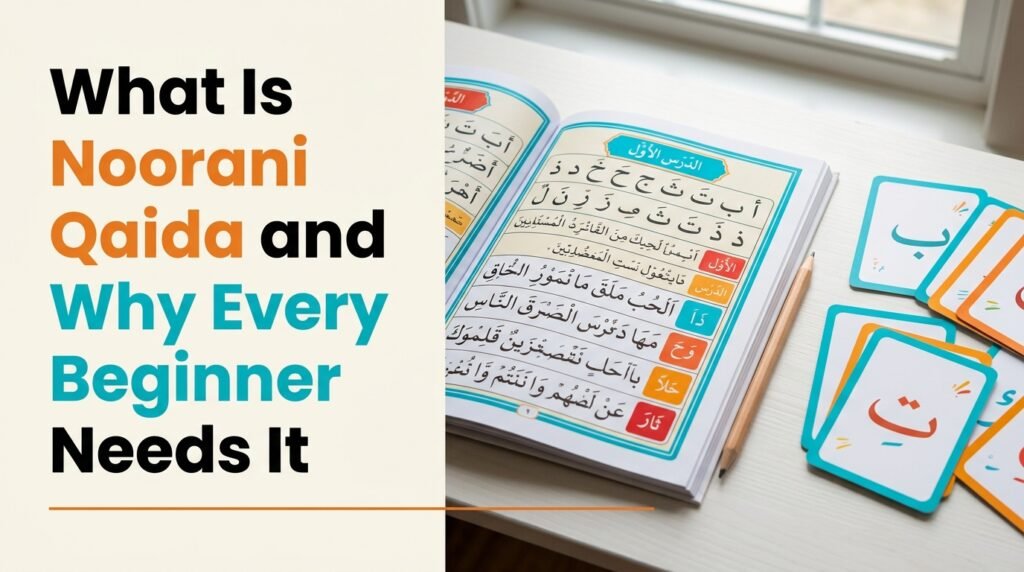
Learning to read the Holy Quran in its original Arabic script is a profound spiritual and intellectual milestone for millions of Muslims and Arabic learners worldwide. Yet, opening a standard copy of the Quran (Mushaf) without prior training can feel overwhelming. Arabic is a cursive language written from right to left, where letters change shape depending on their position in a word, and subtle diacritical marks determine entire meanings and pronunciation rules.
To bridge the gap between complete unfamiliarity and fluent Quranic recitation, scholars developed foundational primers. Foremost among them is Noorani Qaida.
For over a century, Noorani Qaida has served as the undisputed gold standard curriculum for teaching non-Arabic speakers, young children, and adult reverts how to decipher the Arabic alphabet, connect letters into words, and apply the rules of Tajweed (the science of correct Quranic pronunciation) from day one.
1. What Is Noorani Qaida? Origin and History
The word Qaida (قَاعِدَة) in Arabic translates to “rule,” “foundation,” or “principle.” Noorani (نُورَانِي) is derived from Noor, meaning “light.” Informally translated as the “Luminous Foundation,” Noorani Qaida is an introductory booklet designed to take a complete novice through the mechanics of reading classical Arabic script.
The curriculum was compiled in the late 19th century in the Indian subcontinent by the venerable Islamic scholar Sheikh Noor Muhammad Haqqani (1856–1925), hailing from Ludhiana, Punjab. Sheikh Haqqani was a passionate educator dedicated to standardizing Quranic literacy. He observed that many students struggled with proper pronunciation and letter recognition because they were thrust into reading complex sentences before mastering individual letter sounds.
To solve this, he developed a systematic, phonics-based manual named after himself: Al-Qaidah An-Nooraniyyah (commonly known simply as Noorani Qaida). The primer achieved extraordinary success due to its clear pedagogical framework. Over the decades, it spread across South Asia, the Middle East, Southeast Asia, Africa, and Western diaspora communities, remaining one of the most widely published and utilized elementary religious texts in the world.
2. Why Every Beginner Needs Noorani Qaida
Many learners wonder: Can I simply start reading the Quran from Surah Al-Fatiha with transliteration or direct practice?
While transliteration (Arabic written in the Latin alphabet) might seem like an easy shortcut, it often leads to persistent pronunciation mistakes. Latin characters cannot accurately represent unique Arabic guttural and pharyngeal phonemes—such as the difference between ح (Haa) and هـ (haa), or ق (Qaf) and ك (Kaf). A single mispronounced consonant or incorrectly prolonged vowel can completely alter the meaning of a Quranic ayah.
Noorani Qaida is indispensable for several core reasons:
Eliminates Reliance on Romanized Transliteration
Noorani Qaida trains your eyes and auditory cortex to connect the Arabic glyphs directly to their authentic sounds. By teaching letter forms and phonics visually, learners discard the crutch of English transliteration within a few lessons.
Teaches Phonics Through Incremental Complexity
The booklet operates on the pedagogical rule of scaffolding: mastering micro-skills before tackling macro-structures. You never encounter a composite word until you have thoroughly practiced isolated letters, basic vowel marks, and two-letter connectors.
Introduces Tajweed Implicitly
Rather than forcing beginners to memorize dense theoretical definitions of Tajweed rules (such as Idgham, Ikhfa, or Madd), Noorani Qaida introduces these concepts through auditory muscle memory and repetitive reading drills. When a student eventually moves on to studying formal Tajweed rules, the patterns are already familiar to their ears and tongue.
Built Specifically for Non-Native Speakers
Arabic native speakers grow up hearing the phonemes of the language, but non-Arabs must train the vocal tract to articulate sounds produced in the deep throat, soft palate, and back of the tongue. Noorani Qaida’s early exercises isolate these distinct sounds so learners can exercise the specific muscles of articulation (Makharij).
3. The Step-by-Step Curriculum: How Noorani Qaida Is Structured
The modern Noorani Qaida booklet is compact—typically spanning between 16 and 17 chapters—yet every lesson introduces a distinct phonetic or orthographic milestone.
Individual Letters (Huruf Mufradat)
             │
             ▼
Compound Letters & Forms (Murakkabat)
             │
             ▼
Short Vowels (Harakat: Fathah, Kasrah, Dammah)
             │
             ▼
Long Vowels & Soft Letters (Huruf Maddah & Leen)
             │
             ▼
Nunation (Tanween) & Sukoon (Jazm)
             │
             ▼
Advanced Rules (Shaddah, Madd, Waqf)
             │
             ▼
Fluent Quranic Reading
Chapter 1: The Single Letters (Al-Huruf Al-Mufradat)
The journey begins with the 29 isolated Arabic letters, from Alif to Yaa. The emphasis here is not just naming the letters, but locating their Makharij (points of articulation—throat, tongue, lips, and nasal cavity) and recognizing their baseline forms.
Chapter 2: Compound Letters (Al-Murakkabat)
Unlike English, Arabic letters join together in a continuous script, morphing their shapes depending on whether they appear at the beginning, middle, or end of a word. This chapter teaches students how to recognize individual letters when they are combined into two- or three-letter clusters (e.g., how ب and ت join to form بت).
Chapter 3: The Abbreviated Letters (Huruf Muqatta’at)
Students practice the mysterious disconnected letters that open various Surahs of the Quran (such as Alif-Lam-Meem or Yaa-Seen), learning how each letter is pronounced by its full individual name and elongated appropriately.
Chapters 4–6: Short Vowels (Harakat) and Nunation (Tanween)
Arabic does not have separate alphabet characters for short vowels; instead, it uses diacritics (Tashkeel) placed above or below consonants:
- Fathah (producing a short “a” sound)
- Kasrah (producing a short “i” sound)
- Dammah (producing a short “u” sound)
Following the single short vowels, learners master Tanween (double vowels: Fathatayn, Kasratayn, Dammatayn), which add an unwritten “N” sound at the end of words.
Chapters 7–9: Long Vowels (Huruf Maddah) and Diphthongs (Huruf Leen)
Here, students learn how certain letters prolong vowel sounds by two beats (Harakat):
- Alif preceded by a Fathah
- Waw Sakinah preceded by a Dammah
- Yaa Sakinah preceded by a Kasrah
They also practice the Leen letters (soft diphthongs “aw” and “ay”), which require relaxed pronunciation without undue tension in the lips or tongue.
Chapters 10–12: Sukoon (Jazm), Testing Exercises, and Qalqalah
A letter carrying a Sukoon has no vowel sound of its own and must be anchored to the preceding vowelled letter. This chapter introduces consonant stops and the Qalqalah (the echoing or rebounding sound produced on five specific consonants: ق , ط , ب , ج , د when they carry a Sukoon).
Chapters 13–17: Shaddah (Tashdeed), Extended Elongations (Madd), and Stopping Rules (Waqf)
The final third of the book covers more sophisticated reading mechanics:
- Tashdeed/Shaddah: Consonant doubling, where a letter is held for a beat before being released with its vowel.
- Ghunnah: The nasalization applied when Noon or Meem carry a Shaddah.
- Madd Rules: Extended prolongations lasting four to six counts.
- Waqf: Rules regarding how to stop on the end of a word, converting vowels into resting sounds without distorting the text.
By the time a student completes Chapter 17, they possess the technical ability to decode any word printed inside the standard Uthmanic Quran script.
4. Key Pronunciation and Tajweed Concepts Introduced in the Qaida
While Noorani Qaida is an introductory manual, it systematically ingrains the fundamental mechanics of Tajweed.
| Tajweed Concept | Arabic Term | How Noorani Qaida Teaches It |
| Points of Articulation | Makharij al-Huruf | Isolate the exact vocal point (throat, tongue, palate, lips) for each letter in Chapter 1. |
| Heavy vs. Light Letters | Tafkheem & Tarqeeq | Teaches the distinction between full-mouth letters (e.g., ص, ض, ط, ظ, خ, غ, ق) and empty-mouth letters. |
| Echoing Mechanism | Qalqalah | Uses rhythmic drills on letters carrying Sukoon to produce clean bounce sounds without adding vowel drift. |
| Nasal Resonance | Ghunnah | Trains sustained two-beat nasal hums on Noon Mushaddad and Meem Mushaddad. |
| Vocal Extension | Madd | Clear visual symbols show when to stretch a vowel for 2, 4, or 6 counts. |
5. Noorani Qaida for Children vs. Adult Beginners
Because Noorani Qaida relies on short, repetitive exercises, it adapts well to different learning styles across age groups:
For Young Children
- Phonics-First Learning: Children learn to read Noorani Qaida much like they learn to read English via phonics. They identify shapes, associate sounds, and blend them together.
- Rhythmic Drills: The traditional method of reciting the Qaida aloud uses a sing-song cadence that keeps children engaged and helps lock vowel durations into their auditory memory.
- Building Stamina: Lessons are brief (often half a page), offering frequent senses of accomplishment that sustain a child’s confidence.
For Adult Learners and Reverts
- Demystifying the Script: For adults unfamiliar with Semitic languages, Arabic script can appear visually intimidating. Noorani Qaida deconstructs the cursive script into logical segments, removing the guesswork.
- Correcting Muscle Memory: Adults often struggle more with Makharij than children because their vocal habits are deeply set. Noorani Qaida’s isolated drills allow adult learners to systematically practice tough gutturals (like ع and ح) without the distraction of whole sentences.
- Self-Paced Progression: While children typically progress over several months, a committed adult can often work through the entire primer in a few weeks of focused daily practice.
6. How to Study Noorani Qaida Effectively: Proven Strategies
To get the most out of your study, follow these practical recommendations:
1. Always Learn with a Qualified Teacher
While apps, recorded videos, and interactive digital PDFs are helpful supplementary tools, they cannot listen to your recitation and catch minor articulation errors. A teacher can immediately point out if your tongue placement for ث (Thaa) is drifting toward س (Seen), or if your Kasrah is sounding like a flat “e” instead of a crisp “i”.
2. Prioritize Accuracy Over Speed
It is far better to spend three days getting the articulation of five letters right than to rush through five chapters with flawed pronunciation. Bad habits formed during early Qaida lessons tend to persist when reading the Quran later, where they become much harder to unlearn.
3. Read Aloud Every Day
Arabic reading fluency requires motor memory in the tongue, lips, and diaphragm. Reading silently in your head will not build that vocal coordination. Set aside 15 to 20 minutes daily to read aloud with deliberate, clear articulation.
4. Use the “Spelling” (Hijaa) Method First, Then Fluid Reading (Rawaan)
Traditionally, teachers have students read each word in two passes:
- The Spelling Pass (Tahajji / Hijaa): Break down the components aloud (e.g., “Baa-Fathah-Ba, Taa-Fathah-Ta = Ba-Ta”).
- The Flowing Pass (Rawaan): Read the whole word smoothly without pausing (“Bata”).
This two-step method ensures you understand the underlying mechanics before attempting fluent recitation.
The Gateway to Confident Recitation
Noorani Qaida is far more than a simple beginner’s booklet; it is a time-tested educational system that demystifies Arabic phonetics and lays the groundwork for accurate, beautiful Quranic recitation.
By starting with single letters, moving steadily through vowels and connectors, and mastering the physical points of articulation, learners establish a strong foundation in Tajweed. Committing to this short primer turns what initially seems like an intimidating foreign script into a clear, structured, and deeply rewarding journey.